ProductQuant M&A Signals

Know which companies are ready to sell before their banker does

Private equity firms, strategic acquirers, and M&A advisors use M&A Signals to surface acquisition targets weeks or months before they formally hit the market — by reading the distress signals that precede every deal.

Built for PE deal teams screening pipeline, corporate development mapping adjacencies, and boutique M&A advisors who need proprietary sourcing leverage.

  • 13 independent signal sources — job posts, Crunchbase events, SimilarWeb traffic drops, LinkedIn headcount changes, review velocity, and more
  • 0–100 distress scoring — every company scored on an acquisition-readiness scale with explainable weightings per signal
  • Automated flagging — new high-score targets surface daily; your team acts before the process starts

No credit card required. First 25 company profiles free.
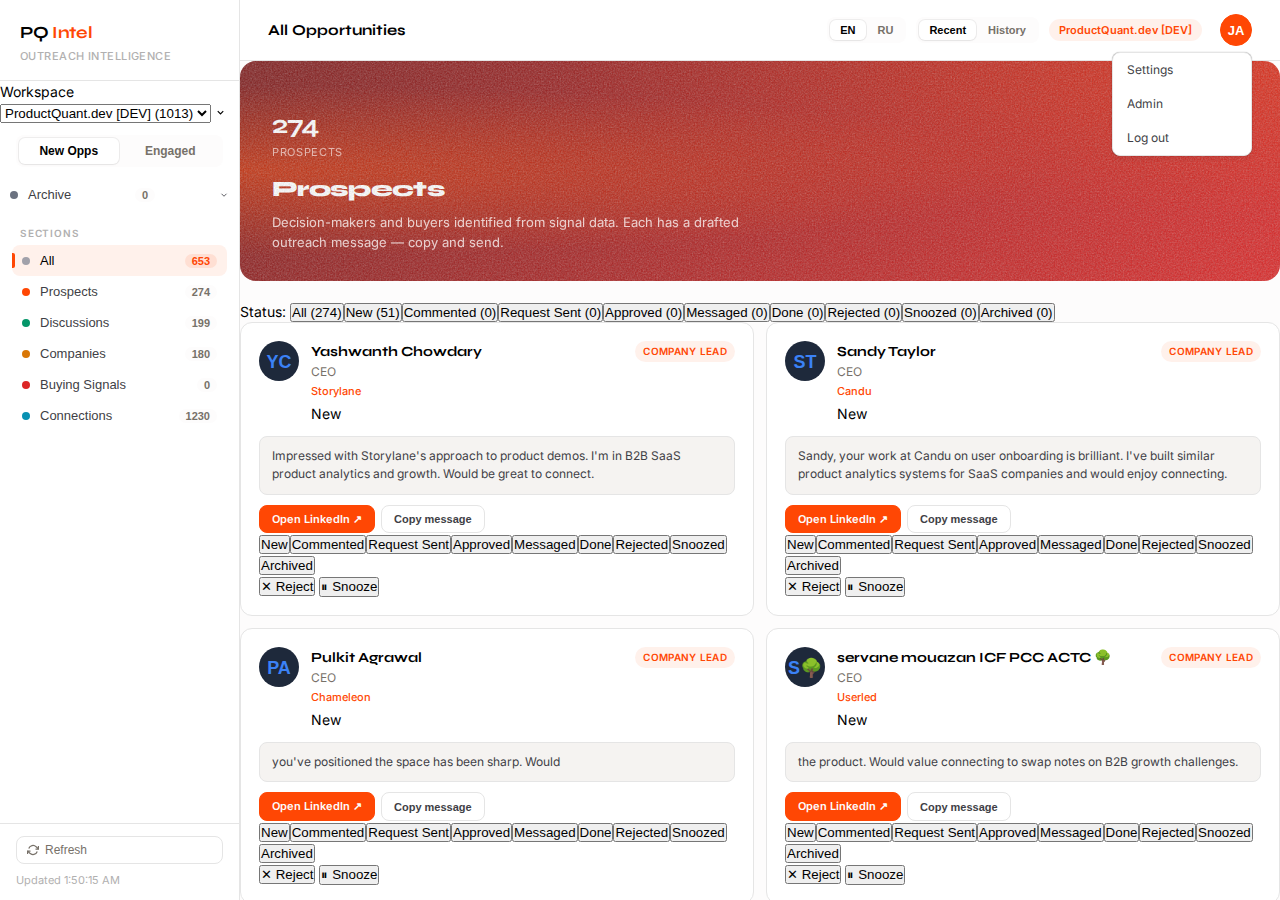
M&A signals dashboard in ProductQuant Intel showing distress scores, signal sources, and flagged acquisition targets
01

You stop waiting for the bank book. Companies don't announce they're struggling — they signal it. A quiet RIF, a sudden traffic decline, a founder who stops posting, a Crunchbase funding gap that stretches past 18 months. M&A Signals surfaces these patterns in aggregate so you identify distress before the sell-side process formalises.

02

Every score comes with an evidence trail. A 78 on the distress scale means nothing without context. The platform shows exactly which signals contributed — three job postings removed, web traffic down 34% quarter over quarter, Glassdoor sentiment decay, two key executives listed as "open to work." Your due diligence starts with a hypothesis, not a hunch.

03

You move before the auction starts. The difference between a proprietary deal and a competitive auction is timing. M&A Signals runs continuously — every new data point adjusts the score. When a target crosses your threshold, you know the same day. While other acquirers wait for teasers, you're already in the room.

From screening criteria to proprietary deal flow in three moves.

M&A Signals doesn't just score companies — it surfaces the ones your pipeline is missing. Here is how the workflow runs from a buyer's perspective.

01

Define your acquisition criteria — sector, size, geography, signal threshold

Tell M&A Signals what you're looking for. Set the industry vertical, revenue band, headcount range, and geographic focus. Then choose which signals matter most — a strategic acquirer might weight job posting removals and executive departures higher; a PE firm might prioritise traffic decline and funding gaps. The platform screens every company in your universe against these criteria and surfaces only those that cross your chosen distress threshold.

What changes: your team stops manually monitoring thousands of companies across separate tools. A single criteria panel replaces Crunchbase alerts, LinkedIn searches, SimilarWeb tabs, and review trackers.

02

Review scored targets with full signal decomposition

Every company that crosses your threshold appears in a queue ranked by distress score. Click into any target and see the full signal breakdown: which of the 13 sources triggered, trend direction over the last 90 days, percentile rank against industry peers, and the confidence level of each signal. The evidence is linked directly — you can open the job posting that was pulled, the SimilarWeb chart showing the traffic cliff, or the LinkedIn profile of the executive who just left.

What changes: your deal team goes from wondering "is this company in play" to knowing exactly why the signal is credible. Due diligence pre-work is done before the first email.

03

Engage with context — reach out before the process is formalised

When a target meets your criteria, M&A Signals provides the intelligence you need to make a proprietary approach. The company profile includes the signal timeline, recommended outreach positioning based on what the data suggests (funding need, operational distress, strategic pivot), and contact enrichment for key decision-makers. No cold call — every outreach is backed by what you already know about their situation.

What changes: you enter conversations as a buyer who understands the business, not a buyer who found them in a database. The asymmetry shifts from "we know you might be selling" to "we understand exactly what you're navigating."

13 independent data streams, one distress score.

M&A Signals ingests from job boards, funding databases, web analytics, review platforms, and social signals. No single source is decisive — the power is in the cross-correlation.

Job Posting Activity

Removed listings, hiring freezes, repeated reposts of the same role — all indicators that headcount strategy has shifted from growth to containment.

Crunchbase & Funding Data

Extended funding gaps, down rounds, bridge notes, and changes in board composition. Companies that can't raise are companies that may sell.

SimilarWeb Traffic Trends

Sustained traffic decline, sudden drop in organic search, or abnormal bounce rate shifts. Revenue-correlated signals that predate most public filings.

LinkedIn Activity Signals

Executive departures, "open to work" flags among leadership, headcount reductions, and sudden pauses in company page engagement.

Review Velocity & Sentiment

Glassdoor rating trajectory, review volume changes, and sentiment decay. Employee sentiment often turns negative 3-6 months before a restructuring.

News & Regulatory Signals

Litigation filings, regulatory actions, press tone analysis, and management change announcements that signal strategic inflection points.

Stop waiting for the teaser. Start seeing the signals.

Every acquisition target was a signal before it was a deal. M&A Scores gives you the data to see them first — proprietary sourcing advantage without the proprietary data cost.

No credit card required. First 25 company profiles free.