ProductQuant M&A Signals · For PE Firms & Corporate Development

Discover acquisition targets before they hit the market.

M&A Signals monitors 13 distress data streams in parallel — job postings, funding activity, web traffic, LinkedIn changes, review velocity, and more — and scores every company 0–100 on acquisition readiness. Your deal team gets a ranked pipeline of candidates with a full evidence trail, updated daily.

Built for PE investment partners screening pipeline, corporate development mapping adjacencies, and portfolio operations monitoring for bolt-ons. Replaces the manual Crunchbase + LinkedIn + news comb through your analysts are doing today.

  • 13 signal sources — job board removals, funding gaps, traffic cliffs, exec departures, review sentiment decay, and more — cross-correlated per company
  • 0–100 distress scoring — every target scored on an acquisition-readiness scale with explainable weightings per signal dimension
  • Daily ranked queue — new high-score targets surface every morning; your team acts before the sell-side process formalises
  • Evidence trail on every target — click through to the actual job posting that was pulled, the Crunchbase gap, the SimilarWeb chart, the LinkedIn departure

No credit card required. First 25 company profiles free. Enterprise pricing available for PE firms with portfolio monitoring needs.
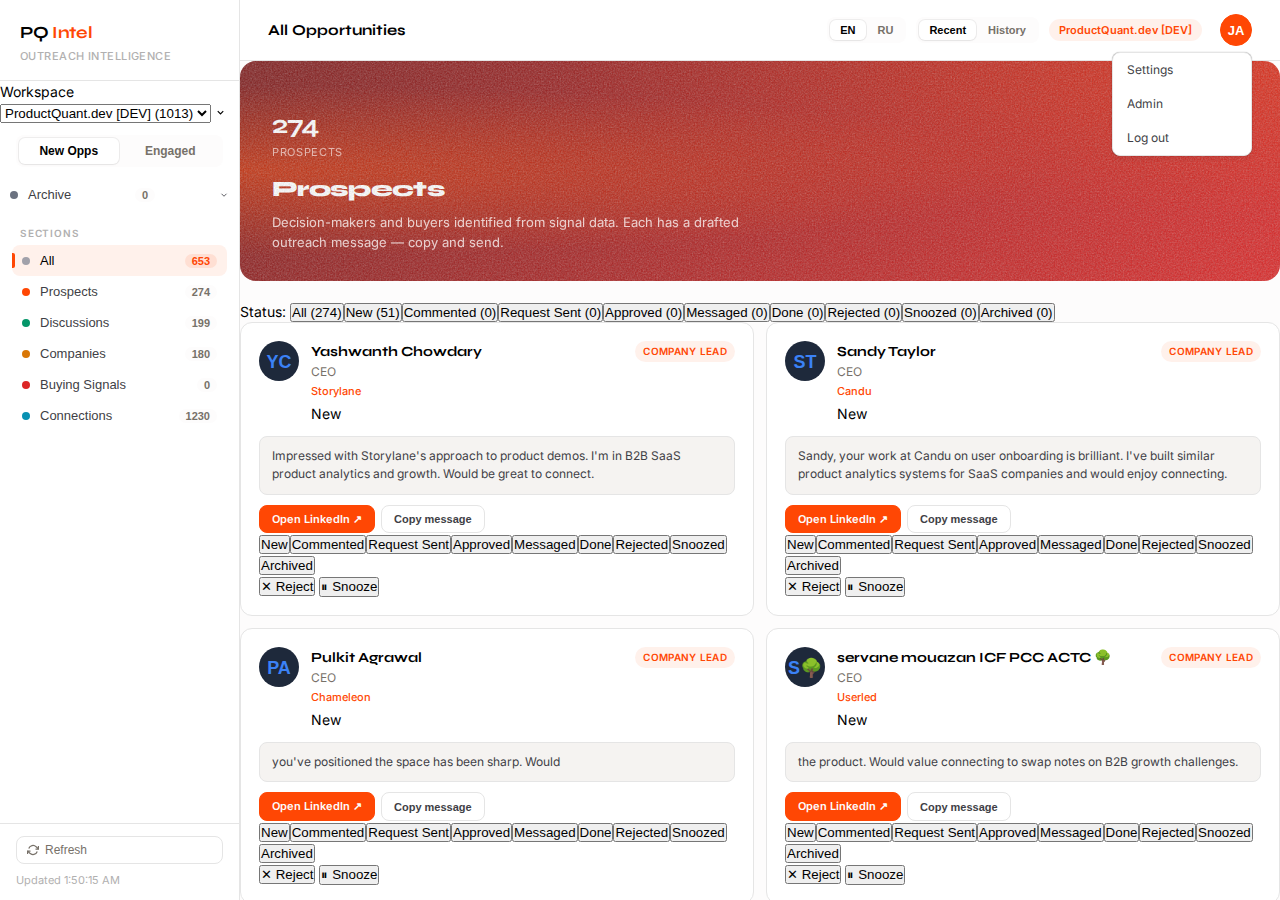
M&A Signals dashboard in ProductQuant Intel showing distress scores, signal breakdowns, and flagged acquisition targets for PE deal teams
PE Deal Sourcing — proprietary pipeline for your next platform or add-on Corp Dev Intelligence — monitor competitors and adjacencies systematically Portfolio Monitoring — track distress signals across existing investments
01

You stop waiting for the bank book. Companies don't announce they're struggling — they signal it. A quiet RIF, a founder who stops posting, a Crunchbase funding gap stretching past 18 months, a Glassdoor rating cliff. M&A Signals aggregates these patterns so your team identifies distress before the sell-side process formalises.

02

Every score comes with an evidence trail. A 78 on the distress scale is worthless without context. The platform shows exactly which signals contributed — three job postings removed, web traffic down 34% quarter over quarter, two key executives listed as "open to work," negative review velocity accelerating. Due diligence starts with a hypothesis, not a hunch.

03

You move before the auction starts. The difference between a proprietary deal and a competitive auction is timing. M&A Signals runs continuously — every new data point adjusts the score. When a target crosses your threshold, you know the same day. While other acquirers wait for teasers, you're already in the room.

Your deal team screens hundreds of companies. You're still missing the ones that matter.

The problem isn't that targets are invisible. It's that the signals are scattered across eight separate tools, and by the time your analyst connects the dots, someone else has already called the founder.

Signal fragmentation costs you weeks

Crunchbase for funding activity. LinkedIn for headcount changes. SimilarWeb for traffic. Glassdoor for sentiment. Google News for press coverage. Your team spends more time switching between tools than evaluating targets — and the connections between signals across platforms get missed entirely.

Off-market targets are invisible — until they're not

The companies that would make the best acquisitions rarely announce they're in play. They quietly restructure, pull job listings, watch their traffic decline, and eventually hire a banker. By the time the book lands on your desk, 20% of the value has already been competed away.

Your pipeline depends on inbound

Banker teasers, proprietary deals from your network, outbound to warm contacts — none of it is systematic. When a partner leaves, their deal relationships leave with them. M&A Signals replaces the personal-network sourcing model with a repeatable, signal-driven pipeline that survives team changes.

From screening criteria to proprietary deal flow in three moves.

M&A Signals doesn't just score companies — it surfaces the ones your pipeline is missing, from a PE and Corp Dev perspective.

01

Define your acquisition criteria — sector, size, geography, signal threshold

Tell M&A Signals what you're looking for. Set the industry vertical, revenue band, headcount range, and geographic focus. Then choose which signals matter most — a PE firm targeting distressed assets might weight job posting removals and funding gaps higher; a Corp Dev team mapping adjacencies might prioritise executive departures and traffic decline. The platform screens every company in your universe against these criteria and surfaces only those that cross your chosen distress threshold.

What changes: your deal team stops manually monitoring thousands of companies across separate tools. A single criteria panel replaces Crunchbase alerts, LinkedIn searches, SimilarWeb tabs, and review trackers. The same system runs whether you're screening 200 or 2,000 companies.

02

Review scored targets with full signal decomposition — daily

Every company that crosses your threshold appears in a queue ranked by distress score, refreshed each morning. Click into any target and see the full signal breakdown: which of the 13 sources triggered, trend direction over the last 90 days, percentile rank against industry peers, and the confidence level of each signal. The evidence is linked directly — you can open the job posting that was pulled, the SimilarWeb chart showing the traffic cliff, or the LinkedIn profile of the executive who just left.

What changes: your investment team goes from wondering "is this company in play" to knowing exactly why the signal is credible. Due diligence pre-work is done before the first outreach email. An analyst who used to spend 10 hours a week on tool-switching now spends 10 minutes reviewing the daily queue.

03

Engage with context — reach out before the process is formalised

When a target meets your criteria, M&A Signals provides the intelligence you need to make a proprietary approach. The company profile includes the signal timeline, recommended outreach positioning based on what the data suggests (funding need, operational distress, strategic pivot), and contact enrichment for key decision-makers. Your team enters conversations as a buyer who understands the business — not a buyer who found them in a database.

What changes: the asymmetry shifts from "we know you might be selling" to "we understand exactly what you're navigating." Proprietary deals come from being in the room before the process starts — M&A Signals makes that repeatable.

13 independent data streams, one distress score.

M&A Signals ingests from job boards, funding databases, web analytics, review platforms, and social signals. No single source is decisive — the power is in the cross-correlation. One signal is noise. Three signals in the same 90-day window is an acquisition opportunity.

Job Posting Activity

Removed listings, hiring freezes, repeated reposts of the same role — all indicators that headcount strategy has shifted from growth to containment. Precursor to restructuring 90% of the time.

Crunchbase & Funding Data

Extended funding gaps, down rounds, bridge notes, and changes in board composition. Companies that can't raise are companies that may sell. Average gap before a distressed exit: 24 months.

SimilarWeb Traffic Trends

Sustained traffic decline, sudden drop in organic search, or abnormal bounce rate shifts. Revenue-correlated signals that predate most public filings by 3–6 months.

LinkedIn Activity Signals

Executive departures, "open to work" flags among leadership, headcount reductions, and sudden pauses in company page engagement — captured at the company level and individual level.

Review Velocity & Sentiment

Glassdoor rating trajectory, review volume changes, and sentiment decay. Employee sentiment turns negative 3–6 months before a restructuring — one of the earliest leading indicators.

News & Regulatory Signals

Litigation filings, regulatory actions, press tone analysis, and management change announcements that signal strategic inflection points. Cross-referenced with stock data for public companies.

From team evaluation to enterprise deployment.

M&A Signals is part of the ProductQuant Intel platform. Start with a free trial to evaluate coverage in your target vertical, then scale to enterprise with portfolio-wide monitoring.

Team

Free to start
First 25 company profiles free · No credit card
  • 25 company profiles — full signal decomposition per company
  • 13 signal sources — all data streams active
  • 0–100 scoring — scored queue with evidence trails
  • Daily ranked updates — new targets every morning
  • Unlimited criteria sets — screen by sector, size, geography
Start Free →

Not ready for full deployment?

Start with the free trial — set up your criteria, review the daily queue for your target sector, and see if the signal density matches your investment thesis. If it does, we'll scope an enterprise plan around your portfolio. If it doesn't, you've lost nothing but the 20 minutes it took to set up criteria.

Set Up Your Free Trial →

Everything your deal team needs to systematically source targets.

Distress scoring engine

7-dimension scoring model combining distress level, market fit, tech stack age, team stability, revenue band, growth trajectory, and buyer demand. Scored out of 100 with per-dimension breakdown.

Multi-source signal aggregation

13 independent data sources cross-correlated per company. A single job listing removal is noise. Job removal + traffic cliff + exec departure = high-confidence acquisition opportunity.

Automated daily digest

New high-score targets surface in a ranked queue every morning. CRITICAL signal combinations trigger Telegram alerts for immediate attention. Your team acts same-day.

Contact enrichment & outreach data

Verified email and LinkedIn profiles for key decision-makers at each target. Signal-informed outreach positioning based on what the data suggests about the company's situation.

Portfolio monitoring mode

Monitor existing portfolio companies for signs of distress or bolt-on acquisition opportunities. Track add-on targets in adjacent verticals with the same signal engine.

API & CRM integration

Export scored targets to your existing deal flow tool or CRM. API access for enterprise plans enables custom pipeline automation and data enrichment workflows.

Common questions from PE firms and corporate development teams.

How is this different from Crunchbase Pro, PitchBook, or SimilarWeb?+

Those tools answer different questions. Crunchbase tells you who raised money. PitchBook tells you who's backed by which fund. SimilarWeb tells you how much traffic a site gets. M&A Signals is the only platform that cross-correlates ALL of these signals per company and scores the combination as an acquisition readiness indicator. A Crunchbase funding gap alone doesn't mean a company is for sale — but a funding gap plus a traffic decline plus three removed job listings plus a Glassdoor rating drop in the same 90-day window is a signal pattern that no single source would reveal. The value is in the correlation, not the individual data streams.

Can we use M&A Signals for portfolio monitoring?+

Yes. Enterprise plans include portfolio-wide monitoring. Upload your existing portfolio companies and M&A Signals tracks the same signal set across every company. New signals on a portfolio company trigger alerts just like new targets — so your team knows if an existing investment shows signs of distress before the next board meeting. The same platform also surfaces bolt-on acquisition targets in adjacent verticals, so your portfolio company can pursue strategic add-ons using the same signal infrastructure.

How many companies does M&A Signals monitor?+

M&A Signals covers the full B2B SaaS universe. The free trial gives you 25 company profiles to evaluate coverage in your target vertical. Enterprise plans have no cap on monitored companies — scope depends on your investment universe size. Typical PE firm deployments monitor 500–2,000 companies across 2–3 verticals. If your investment thesis spans multiple sectors, we set up separate criteria sets per vertical so the scoring model is calibrated to each market's baseline signal density.

How often are scores updated?+

Scores are updated continuously as new data arrives from each signal source. Some sources update in real time (LinkedIn activity, Crunchbase events, news signals); others refresh daily or weekly (SimilarWeb traffic data, Glassdoor review aggregation). The daily ranked digest reflects the latest score for every company in your universe. When a company's score jumps significantly — especially when two or more HIGH-severity signals trigger within the same window — an automated alert is sent to your team via Telegram or email so you can act within hours, not days.

Do you help with outreach or deal execution?+

M&A Signals is a discovery and intelligence platform — it surface targets and provides the evidence that informs your outreach positioning. ProductQuant also offers Product Due Diligence services (fixed-price retention risk assessments and product quality audits) for targets you're actively evaluating. But M&A Signals itself is a software product that your team uses independently. We provide onboarding support for enterprise plans to calibrate criteria sets and train your team on the signal reading framework.

Can we integrate M&A Signals with our CRM or deal flow tool?+

Enterprise plans include API access that lets you export scored targets to your existing deal flow infrastructure — Affinity, DealCloud, Salesforce, or custom CRM. You can pull target profiles, scores, signal breakdowns, and contact data into your pipeline automatically. Contact us to discuss the integration scope during onboarding.

What if we don't find enough targets in our sector during the trial?+

Signal density varies by sector. Some verticals (B2B SaaS, HR Tech, FinTech) have high signal coverage because the companies are active on job boards, Crunchbase, LinkedIn, and review platforms. Others (defence tech, on-prem enterprise software) are less visible in public data streams. During the free trial, you can evaluate coverage in your target verticals with no commitment. If the signal density doesn't match your investment thesis, you can simply stop using the platform — no charge, no data retention requirements.

Stop waiting for the teaser. Start seeing the signals.

Every acquisition target was a signal before it was a deal. M&A Signals gives your deal team the data to see them first — proprietary sourcing advantage without the proprietary data cost.

No credit card required. First 25 company profiles free. Enterprise pricing available for PE firms and corporate development teams.

Explore other M&A service tracks.