

TL;DR
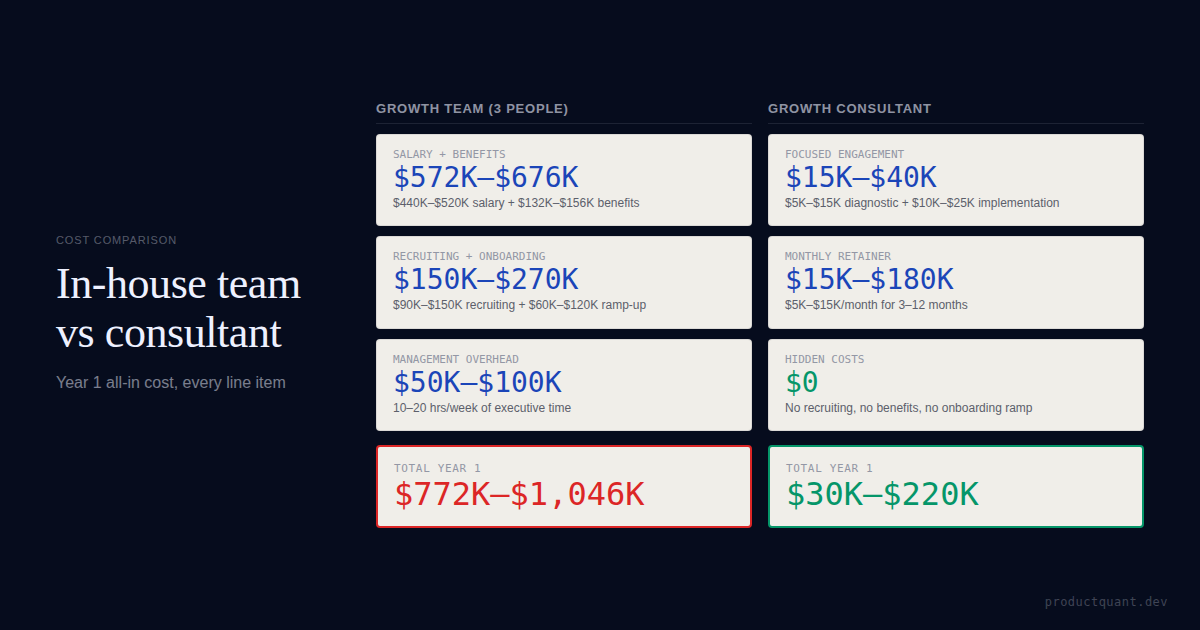
- An in-house growth team of 3 people costs $772K–$1,046K in Year 1. That includes $440K–$520K in salary, $132K–$156K in benefits and equity, $90K–$150K in recruiting fees, $60K–$120K in lost productivity during onboarding, and $50K–$100K in management overhead.
- A growth consultant costs $20K–$190K in Year 1. Focused engagement: $15K–$40K. Monthly retainer: $5K–$15K/month. No recruiting fees, no benefits, no onboarding ramp-up — productive from week one.
- The consultant delivers strategy and diagnosis. The team delivers execution. If your problem is "we don't know what to build," a consultant is cheaper and faster. If your problem is "we know what to do but don't have enough people," a team is the answer.
- The hidden cost of an in-house team is management overhead. The founder or VP Product spends 10–20 hours per week on 1:1s, planning, and cross-functional alignment. That's $50K–$100K per year in executive time.
- The break-even point: If you need 40+ hours per week of growth work ongoing, the team becomes cost-effective by Year 2. If you need 10–20 hours per week, the consultant is always cheaper.
The In-House Growth Team: Full Cost Breakdown
When a B2B SaaS company decides to build a growth team, the conversation usually starts with salary.
That is the visible cost. It is also the smallest part of the real expense.
The full cost of a 3-person growth team includes salary, benefits and equity, recruiting fees, onboarding ramp-up, and the management overhead that almost nobody budgets for.
A typical 3-person growth team looks like this:
- Head of Growth or Growth PM: $180K–$220K
- Growth Engineer: $140K–$160K
- Growth Marketer or Analyst: $120K–$140K
That's $440K–$520K in base salary. Add benefits, 401k, PTO, and equity grants at roughly 30% of salary, and you're at $572K–$676K before the team has produced anything.
Then come the costs that don't appear in a spreadsheet:
- Recruiting fees — 20–25% of salary per hire = $90K–$150K in Year 1
- Onboarding ramp-up — 3–6 months per hire = $60K–$120K in lost productivity
- Management overhead — 10–20 hours per week of executive time = $50K–$100K per year
| Component | Year 1 Cost | Year 2+ Cost |
|---|---|---|
| Salary (3 people) | $440K–$520K | $440K–$520K |
| Benefits + equity (~30%) | $132K–$156K | $132K–$156K |
| Recruiting fees | $90K–$150K | $0 |
| Onboarding lost productivity | $60K–$120K | $0 |
| Management overhead | $50K–$100K | $50K–$100K |
| Total | $772K–$1,046K | $622K–$926K |
Year 2 drops significantly because recruiting and onboarding are one-time costs.
But even at $622K–$926K, the in-house team is a substantial ongoing commitment.
It requires 40+ hours per week of meaningful work to justify.
The Growth Consultant: Full Cost Breakdown
A growth consultant operates on a completely different cost structure.
There are two engagement models: a focused project engagement or a monthly retainer. Both are significantly cheaper than a team, but they serve different purposes.
Focused Engagement
A focused engagement runs $15K–$40K over 6–12 weeks:
- Diagnostic: $5K–$15K — 2–4 weeks, produces a prioritized roadmap
- Implementation: $10K–$25K — 4–8 weeks, executes the top 2–3 items
This model is ideal for companies that need a specific deliverable — an ICP definition, a pricing redesign, a sales process build — and want to own the result after the engagement ends.
Monthly Retainer
A monthly retainer runs $5K–$15K per month for 3–12 months, totaling $15K–$180K depending on duration.
This model is ideal for companies that want ongoing strategic guidance alongside their existing team. The consultant diagnoses, advises, and adjusts — but the team executes.
No Hidden Costs
The critical difference from an in-house team is that a consultant has no hidden costs:
- No recruiting fees — the consultant is already hired
- No benefits or equity — they're a contractor
- No onboarding ramp-up — they're productive from week one
- Management overhead: 2–3 hours per week — not 10–20
| Component | Year 1 Cost | Year 2+ Cost |
|---|---|---|
| Engagement or retainer | $15K–$180K | $15K–$180K |
| Management overhead (2–3 hrs/wk) | $5K–$10K | $5K–$10K |
| Total | $20K–$190K | $20K–$190K |
The consultant is 4–50× cheaper in Year 1 depending on the engagement model. Even at the high end of a monthly retainer, the consultant costs less than one person on the growth team — and delivers strategy and diagnosis that the team doesn't have the pattern recognition to produce.
The Decision: When Each Makes Sense
The cost comparison above is useful, but it misses the more important distinction:
A consultant diagnoses. A team executes.
These are different jobs, and the right answer depends on which job you need done.
Hire a Team When:
- You need 40+ hours per week of growth execution
- You've already diagnosed your growth bottlenecks
- You're Series B or beyond with revenue to support a team
- You want to build institutional knowledge that stays when consultants leave
The team is your execution engine. It needs a playbook to be effective.
Hire a Consultant When:
- You need 10–20 hours per week of growth expertise
- You haven't diagnosed your growth bottlenecks yet
- You're Seed to Series A and can't justify a $500K+ team
- You need specialized expertise — pricing redesign, ICP refinement, analytics build
The consultant writes the playbook. For a middle-ground option between consultant and full-time hire, see our fractional CPO guide.
The Optimal Path
The optimal path for most Series A companies is consultant first, team second.
The consultant diagnoses your bottlenecks and builds the playbook. Once the playbook is proven with data on what works, you hire a team to execute it at scale.
The alternative — hiring a team first and asking them to figure out the playbook — costs $500K+ and takes 6–12 months of experimentation.
For the full agency vs CPO vs in-house decision framework, see our comparison guide.
The Break-Even Analysis
Here's what the cumulative cost looks like over two years across three scenarios:
- A full 3-person team
- A consultant on monthly retainer
- A consultant plus one dedicated hire
| Scenario | Year 1 | Year 2 | 2-Year Total |
|---|---|---|---|
| 3-person team | $772K–$1,046K | $622K–$926K | $1.39M–$1.97M |
| Consultant (retainer) | $65K–$190K | $65K–$190K | $130K–$380K |
| Consultant + 1 hire | $220K–$380K | $220K–$380K | $440K–$760K |
The consultant is 4–10× cheaper over 2 years. The consultant plus one hire is 2–4× cheaper. The full team only becomes the right answer when you need 40+ hours per week of execution and have the revenue to support the overhead — typically $10M+ ARR.
FAQ
Can I start with a consultant and hire a team later?
Yes — and this is the optimal path. The consultant diagnoses your bottlenecks and builds the playbook. Once the playbook is proven with data, you hire a team to execute it at scale. The alternative — hiring a team first — costs $500K+ and takes 6–12 months.
What if the consultant leaves and takes all the knowledge?
A good consultant documents everything: the diagnostic report, the playbook, the analytics architecture, the intervention workflows. The handoff is part of the engagement. If the consultant doesn't document, that's a red flag.
How do I know if the consultant is delivering value?
Within 30 days: a diagnostic report with a prioritized 90-day roadmap. Within 90 days: measurable impact on one growth metric — activation rate, trial-to-paid conversion, CAC payback, or NRR. If you don't have both by day 90, the engagement isn't working.
Sources
- Bain — Growth Team Effectiveness — Growth team research. 381 words.
- Glassdoor — Growth Manager Salary — Salary benchmarks.
- Levels.fyi — Product Manager Salary — Compensation benchmarks.
- SaaStr — Building Growth Team — Team structure guidance.
- OpenView — Growth Team Structure — Team sizing.

Jake McMahon builds growth infrastructure for B2B SaaS companies — analytics, experimentation, and predictive modeling that turns product data into revenue decisions. He's worked as both a consultant and an advisor to growth teams across multiple engagements. Book a diagnostic call to discuss your growth team structure.