SAAS PRODUCT DNA ANALYZER — SELF-GUIDED TOOLKIT / FREE for a limited time
The DECODE Framework — a 10-dimension classification system that tells you exactly which SaaS strategies will work for YOUR product type.
30-day money-back guarantee
Free while we’re in launch mode. No payment, no card.
WHAT’S INCLUDED
FREE · limited time · email required · instant download
SOUND FAMILIAR?
Someone in the room brings up a famous PLG success story. You spend weeks scoping a free tier, a referral loop, a team invite flow. Six months and $100K later, adoption is flat. The reason: Slack’s model assumes instant individual value, organic team spread, and a self-serve billing motion. Your product has none of those things. The playbook wasn’t wrong — it was written for a different product.
Sales wants to add more reps. Marketing wants to build an SEO moat. Product wants to ship self-serve onboarding. All three are reading from the same generic SaaS playbook — but for your specific product, only one of those moves makes structural sense. The others will absorb budget and headcount without moving the number you care about.
The SaaS advice ecosystem doesn’t tell you this openly, but almost none of it is contextualized. When someone says “add a free tier,” they’re assuming your product has instant time-to-value, individual users with purchasing authority, and a natural viral loop. When someone says “hire more salespeople,” they’re assuming your deal size justifies the CAC. The advice isn’t wrong — it’s just written for a different product than yours.
days from strategy confusion to a complete Product DNA profile, validated priorities, and a 90-day action plan grounded in what your product actually is.
Tested with teams building these products
HackingHR
Net Atelier
QForm
THE PROBLEM
Copying a growth strategy from a product with different DNA. Most common: B2B enterprise products trying PLG because “Slack did it.” The SaaS advice ecosystem has a dirty secret — almost none of it is contextualized. When someone says “add a free tier,” they’re assuming your product has instant time-to-value, individual users with purchasing authority, and a natural viral loop. Most products don’t.
Your CEO thinks you’re building a System of Record (long-term lock-in, high switching costs). Your product team is building a Workflow Tool (quick wins, easy to replace). Your sales team is selling it as an Intelligence Layer (insights and analytics). Everyone’s right about a piece, nobody’s right about the whole. When someone says “hire more salespeople,” they’re assuming your deal sizes justify CAC, your buyers need hand-holding, and your product requires configuration.
Measuring the wrong things because you’re using a metrics framework designed for a different product type. A usage-based product tracking seat growth. A network-effect product ignoring viral coefficient. A sales-led product optimizing for self-serve conversion. SaaS products are treated as a single category when they’re actually dozens of distinct product types, each with different optimal strategies.
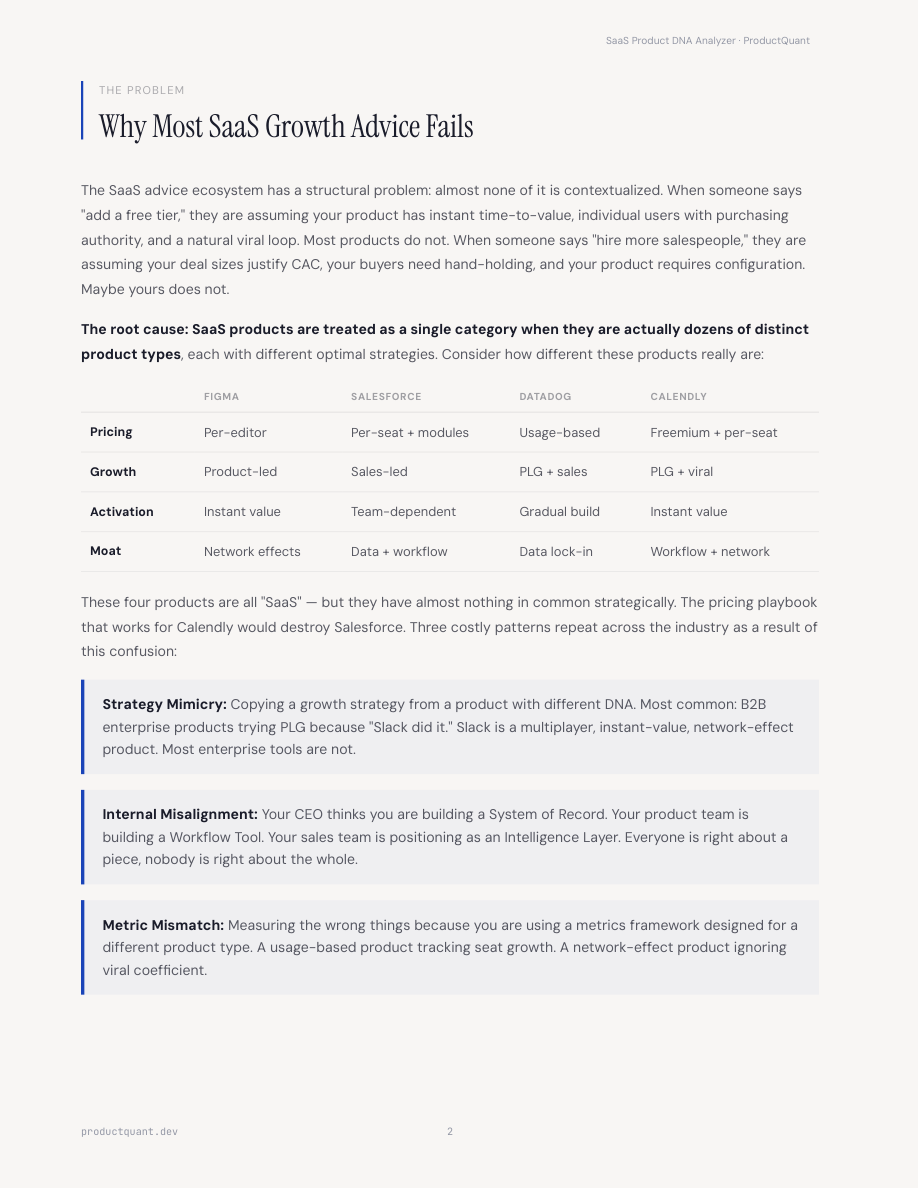
Consider how different these products really are:
| Figma | Salesforce | Datadog | Calendly | |
|---|---|---|---|---|
| Pricing | Per-editor | Per-seat + modules | Usage-based | Freemium + per-seat |
| Growth | Product-led | Sales-led | Product-led + sales | Product-led + viral |
| Activation | Instant value | Team-dependent | Gradual build | Instant value |
| Moat | Network effects | Data + workflow | Data lock-in | Workflow + network |
These four products are all “SaaS” — but they have almost nothing in common strategically. The pricing playbook that works for Calendly would destroy Salesforce. The sales motion that works for Salesforce would bankrupt Calendly. You need to know YOUR product’s DNA before you pick your strategy.
THE SOLUTION
Most strategy tools look at growth motion in isolation, or pricing in isolation, or activation in isolation. DECODE shows you how all of these interact — and finds the misalignments that are costing you growth.
Revenue model, expansion mechanics, perceived value
Viral potential, network effects, collaboration dynamics
Go-to-market approach, team structure, funnel design
Product category, switching costs, competitive dynamics
Sales complexity, adoption friction, champion strategy
Onboarding design, time-to-value, trial structure
Defensibility, churn drivers, lock-in strategy
Implementation approach, support needs, deal structure
NRR strategy, upsell mechanics, account growth
Messaging, differentiation, market approach
THE FRAMEWORK IN ACTION
Notion is widely described as a PLG product. The classification tells a more precise story:
| Dimension | Common assumption | What classification reveals |
|---|---|---|
| Growth Motion | Pure PLG — individual adoption, bottom-up | Hybrid PLG + SLG. The most lucrative growth is team expansion, not individual. Bottom-up starts the deal; top-down closes it. |
| Buyer vs. User Map | Same person — individual uses and buys | Split. Individual adopts. IT admin or finance approves at scale. Onboarding optimised for individuals breaks at enterprise. |
| Activation Pattern | Instant value — blank canvas, immediate start | Gradual build. Notion’s value is the system you build over time, not the first session. This changes every onboarding metric. |
Real application — anonymised
Before classification
A B2B SaaS form builder was stalling. The team’s diagnosis: they needed PLG mechanics. They committed 6 months of roadmap to viral features, referral loops, and team invitations.
After classification
User Topology: Single-Player (1/5). One person creates forms; many fill them. No viral loop. Free tier was attracting institutional users with no purchase authority. The real problem: pricing fragmentation across 6 billing blocks.
The team had been debating growth tactics for six months. The classification took two hours. The answer wasn’t a tactic — it was a structural misread of what kind of product they were building.
30-day money-back guarantee
What You’ll Find Inside
This preview covers the framework and why it works. The full toolkit gives you all 8 working documents — the Product Profile Canvas, Strategy Implications Matrix, and 90-day action plan — to run the full classification yourself.
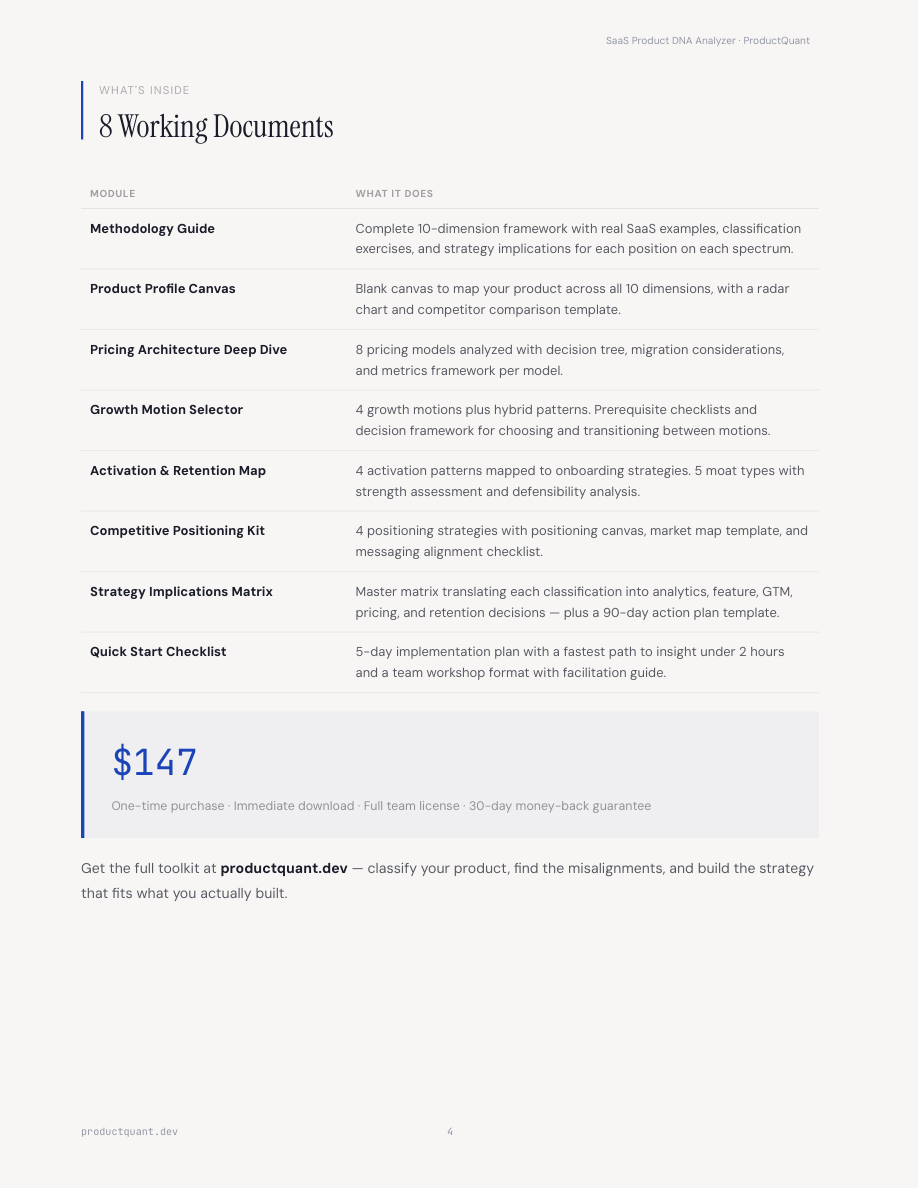
WHAT’S INCLUDED
Complete 10-dimension framework with real SaaS examples, exercises, and theory. The engine that powers everything.
Blank canvas to map your product across all 10 dimensions. Radar chart. Competitor comparison template.
8 pricing models analyzed. Decision tree. Migration guide. Metrics per model.
4 growth motions + hybrids. Prerequisite checklists. Decision framework.
4 activation patterns mapped to onboarding strategies. 5 moat types with strength assessment.
4 positioning strategies. Positioning canvas. Market map template. Messaging alignment checklist.
Master matrix showing what each classification means for analytics, features, GTM, pricing, and retention. 90-day action plan.
5-day implementation plan. Pre-work list. Troubleshooting guide.
Total individual value: $366
Your price: $147
WHAT HAPPENS NEXT
Enter your email. The toolkit opens immediately — all 8 documents, no waiting. We’ll also email you the link so you can find it later.
Document 8 tells you exactly what to do first. Block 2 hours for Day 1. You’ll end the session with your complete Product DNA profile.
By Day 5, you have validated strategies across pricing, growth, and positioning — and a 90-day action plan grounded in what your product actually is, not what another product told you to do.
30-day money-back guarantee
HOW IT WORKS
Work through all 10 dimensions using the Methodology Guide. Mark your position on each spectrum. Fill in your Product Profile Canvas. You’ll end the day with your Product DNA profile.
Deep-dive into your pricing architecture and growth motion. Use the decision trees to validate or challenge your current approach. Identify misalignments.
Map your activation pattern and assess your moat strength. Discover whether your onboarding matches your activation type. Find retention risks.
Define your competitive positioning strategy. Build your market map. Check messaging alignment against your product DNA.
Run your DNA through the Strategy Implications Matrix. Flag misalignments. Build your 90-day action plan based on what your product DNA actually calls for. End of week: complete Product DNA profile, validated strategies across pricing/growth/positioning, and a shared language your entire team can use to make better product decisions.
Most teams that go through the DECODE Framework identify 3–5 structural misalignments they were unaware of — mismatches between growth motion, pricing architecture, and activation pattern that were silently limiting growth.
THE OUTCOME
By end of Day 5, four things exist that didn’t exist before. Each one is a decision your team can make that was previously a debate.
A complete classification across all 10 dimensions — not as a one-time document but as a shared language your entire team uses going forward. Every future strategy debate can be anchored to dimensions and evidence instead of opinion and precedent. Your CEO, product lead, and head of sales will finally describe the same product.
A freemium tier that can’t work because activation is team-dependent. A sales motion too expensive for your ACV. A retention strategy built for the wrong moat type. A metrics framework designed for a different product entirely. These are the things bleeding growth that you can’t see without classifying across all 10 dimensions simultaneously.
Not “here’s what’s working in SaaS right now.” Here’s what’s right for your specific product type, your ARR stage, and your buyer map. The Strategy Implications Matrix translates every dimension of your DNA into concrete decisions — what to measure, what to build, how to go to market, how to expand revenue.
Built from your classification. Every priority grounded in what your product DNA actually calls for — not what a famous company did. Teams that run this process stop arguing about strategy in the abstract and start executing against a shared blueprint. The classification outlasts the workshop.
WHO THIS IS FOR
What people say
30-day money-back guarantee
PRICING
A strategy misalignment that sends your team down the wrong growth motion for six months costs far more than a toolkit that prevents it. This is free during launch — it moves to $147 when we open the LemonSqueezy checkout.
Free while we’re in launch mode. When LemonSqueezy goes live, this returns to $147. Get it now.
30-Day Guarantee
Work through the full classification. If it doesn’t identify at least 3 strategic misalignments in your current growth or GTM approach — tell us within 30 days for a full refund. No questions asked.
FREQUENTLY ASKED QUESTIONS
Everything you need to know before you buy. If something’s still unclear, email us directly.
When your team has a shared, documented classification of what your product actually is, “we should do what Slack did” becomes a sentence you can answer with evidence — not another hour of argument.
30-day money-back guarantee · Free during launch · No card required