

TL;DR
- A fractional CPO owns the product strategy: product vision, roadmap, feature prioritization, PM team coaching. They answer "what should we build and why?" $5K–$15K/month for 10–20 hours/week.
- A growth consultant owns the growth infrastructure: event taxonomy, analytics dashboards, experiment design, churn diagnosis. They answer "how do we measure and optimize what we already have?" $5K–$15K/month or $15K–$30K per engagement.
- The overlap: both work on product strategy and prioritization. The CPO approaches it from the roadmap angle. The consultant approaches it from the data and experimentation angle.
- When to hire a fractional CPO: You don't have a product leader, your roadmap is a list of stakeholder requests, and you're unsure what to build next.
- When to hire a growth consultant: You have a product leader and a roadmap, but your analytics are blind, your experiments are ad-hoc, and you don't have data to back your product decisions.
The Two Roles, Side by Side
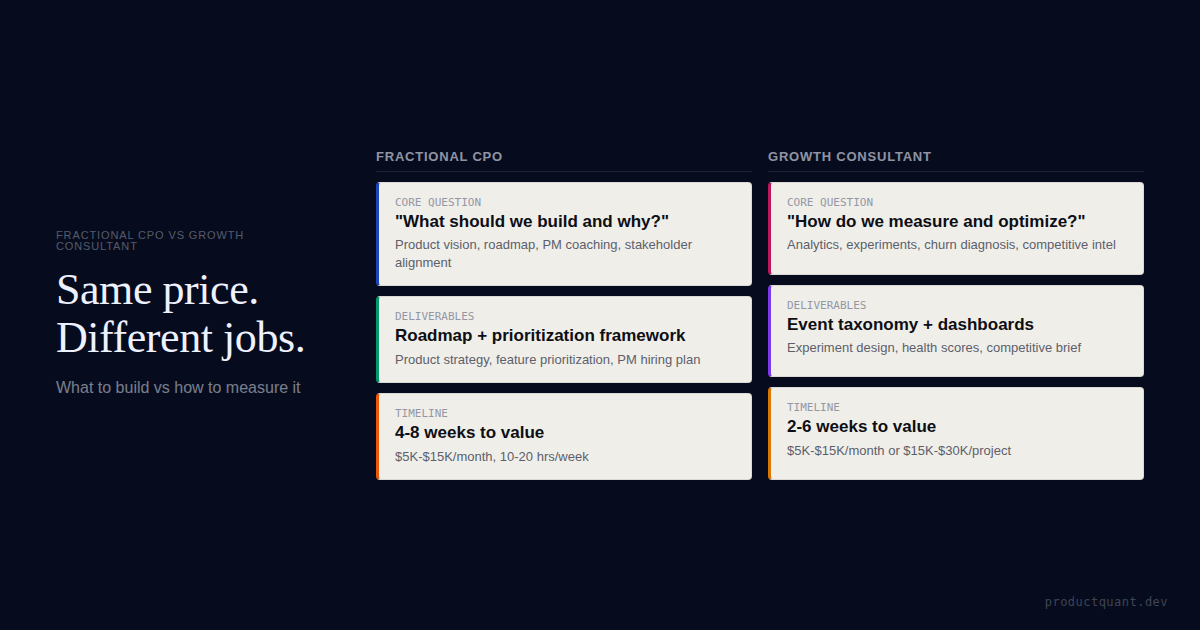
A fractional CPO and a growth consultant cost roughly the same amount of money — $5K to $15K per month. But they do completely different jobs. The fractional CPO is a part-time product leader who owns the "what should we build and why" question. The growth consultant is a part-time growth operator who owns the "how do we measure and optimize what we already have" question. If you hire the wrong one, you will pay for 6 months and get an answer to the question you didn't need asked.
| Fractional CPO | Growth Consultant | |
|---|---|---|
| Core question | "What should we build and why?" | "How do we measure and optimize what we have?" |
| Scope | Product vision, roadmap, prioritization, PM coaching | Analytics, experiments, churn diagnosis, competitive intel |
| Time commitment | 10–20 hours/week | 5–15 hours/week |
| Cost | $5K–$15K/month | $5K–$15K/month or $15K–$30K per project |
| Deliverables | Product roadmap, prioritization framework, PM hiring plan | Event taxonomy, dashboards, experiment design, health scores |
| Timeline to value | 4–8 weeks | 2–6 weeks |
The fastest way to decide which one you need is to look at your biggest unanswered question. If it is "what should we build next," you need a fractional CPO. If it is "why isn't what we built working," you need a growth consultant. If it is both, you probably need both — but in a specific order, which we'll get to.
The Fractional CPO: Product Strategy
The fractional CPO is a part-time product leader. They fill the gap between "no product leadership" and "full-time CPO." Most companies that hire a fractional CPO are at the stage where they have 0–2 PMs, no senior product leadership, and a roadmap that is really just a list of stakeholder requests sorted by who yelled the loudest.
A fractional CPO owns product vision and strategy, roadmap design, feature prioritization using frameworks like JTBD, Kano, or RICE, PM team coaching and hiring, and stakeholder alignment between the founder, engineers, and investors. They do not own analytics, experiment design, or churn diagnosis — those are the growth consultant's job. If your problem is not "what to build" but "how to measure what we built," a fractional CPO is not the right hire.
You need a fractional CPO when you have no senior product leadership, your roadmap is a list of stakeholder requests rather than a strategy, you're unsure what to build next or why, or your PM team is executing but not strategizing. You don't need one if you already have a strong VP Product or CPO, or if your problem is analytics, experiments, or churn diagnosis — that's the growth consultant's job.
The Growth Consultant: Growth Infrastructure
The growth consultant is a part-time growth operator. They build the systems that connect product data to revenue decisions. Most companies that hire a growth consultant have a product leader and a roadmap, but their analytics are blind, their experiments are ad-hoc, their churn is rising, and they can't answer "what's our activation rate" without a three-day investigation.
A growth consultant owns event taxonomy design, dashboard architecture that answers actual business questions, experiment design with pre-registered hypotheses and calculated sample sizes, churn diagnosis through behavioral health scores and at-risk account lists, and competitive intelligence. They do not own product vision, roadmap design, or PM team management — those are the fractional CPO's job. If your problem is not "how to measure" but "what to build," a growth consultant is not the right hire.
You need a growth consultant when you have a product leader and a roadmap but your analytics are blind, your experiments have no hypothesis or sample size, your churn is rising and you don't know why, or you can't answer basic growth metrics without a multi-day investigation. You don't need one if you don't have a product roadmap yet — hire a fractional CPO first. And you don't need one if your problem is product vision or PM team management — that's the CPO's job.
The Overlap: Where They Collide
Both roles touch product strategy and prioritization. This is where most founders get confused, because both the fractional CPO and the growth consultant will give you an opinion on what to build next. The difference is in how they arrive at that opinion.
The fractional CPO prioritizes based on strategic fit, customer need, and engineering capacity. "We should build this feature because it advances our core job and aligns with our Q3 roadmap." The growth consultant prioritizes based on data impact and experiment results. "We should build this feature because the activation data shows it's the missing step for 60% of retained users."
When both are hired, the CPO sets the strategic direction and the consultant provides the data to validate or challenge it. The CPO says "we think this is the right direction." The consultant says "here's the data that confirms or refutes it." When only one is hired, that person does both jobs — poorly. A fractional CPO without data is guessing. A growth consultant without strategy is optimizing the wrong thing.
The pattern we see most often is that companies hire a fractional CPO who sets a roadmap based on customer interviews and competitive analysis, but without instrumentation to validate whether the roadmap actually moves growth metrics. Or they hire a growth consultant who identifies the highest-impact experiment to run, but without a product leader to prioritize it against the existing roadmap and manage the engineering trade-offs. The two roles are complementary, not competing.
The Hiring Decision Tree
The fastest way to decide which role you need is to follow this decision tree. It takes 30 seconds and eliminates most of the confusion.
Do you have a product leader — a VP Product, CPO, or senior PM? If no, do you have a product roadmap? If no, hire a fractional CPO. You need strategy before measurement. If you have a roadmap but no leader, still hire a CPO — a roadmap without leadership is just a wish list.
If yes, you have a product leader. Do you have growth infrastructure — analytics, experiments, churn diagnosis? If no, hire a growth consultant. You have strategy but no measurement. If yes to both, you have both roles covered. You might need neither.
FAQ
Can one person do both jobs?
Some can. A fractional CPO with analytics and experimentation experience can cover both roles. A growth consultant with product strategy experience can too. But most specialists excel at one and are adequate at the other. If budget allows, hire both. If not, hire for your biggest bottleneck.
Should I hire the fractional CPO or the growth consultant first?
Product strategy before measurement. If you don't know what to build, no amount of analytics will tell you. Build the roadmap first, then build the measurement system. The exception is when you have a roadmap but it's based on gut feeling — in that case, hire the growth consultant to validate the roadmap with data before the CPO builds on top of it.
How long should each engagement last?
Fractional CPO: 6–12 months. Product strategy takes time to validate and the roadmap needs iteration. Growth consultant: 2–6 weeks for a focused engagement, or 3–6 months for ongoing advisory.
Sources
- Bain — Fractional Product Leadership — Fractional leadership research. 381 words.
- SaaStr — Fractional CPO Guide — Fractional CPO overview.
- OpenView — Fractional Product Leader — Fractional leadership. 95 words.

Jake McMahon builds growth infrastructure for B2B SaaS companies — analytics, experimentation, and predictive modeling that turns product data into revenue decisions. He's worked alongside fractional CPOs and product leaders across multiple engagements. Book a diagnostic call to discuss your product and growth leadership.