

TL;DR
- A GTM consultant diagnoses and fixes the gap between your product and your revenue. They work across ICP definition, messaging, pricing, sales process, channel strategy, and analytics. Unlike a marketing consultant (top-of-funnel) or a sales consultant (close), a GTM consultant covers the full journey from positioning to revenue.
- The typical engagement has 2 phases: Diagnostic (2–4 weeks, $5K–$15K) and Implementation (4–8 weeks, $10K–$25K). The diagnostic produces a prioritized roadmap. The implementation executes the top 2–3 items.
- When to hire: Pre-Series A for ICP and messaging. Post-Series A for repeatable sales process. Growth plateau when the old motions stop working.
- What they deliver: ICP definition, messaging framework, pricing analysis, sales process design, channel strategy, analytics architecture, and a 90-day roadmap.
- What they don't deliver: Ad campaigns, content creation, cold email sequences, or CRM configuration. These are execution tasks — the consultant's job is strategy.
What a GTM Consultant Is (And What They're Not)
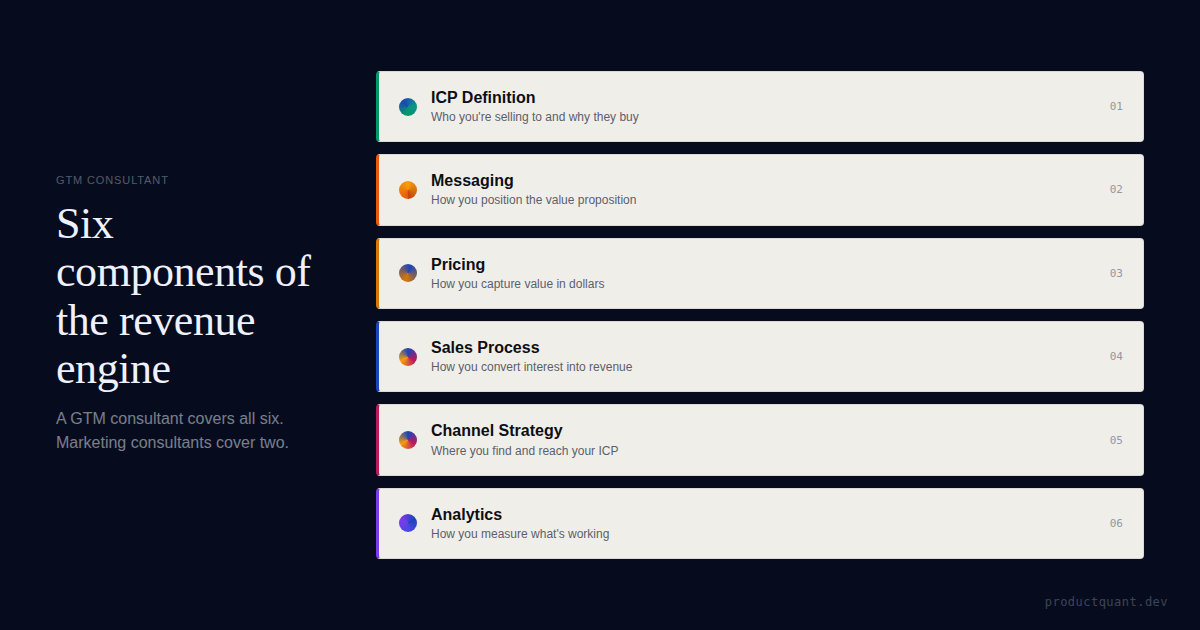
A GTM (go-to-market) consultant works on the system that connects your product to revenue. That system has 6 components: ICP definition, messaging, pricing, sales process, channel strategy, and analytics. The consultant's job is to make sure all 6 are working together as one coherent system — not as 6 separate functions that nobody has connected.
Most companies under $5M ARR don't have a GTM system. They have a founder who is personally connecting positioning to revenue, a sales rep figuring out what works through trial and error, and a marketer generating leads that may or may not match the actual buyer. A GTM consultant diagnoses this disconnect and builds the system that replaces it.
The 6 components break down like this:
- ICP definition — who you're selling to and why they buy
- Messaging — how you position the value proposition
- Pricing — how you capture the value in dollars
- Sales process — how you convert interest into revenue
- Channel strategy — where you find and reach your ICP
- Analytics — how you measure what's working and what's not
A GTM consultant covers all 6. A marketing consultant covers messaging and channels. A sales consultant covers pricing and sales process. Neither one sees the full picture, which is why hiring them separately often produces conflicting recommendations.
GTM Consultant vs. Marketing Consultant vs. Sales Consultant
| GTM Consultant | Marketing Consultant | Sales Consultant | |
|---|---|---|---|
| Scope | Full funnel (ICP → Revenue) | Top of funnel (Awareness → MQL) | Middle to bottom (SQL → Close) |
| Deliverables | ICP, messaging, pricing, sales process, channels, analytics | Campaign strategy, content, ad spend | Sales process, objection handling, close rates |
| Blind spot | None — connects positioning to revenue | Doesn't see what happens after MQL | Doesn't see why leads are low quality |
The GTM consultant's unique value is the full-funnel view. A marketing consultant sees from awareness to MQL and optimizes for lead volume. A sales consultant sees from SQL to close and optimizes for win rate. A GTM consultant sees from "who should we be selling to" to "how much revenue did we close" — and connects the dots between each stage. This is why they are especially valuable for companies under $5M ARR, where the bottlenecks can be anywhere in the funnel.
The Engagement: Diagnostic + Implementation
A GTM engagement has two distinct phases. The first diagnoses what is broken. The second fixes it. Skipping the diagnostic is the most common mistake companies make — it is like asking a doctor to prescribe medication without running any tests.
Phase 1: Diagnostic (2–4 weeks, $5K–$15K)
The consultant interviews your team — founder, sales, marketing, product, customer success — and analyzes your data: pipeline, conversion rates, CAC, churn, NRR. They also review your GTM artifacts: website, pitch deck, pricing page, sales collateral. The goal is to produce a prioritized list of what is broken, in order of revenue impact.
The diagnostic output is a GTM diagnostic report that identifies ICP gaps, messaging misalignment, pricing leaks, sales process breakdowns, channel inefficiencies, and analytics blind spots. Most importantly, it produces a prioritized 90-day roadmap with the top 2–3 fixes ranked by expected revenue impact.
Phase 2: Implementation (4–8 weeks, $10K–$25K)
The consultant executes the top 2–3 items from the diagnostic roadmap. This is not a handoff — the consultant builds alongside your team so that the deliverables are owned by your people, not by an outside vendor. Typical implementation work includes ICP refinement based on retention data, messaging rewrite around customer jobs, pricing redesign to capture more value, sales process design with stage-specific conversion benchmarks, channel optimization, and analytics build with event instrumentation and dashboards.
The result after both phases is a GTM system that your team can run independently. The consultant is gone. The system stays.
When to Hire a GTM Consultant
Not every company needs a GTM consultant at every stage. The decision depends on where you are and what is broken. Here is the pricing and engagement breakdown by ARR stage:
| ARR Stage | Typical Engagement | Cost Range | Primary Deliverable |
|---|---|---|---|
| Pre-Series A ($500K–$2M) | Diagnostic only | $5K–$15K | ICP definition + messaging framework |
| Post-Series A ($2M–$10M) | Diagnostic + Implementation | $15K–$40K | Sales process + channel strategy |
| Growth Plateau ($5M–$15M) | Full engagement | $25K–$60K | Full GTM redesign + analytics build |
At the pre-Series A stage, the problem is usually that you have product-market fit for a small segment but don't know how to scale it. Your ICP is fuzzy, your messaging is feature-focused, and your pricing was set by gut feeling. The consultant defines your ICP based on retention data, rewrites your messaging around customer jobs, and designs a pricing model that captures expansion value.
At the post-Series A stage, the problem shifts. Founder-led sales worked at $1M ARR but doesn't scale past $3M. You need process, not personality. The consultant maps your current sales process, identifies the bottlenecks where deals stall, designs a new process with stage-specific conversion benchmarks, and builds the analytics to measure it.
At the growth plateau stage, the motions that got you to $5M aren't getting you to $10M. CAC is rising, sales cycles are extending, and NRR is flat. The consultant runs a full GTM audit across all 6 components to identify which lever is broken. Usually it is one of three: wrong ICP, wrong messaging, or wrong pricing. The fix is rarely obvious from the inside — which is why an external diagnostic is worth the investment.
What a GTM Consultant Doesn't Do
Knowing what a GTM consultant does not do is just as important as knowing what they do. The most common reason GTM engagements fail is that companies hire a consultant to do tactical production work — and then wonder why the strategy never materializes.
A GTM consultant does not write ad copy. They do not build cold email sequences. They do not configure your CRM. They do not create content. And they do not close your deals. These are execution tasks — production work that belongs to your marketing, sales development, and RevOps teams. The consultant's job is strategy, diagnosis, and system design.
If you need someone to execute, that is a fractional CMO or a sales hire — not a GTM consultant. The consultant produces the strategy and the playbook. Your team executes. If you hire a GTM consultant to write ad copy, you are paying $15K for work that a $60K marketing coordinator could do — and you are wasting the one thing the consultant actually brings to the table: the ability to see the full funnel and diagnose which lever is broken. For the cost comparison between hiring a team and hiring a consultant, see our growth team vs consultant breakdown.
The GTM Consultant's Unique Lens
What separates a GTM consultant from other types of consultants is their view of the entire funnel, not just one section of it. A marketing consultant sees from awareness to MQL and optimizes for lead volume and quality. A sales consultant sees from SQL to close and optimizes for win rate and deal size. A GTM consultant sees from "who should we be selling to" all the way to "how much revenue did we close" — and connects the dots between each stage.
This full-funnel view is why GTM consultants are especially valuable for companies under $5M ARR. At this stage, the founder is still personally connecting positioning to revenue, and the bottlenecks can be anywhere in the funnel. A GTM consultant diagnoses which lever is broken — ICP, messaging, pricing, sales process, channels, or analytics — and fixes the highest-impact one first. The result is not a 50-page strategy document. It is a 90-day roadmap with 2–3 fixes that move revenue.
FAQ
How much does a GTM consultant cost?
Diagnostic: $5K–$15K (2–4 weeks). Implementation: $10K–$25K (4–8 weeks). Ongoing advisory: $5K–$15K/month (3–6 months). The ROI comes from fixing one broken lever — usually pricing or ICP — which pays for the engagement in the first quarter.
How do I know if I need a GTM consultant vs. a marketing consultant?
If your problem is top-of-funnel — not enough leads, wrong leads, high CAC — a marketing consultant might be enough. If your problem is the full journey from positioning to revenue, including ICP, messaging, pricing, sales process, channels, and analytics, you need a GTM consultant.
Can a GTM consultant work with our existing team?
Yes — and this is the ideal setup. The consultant diagnoses and recommends. Your team executes with the consultant's guidance. The engagement ends when your team can maintain and iterate the GTM system independently.
What's the biggest mistake companies make when hiring a GTM consultant?
Hiring one to execute tactics instead of diagnosing strategy. A GTM consultant who writes ad copy is like an architect who lays bricks. Both are valuable — but they are different jobs.
How do you measure the ROI of a GTM consultant?
Track three metrics: CAC payback period (should decrease 20–40%), trial-to-paid conversion (should increase 10–25%), and pipeline velocity — time from first touch to close (should decrease 15–30%). The consultant's diagnostic report should establish baselines for all three. If those numbers don't move within 90 days, the consultant didn't diagnose the right bottleneck.
Sources
- FullFunnel — What Is GTM Consulting — Positioning, segmentation, sales enablement. 1,381 words.
- SaaSHero — SaaS GTM Sales Enablement Consulting — 49% win rates, 3:1 LTV:CAC. 1,789 words.
- Asana — 9-Step GTM Strategy Guide — Complete GTM process. 4,558 words.
- Stripe — GTM Strategy for Startups — Startup GTM guide. 2,813 words.
- Bain — GTM Strategy Research — Bain insights. 381 words.

Jake McMahon builds growth infrastructure for B2B SaaS companies — analytics, experimentation, and predictive modeling that turns product data into revenue decisions. He's consulted on GTM strategy across multiple engagements and connected GTM diagnostics to product analytics. Book a diagnostic call to discuss your GTM system.