


TL;DR: The 3-Phase Framework
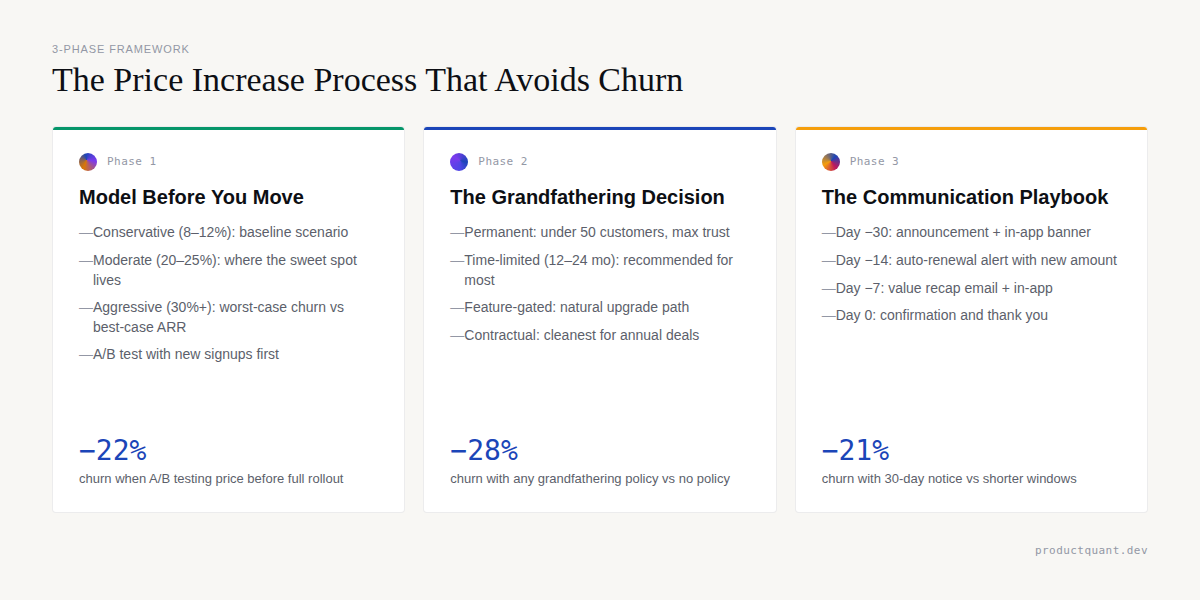
- Phase 1 — Model: Build conservative, moderate, and aggressive scenarios with churn projections before changing any numbers. The data often reveals higher safe increases than leadership expects.
- Phase 2 — Grandfather: Choose from 4 grandfathering policies. Time-limited grandfathering at 12-24 months is the recommended starting point for most companies, reducing churn by 28%.
- Phase 3 — Communicate: Follow a 30-day timeline with 5 touchpoints across email and in-app. 45% of customers cite surprise increases as their top reason for leaving.
The Fear of Raising Prices Is Costing You Revenue
Kontentino, a B2B social media management platform, wanted to raise prices. Their leadership team was paralyzed by fear — they believed any increase would trigger mass customer cancellations. They brought in a pricing consultancy to model the impact, and the data revealed something unexpected.
They could raise prices 20% higher than their original plan without triggering any meaningful churn. They executed the increase with zero cancellation spikes and zero negative customer sentiment.
This is not rare. Companies that approach price increases strategically — with data modeling, grandfathering policies, and structured communication — consistently see minimal churn impact. Companies that raise prices without a plan see churn spike by 12 to 15% on average (WinSavvy). The cost of getting this wrong is just one of several ways bad pricing caps your growth.
A price increase is not a revenue event. It is a trust test. Pass it with data, not with hope.
If you have not yet set your pricing strategy, start with our complete SaaS pricing strategy guide before planning an increase. The rest of this article walks through each phase of the framework in detail, with templates, numbers, and real examples you can use immediately.
Phase 1: Model Before You Move
The single biggest mistake SaaS companies make is setting a new price based on gut feel. Before you change a single number on your pricing page, model the impact across three distinct scenarios.
The data from the Kontentino engagement proves that scenario modeling regularly reveals higher safe price increases than leadership initially believes.
Build Three Scenarios
Here is the scenario structure that pricing consultancies use when advising SaaS companies on increases. Each scenario gives you a different risk-reward profile to evaluate against your customer base and growth trajectory.
- Conservative scenario (8-12%): Your planned increase, which aligns with the industry average for annual SaaS price increases. Model expected churn, ARR uplift, and customer sentiment for this baseline.
- Moderate scenario (20-25%): Your planned increase plus 10-15% more. This is usually where the optimal sweet spot lives, and it is exactly what Kontentino discovered — their moderate scenario revealed they could safely increase 20% above their original plan.
- Aggressive scenario (30%+): A structural repricing. Model the worst-case churn scenario, which for early-stage startups can reach a 35% churn spike, alongside the best-case ARR outcome.
For each scenario, model the following outputs:
- ARR projection at 3, 6, and 12 months post-increase
- Expected churn rate by customer segment
- Price uplift per plan tier
- How your specific customer segments have responded to past changes
The output is not a single number — it is a range with confidence levels attached to each point.
Understand the Churn Math
The difference between a 25% churn spike and 3% incremental churn from the exact same 10% price increase comes down to one variable.
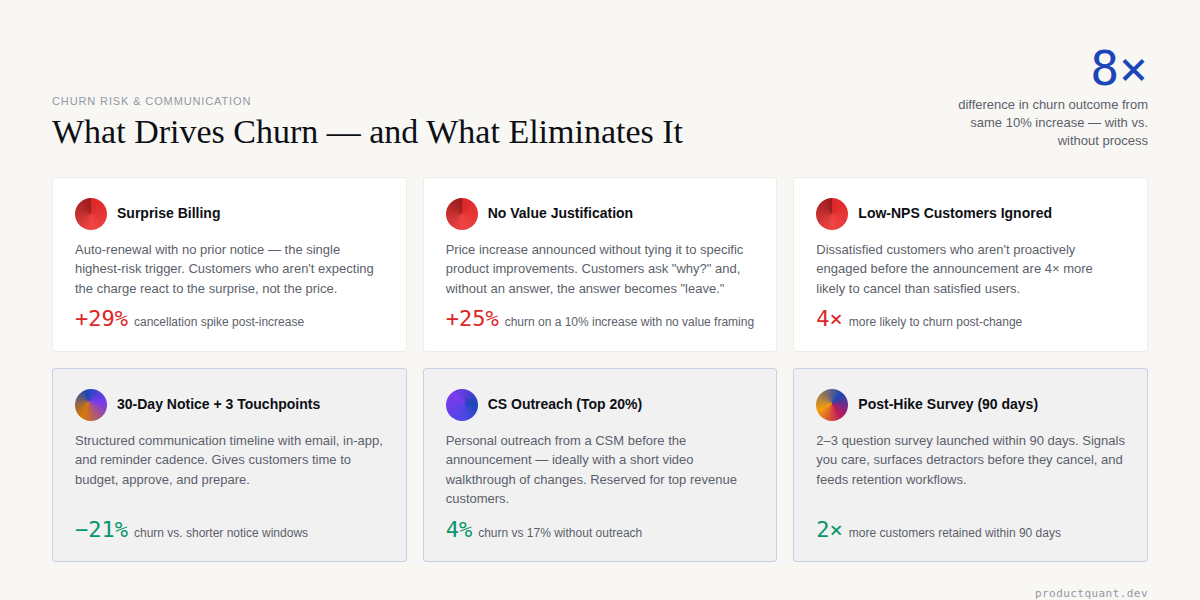
A 10% price increase triggers up to 25% churn if communication is poor — but with structured communication and grandfathering, that same increase produces under 3% incremental churn. Same increase. Eight times the difference in outcome.
Customers do not churn from price changes. They churn from surprise, from perceived value loss, and from feeling trapped. Your modeling needs to account for all three factors.
Test Before You Roll Out
Companies that A/B test price increases before a full rollout see 22% less churn (WinSavvy). Run a cohort-based test with new signups first. Try different price points, different messaging, and different timing. The data from new customers is a leading indicator of how your existing base will respond — without the risk of triggering cancellations from your revenue core.
Phase 2: The Grandfathering Decision
Grandfathering is the single most effective churn mitigation tool available to SaaS companies. Allowing existing customers to retain their legacy pricing while new customers pay the increased rate reduces churn by 28% (WinSavvy).
But every grandfathered customer represents a growing revenue gap between what they pay and what new customers pay. Choosing the right grandfathering policy requires balancing trust preservation against revenue capture. Here are the four policy models available, each with different trade-offs for your specific situation.
Permanent Grandfather
Existing customers keep their current price indefinitely. This model is simple to communicate and generates the highest trust signal, but the revenue gap compounds over years as your pricing evolves. It works best for early-stage companies with fewer than 50 customers, where the total opportunity cost remains manageable and predictable.
Time-Limited Grandfather (Recommended)
Existing customers keep their price for a defined period — typically 12 to 24 months or one full renewal cycle. This approach balances trust-building with eventual revenue capture. The typical grandfathered user discount sits at 10-20% below new customer pricing (Parseur). Most companies should start here and adjust based on their customer count and growth trajectory.
Feature-Limited Grandfather
The old price is maintained for existing customers, but new or premium features are gated behind the updated pricing tiers or sold as add-ons. This creates a natural upgrade path — customers who want the new features voluntarily move to the new pricing, while those who do not need them stay on the legacy plan without feeling forced into a decision.
Contractual Grandfather
Legacy pricing is honored only for the duration of the existing contract term. At renewal, the customer aligns with the new pricing structure. This is the cleanest approach for enterprise customers with annual or multi-year contracts, as it requires no special billing logic and sets clear expectations from the start.
The Revenue Loss Formula
Before choosing a model, calculate the actual cost of grandfathering so you can make an informed decision rather than an emotional one. The formula is straightforward.
(New Price − Old Price) × Grandfathered Customers × Months on Legacy Pricing
Example: raising a plan from $50 to $75 per month, with 200 grandfathered customers on a 12-month legacy period, equals $60,000 in annualized revenue forgone. The question is whether a single 25% churn spike from a poorly communicated increase would cost far more in lost ARR.
Phase 3: The Communication Playbook
of customers cite surprise price increases as the top reason for leaving. Surprise is entirely preventable with a structured communication timeline.
The data is clear on what works:
- A 30-day notice reduces churn by 21% compared to shorter notice windows
- Sending 3 or more email reminders reduces churn by 21%
- In-app messaging yields 17% less churn than email alone
The 30-Day Communication Timeline
Here is the exact communication timeline you should follow, with specific actions for each touchpoint and the channel that delivers the best results at each stage.
| Timing | Action | Channel |
|---|---|---|
| 30 days out | Initial announcement: what is changing, why, and when. Include FAQ link. | Email + in-app banner |
| 14 days out | Auto-renewal alert: new charge amount and billing date. | |
| 7 days out | Reminder and value recap: specific features added since last price change. | Email + in-app |
| Day of change | Confirmation and gratitude: plan has updated, thank you message. | |
| Within 90 days | Post-hike survey: 2-3 questions to capture sentiment. Trigger retention workflows for detractors. |
Auto-renewals without any prior notice cause a 29% cancellation spike (WinSavvy). Do not let this happen to your customer base.
Email Template: 30-Day Initial Announcement
Use this template as your starting point for the first communication. Personalize the bracketed fields and tie the value proposition to specific improvements your customers have experienced.
Subject: An update to your [Product] pricing — effective [Date]
Email Template: 7-Day Value Recap
7 days before the change goes live, send a reminder that reinforces the value delivered since the last price change. This is your last chance to address concerns before the billing date.
Subject: One week until your plan update — here is what you have gained
Email Template: Day-of Change Confirmation
On the day the change takes effect, send a brief confirmation. This is not the time for a long message — it is a receipt and a thank you.
Subject: Your [Product] plan has been updated
The Customer Success Outreach
For your top 20% of customers by revenue, email is not sufficient. Have their customer success manager reach out personally with a warm, clear message and, ideally, a short video walking through the changes.
The Messaging Framework
Every price increase communication needs to answer three specific questions. Your customers will ask these whether you answer them proactively or not, and the customers who do not get answers are the ones who cancel.
- What is changing? Be specific with the exact plan, the old price, the new price, and the effective date. Ambiguity breeds anxiety.
- Why is it changing? Tie the increase to customer outcomes, not your internal costs. Reference specific features, integrations, security certifications, or performance improvements shipped since the customer's last price point.
- What are their options? Present the available paths forward: continue on the current plan at the new rate, upgrade for additional value, or downgrade if their needs have changed.
When you communicate the new pricing, make sure your pricing page clearly presents the updated structure. Confusion at this stage is the fastest way to undo all your careful modeling. See our pricing page teardown analysis for best practices on presenting updated pricing.
Advanced Tactics for Near-Zero Churn Increases
Beyond the core 3-phase framework, there are four advanced tactics that separate companies with near-zero churn increases from companies that experience measurable customer loss.
These are the operational details that determine whether your price increase lands cleanly or triggers avoidable friction.
NPS-Driven Segmentation
Survey your customers 30 days before the price increase announcement using a standard NPS questionnaire. The purpose is not to measure NPS itself — it is to identify the customers most likely to churn when prices change.
Low NPS scorers are 4 times more likely to churn than high NPS users after a price change (WinSavvy). Once identified, offer them personalized support, temporary credits, or a delayed pricing timeline to pre-emptively catch churn before it happens.
Transition Incentives
Offering temporary tier upgrades for 1-3 months, free premium feature access, or early-renewal discounts framed as loyalty rewards reduces the perceived sting of a price increase. Upgrade discounts during price changes reduce churn by 19% (WinSavvy). The key is framing: these are loyalty rewards for existing customers, not discounts for price-sensitive prospects.
Annual Cadence
Making price increases predictable transforms them from a jarring event into an expected business rhythm. Companies that implement annual price increases see 12% lower churn than those with irregular increases (WinSavvy). The average B2B SaaS price increase in 2025 was 11.4% — roughly 5 times the general market inflation rate (Parseur). When your customers expect an annual adjustment, the conversation shifts from "why are you doing this" to "what did you ship this year."
The Post-Hike Survey
Launch a 2-3 question survey within 90 days of the price change. Ask about clarity, fairness, and what improvements the customer needs to see. Act on the responses and reach out to dissatisfied users with retention offers before they reach the cancel button.
Post-hike surveys retain 2x more customers within 90 days (WinSavvy). The survey itself signals that you care about the customer's perspective, which independently reduces churn likelihood.
What Not to Do: Real Mistakes That Cost ARR
Every mistake in this section has been made by a real SaaS company and has measurable churn consequences. Understanding what not to do is as important as knowing what to do — the cost of a single mistake can erase months of careful pricing work.
| Mistake | Measurable Impact | How to Fix It |
|---|---|---|
| Surprise increases with no advance notice | 45% cite this as top reason for leaving | Minimum 30-day notice with 3+ touchpoints across email and in-app |
| Blanket increases applied to all segments equally | 19% higher churn than segmented approaches | Segment by ACV, usage patterns, and NPS score before setting increase amounts |
| No value justification for the increase | 25% churn on a 10% increase | Tie the increase to specific product improvements shipped since the last price |
| Increasing more than 15% without new features | 2.5x the normal churn rate | Bundle the price increase with a feature launch or security certification |
| Auto-renewal without notice | 29% cancellation spike post-increase | Send a 14-day auto-renewal alert minimum with the new charge amount |
| Ignoring low-NPS customers before the announcement | 4x more likely to churn post-change | Personalized outreach and delayed pricing for identified detractors |
The pattern across all 6 mistakes is the same: treating the customer as a billing record instead of a relationship. Every fix starts with communication, segmentation, and advance notice. Surprise is the most expensive pricing mistake you can make.
The Product DNA Lens on Price Increases
How easily your company can raise prices without triggering churn is not a marketing question. It is a product architecture question. The structure of your pricing tiers, the modularity of your feature set, and the clarity of your value metric determine whether you have multiple levers to pull or only one blunt instrument.
Companies with modular, tiered product architectures can raise prices through several mechanisms simultaneously. They can gate new features behind higher tiers, introduce premium add-ons, adjust usage thresholds, or create entirely new plan levels.
Each of these approaches affects different customer segments differently, which means the churn impact is distributed rather than concentrated. This is the structural advantage that companies like Slack and Notion have — their pricing pages show tiered per-user models where new features naturally flow into higher tiers.
Companies with monolithic pricing — a single flat rate for all customers — have no structural levers. Every price change affects every customer equally, which maximizes the churn risk. If your product does not have clear value metrics and modular feature sets, you are trapped into blanket increases.
The solution is not to stop raising prices. The solution is to redesign your pricing architecture first, then execute the increase through the new structure.
The practical implication is straightforward. If you are planning a price increase within the next 6 months and your current pricing structure is a single tier or poorly differentiated tiers, spend the first month redesigning the architecture. The increase will land cleaner, the churn will be lower, and the revenue capture will be higher. For the framework on designing modular pricing architecture, see our complete SaaS pricing strategy guide.
Get the Price Increase Communication Templates
Email templates, timeline checklist, and grandfathering decision matrix — ready to customize and send.
FAQ: Raising SaaS Prices
How much should I increase prices?
The average B2B SaaS price increase falls between 8.7% and 12% annually (Valueships). For aggressive repricing that involves a new pricing model or major feature additions, 20-25% is the ceiling before churn accelerates sharply. The right approach is to model three scenarios — conservative, moderate, and aggressive — and let the data tell you where the sweet spot lives for your specific customer base.
Should I grandfather existing customers?
Yes, for at least one full renewal cycle. Grandfathering reduces churn by 28% (WinSavvy). The revenue gap between legacy and new pricing is the cost of trust, and trust is the prerequisite for every future price increase. The recommended model is time-limited grandfathering at 12-24 months, which balances retention with eventual revenue alignment.
When is the best time to raise prices?
Annual cadence works best and produces 12% lower churn than irregular increases (WinSavvy). Tie your increases to major feature launches, security certifications, or the start of your customer's fiscal year whenever possible. Avoid raising prices during your customer's peak usage season or end-of-quarter budget crunch, as these are moments of maximum sensitivity.
What if my customers are on annual contracts?
Contractual grandfathering is the cleanest approach for annual contracts. Honor the existing contract price through the current term and align with new pricing at renewal. The critical detail is communication timing — communicate the change at the start of the contract, not at renewal, giving customers 30-90 days to plan their budget and get internal approval (Valueships). Surprise at renewal is the fastest path to a lost contract.
How do I communicate a price increase to customers?
Your communication must answer three questions clearly and specifically: what is changing with exact numbers and dates, why it is changing tied to customer outcomes rather than your internal costs, and what options the customer has moving forward. 73% of customers accept a price increase when it is tied to clear product improvements (WinSavvy). Use a 30-day communication timeline with a minimum of 3 touchpoints across email and in-app channels.
Can I raise prices if I have not shipped new features recently?
You can, but the churn risk is significantly higher. B2B SaaS price increases above 15% without new features produce 2.5x the normal churn rate (WinSavvy). If you must raise prices without a feature launch, keep the increase below 10%, extend the communication timeline to 45 days, and frame the increase around infrastructure investments, support improvements, or security certifications rather than new features.
Sources
- WinSavvy — Churn vs Price Increases: What the Data Actually Shows
- Valueships — How We Helped Kontentino Increase Prices
- Paddle — SaaS Pricing Models, Strategies, and Best Practices
- Maxio — Guide to SaaS Pricing Models, Strategies, and Best Practices
- Parseur — Grandfathering in B2B SaaS
- CremyX — Raise SaaS Prices Without Losing Customers

About the Author
Jake McMahon builds growth infrastructure for B2B SaaS companies — analytics, experimentation, and predictive modeling that turns product data into revenue decisions. He has run pricing audits across multiple engagements, modeled price increase scenarios for companies from seed to Series B, and connected pricing strategy to product DNA analysis. The frameworks in this article are built from real engagement data, not theory. Book a diagnostic call to discuss your pricing strategy.