

TL;DR
- Must-Have features must appear on every tier. Paywalling them — compliance, core workflows, basic data management — creates dissatisfaction and churns customers who feel shortchanged.
- Performance features are the correct lever for tier differentiation. Volume limits, seat counts, and throughput scale linearly with customer size and justify predictable price jumps.
- Delighters belong in premium tiers. Features that produce strong positive reactions (workflow automation, multi-party routing, advanced analytics) justify higher prices and create natural upgrade triggers.
- Reverse attributes should be removed entirely, not buried in a lower tier — they actively drive churn regardless of which plan a customer is on.
- The Kano survey takes 2–3 days to run and produces a feature map that most teams spend months guessing at, with direct implications for packaging decisions.
Pricing tier design in B2B SaaS usually goes one of 2 ways. The team looks at what competitors charge and copies the structure. Or a founder decides intuitively which features feel "starter" and which feel "enterprise" and ships that. Both approaches produce the same result: a pricing structure that reflects the product team's assumptions about value rather than how users actually experience it.
The cost shows up later. A feature the team classified as premium turns out to be something customers expect at every tier. Locking it behind a higher plan does not create upgrade pressure — it creates refund requests. A feature the team gave away for free turns out to be the reason power users pay at all. That revenue is gone permanently.
The Kano model, developed by Noriaki Kano in 1984, classifies features into 3 satisfaction-relevant categories: Must-Haves (expected; absence causes dissatisfaction), Performance features (satisfaction scales linearly with quality or quantity), and Delighters (unexpected; presence creates strong positive reactions). A 4th category — Reverse attributes — covers features that actively cause frustration when present.
When you run a Kano survey on your full feature set, the output is not just a prioritisation list. It is a pricing architecture. Must-Haves define the floor of every tier. Performance features define where tier lines naturally fall. Delighters define what makes premium tiers worth buying. This article covers how that translation works — using real patterns from a healthcare SaaS engagement where the Kano output rewired packaging decisions the team had spent months debating without resolution.
"Most pricing debates are really feature classification debates in disguise. Once you know which features are Must-Haves, which are Performance, and which are Delighters, the tier structure is almost self-evident."
— Jake McMahon, ProductQuant
The 3-Layer Pricing Architecture from Kano

Every pricing tier decision is a claim about how users experience value. The Kano model gives you an empirical way to test those claims before you ship them. Here is how each Kano category maps to a tier design decision.
Layer 1: Must-Haves define the floor of every tier
Must-Have features are baseline expectations. If they are present, users are neutral. If they are absent, users are actively dissatisfied — not merely less satisfied, but frustrated enough to churn or refuse to convert in the first place.
The critical packaging rule for Must-Haves: they must never be paywalled. A Kano engagement with a HIPAA-compliant healthcare SaaS platform identified 9 features in this category: HIPAA compliance, digital forms, e-signatures, contact management, mobile-responsive delivery, basic templates, email delivery, a complete audit trail, and a signed Business Associate Agreement. Every one of these was expected by every prospect. Locking any of them behind a higher tier would not create upgrade motivation — it would create disqualification. Competitors in the same category include these without exception.
The practical test for identifying Must-Haves: ask your sales or support team which features, when missing, generate immediate objections during demos. If a prospect says "wait, that's not included?" — that is a Must-Have. It belongs in every tier you offer, and nothing changes that classification except category maturity shifting other features up.
Layer 2: Performance features determine where tier lines fall
Performance features have a linear relationship with satisfaction. More is better. Faster is better. Higher limits are better. This makes them the structurally correct lever for tier differentiation — not because they are premium features, but because they scale with the customer's operational size.
A solo practitioner with 250 form submissions per month does not have the same needs as a 30-person multi-location operation processing 7,500 submissions. The feature is identical. The quantity is not. Tier lines drawn around Performance feature quantities create self-selecting upgrade triggers that align with the customer's growth rather than an arbitrary feature gate.
Common Performance feature dimensions in B2B SaaS: submission or transaction volume, seat counts, storage limits, workflow or automation instances, pipeline capacity, and API call quotas. The healthcare platform engagement identified 7 Performance features, each with a direct relationship to practice size — form submissions, SMS message volume, users per account, storage, template access breadth, workflow count, and pipeline count. Each scaled predictably with customer revenue, which meant the tier structure could match the customer's expansion trajectory rather than fight it.
Layer 3: Delighters define what makes premium tiers worth buying
Delighters are features users did not expect but react positively to when they discover them. The defining characteristic: their absence does not cause dissatisfaction. Users are neutral when they are missing. But their presence creates strong positive reactions — and willingness to pay for access.
Delighters belong in mid-tier and premium tiers, not the entry tier. Including them in the base plan removes the pricing signal they carry. When a user discovers a Delighter behind a tier gate, it becomes a concrete reason to upgrade. When the same feature is available on the cheapest plan, it has no upgrade value — it is table stakes.
In the healthcare SaaS engagement, the Kano analysis identified 8 Delighter features. "Save as template" — triggered after a user sends a document — generated the reaction "that's really helpful." Multi-party document routing generated "very cool." A contact timeline showing full patient history was described as "really neat." Workflow condition preview in plain English was "that's awesome." Each of these was worthless in the base tier. Behind a mid-tier gate, each became a concrete justification for upgrade.
The 4th category: Reverse attributes are not a packaging question
Reverse attributes cause frustration when present. Hidden navigation buttons. Dead-end empty states. Context-switch redirects that disorient users mid-workflow. A "Send" button mislabelled on a calendar save screen, creating anxiety about who was receiving a notification.
These should not appear in any tier. They are not features to gate — they are product defects to eliminate. The Kano analysis identified 7 Reverse attributes in the healthcare platform, each creating abandonment or confusion regardless of which plan a customer was on. The resolution is product work, not packaging strategy.
The Pricing Audit: What Your Tier Structure Is Actually Telling You
If your pricing tiers were designed without Kano data, some of your tier lines are in the wrong place. ProductQuant's Pricing Audit diagnoses where tier boundaries are misaligned and what to change.
What the Kano-to-Tier Translation Looks Like in Practice
The pattern below comes from a Kano engagement with a HIPAA-compliant healthcare SaaS platform serving medical practices across multiple specialties. The platform had a 5-tier structure with confusing naming and several features placed in the wrong tier relative to how users actually experienced them. The Kano analysis produced a feature map that pointed to a simpler 4-tier architecture with cleaner upgrade triggers at every boundary.
The before state: features placed by intuition
Before the Kano analysis, the platform had positioned two-way SMS communication above the entry plan, intending it as an upgrade driver — a feature smaller practices would want badly enough to move up a tier.
The Kano survey complicated this. SMS appointment reminders tested as a Performance capability — satisfaction scaled with volume, not as an on/off toggle. The feature was not acting as a Delighter that could be withheld at entry level without consequence. It was behaving like a Performance feature that should live in all relevant tiers with quantity as the differentiator, not presence.
The analysis also identified what was generating the most visible dissatisfaction on the platform: a "Send" button mislabelled on the calendar save screen. Users hesitated every time. This was a Reverse attribute — present in every tier, causing anxiety across the entire user base. It had nothing to do with pricing architecture. It was a product fix that needed to ship before the next sales conversation.
The Kano-informed tier architecture
The analysis produced a clear 4-tier structure. Entry tier: all 9 Must-Have features plus baseline Performance allocations (250 submissions/month, 2 users, 5GB storage, 1 workflow, 3 pipelines). Mid tier: expanded Performance allocations plus 4 Delighters — packet bundling, synced forms across locations, drawing and annotation tools, conditional form logic. Upper tier: further Performance expansion plus multi-party document routing, workflow automation, and API access. Enterprise: unlimited Performance allocations plus white-label branding and dedicated customer success.
Time saved per new patient intake when Must-Have features — digital forms, e-signatures, contact management — are working correctly on every tier. Identified in the healthcare SaaS engagement from platform-reported operational data. At a standard staff cost of $30/hr, that is $10.50 saved per patient interaction before any Performance or Delighter features come into play.
The distinction mattered most at the entry-to-mid tier boundary. The upgrade trigger from entry to mid tier became concrete and operationally visible: practices that wanted to send form packets as bundled documents rather than individually, or who needed forms to sync across multiple locations, would hit the Delighter gate naturally as their operations grew. These were not arbitrary feature walls — they were features that users actively valued once discovered, making them structurally correct as upgrade triggers rather than base inclusions.
A public example: Beehiiv's pricing follows the same logic
Beehiiv is a useful public example of Kano-like tier design even without knowing whether the team explicitly used Kano. Their public pricing makes the structure visible. The base Launch plan includes the core product expectations for getting a newsletter running — custom website, campaign analytics, recommendation network, custom domains, API access, and unlimited email sends. That last point matters because it removes a major usage-risk objection. A growing publisher does not have to worry that sending more often will trigger a punitive overage pattern before the business model is working.
The real tier movement happens in 2 ways at once. First, Beehiiv gates higher-value growth and monetization capabilities into paid plans: Ad Network, Boosts, paid subscriptions, automations, advanced analytics, surveys, webhooks, branding removal, dynamic content, and broader multi-publication support. Those behave much more like Delighters and premium operating features than baseline expectations. Second, the plan cost itself rises with active subscriber count. That is classic Performance logic. As a newsletter grows, the customer is getting more value from the product at the same moment Beehiiv's subscriber-tier pricing increases. The user's success metric and the vendor's expansion motion stay aligned.
This is why Beehiiv's packaging feels structurally sound. Must-Have utility stays available. Premium growth and monetization tools create clear reasons to upgrade. And the main scaling dimension is the one customers already want to increase anyway: audience size. When your pricing model uses that pattern well, expansion does not feel like coercion. It feels like the natural price of getting more value from the system.
| Kano Category | Tier Placement Rule | What Happens If You Get It Wrong |
|---|---|---|
| Must-Have | Every tier, no exceptions | Customers feel shortchanged; competitor comparisons go badly; early churn in the first 30 days |
| Performance | Scale with tier; define natural tier boundaries via quantity | Upgrade triggers feel arbitrary; customers resent limits that do not reflect their operational growth |
| Delighter | Mid-tier and above; never include for free | Upgrade motivation disappears; the feature that could justify a tier becomes table stakes |
| Reverse | Remove from all tiers — product work, not packaging | Frustration persists across every plan; churn accelerates regardless of tier placement |
Customer Research Stack: Kano + JTBD + Usage Data in One Engagement
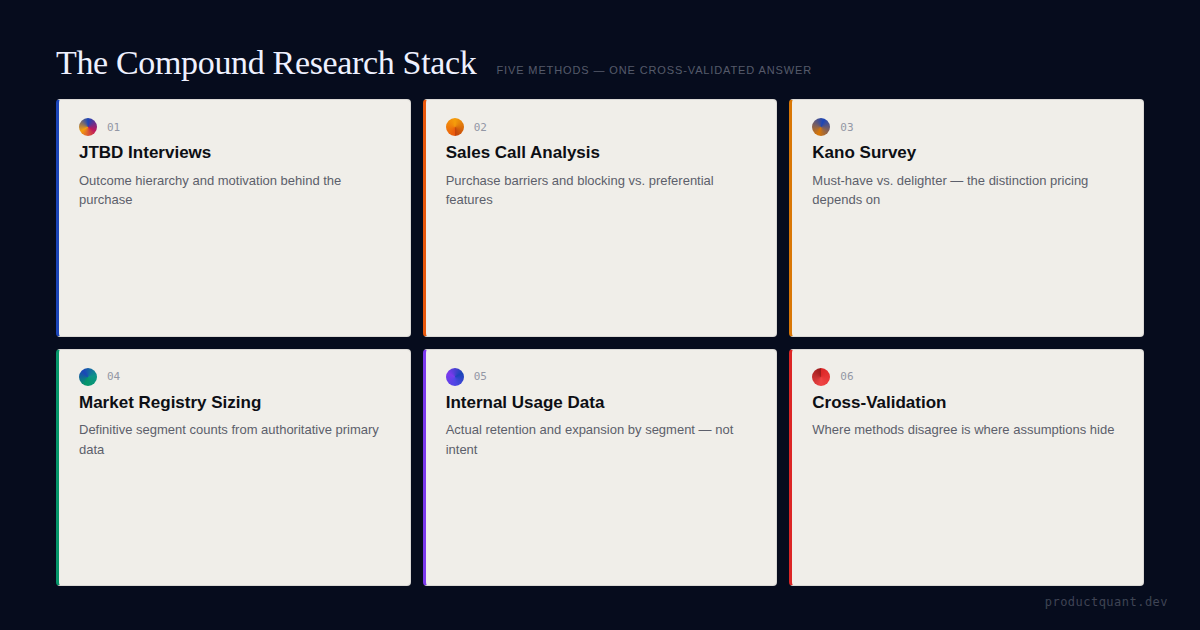
ProductQuant runs Kano analysis as part of a broader research stack — combined with JTBD interviews, sales call synthesis, and product usage data. The output covers pricing architecture, roadmap prioritisation, and positioning simultaneously. Engagements start at $9,000.
How to Run a Kano Survey and Map the Output to Your Tiers
The Kano survey is a structured instrument, not a complex one. Each feature gets 2 questions: how do you feel if the product has this feature? How do you feel if the product does not? Response options run from "I like it that way" through "I expect it that way" to "I dislike it that way." The combination of functional and dysfunctional question responses determines the Kano category. Standard survey design takes 2–3 days to field at a usable sample size. Here is the translation layer — how to move from Kano categories to tier placement decisions.
- Step 1: List every feature you currently have or are planning. Include features you consider obvious. Must-Have classification can only be confirmed empirically — assumptions about what is "table stakes" are frequently wrong in both directions. Teams regularly misclassify Must-Haves as Delighters and vice versa before running the survey.
- Step 2: Field the survey to a mix of current customers and recent churns. Churned customers often have the clearest signal on Must-Have failures — they can tell you precisely which absent feature drove their decision. Current customers on premium tiers surface Delighter reactions more clearly. Aim for 30+ responses per segment for reliable classification.
- Step 3: Classify each feature using the Kano evaluation table. The classification table is widely published and maps every combination of functional/dysfunctional response to a category. The rule of thumb: if the dysfunctional response is strongly negative (users dislike the absence), it is a Must-Have. If both responses scale together, it is Performance. If the functional response is strongly positive but the dysfunctional response is neutral, it is a Delighter.
- Step 4: Audit your current tier structure against the classification. For every tier gate you currently draw, ask whether the feature on the gated side is a Delighter, a Performance feature at tier-appropriate volume, or something else. Any gate sitting on a Must-Have is a churn risk. Any gate sitting on a Reverse attribute is a product defect that pricing cannot fix.
- Step 5: Redesign tier boundaries around Performance feature quantities. Assign Delighters to the tier where their upgrade motivation is highest — typically mid-tier, not top tier, because that is where the most natural expansion happens. Reserve the highest-impact Delighters for your most senior tier.
One structural caution: Kano categories are not permanent. A Delighter in 2024 can become a Must-Have in 2026 as the category matures and competitors standardise on it. The survey should be re-run every 18–24 months in a competitive category to catch category drift before your pricing structure falls behind market expectations and starts generating objections your sales team cannot explain.
FAQ
How many features should I include in a Kano survey?
Between 15 and 30 features is the practical range. Below 15 and you risk missing important classification nuance between similar features. Above 30 and survey fatigue degrades response quality — especially on the dysfunctional half of each pair, which is already cognitively harder for respondents than the functional half. If you have a larger feature set, run 2 surveys across different user segments rather than forcing everything into one instrument.
Can I run a Kano survey if I have a small user base?
Yes, with calibration. The statistical reliability of Kano classification improves with sample size, but useful directional signals emerge at 20–30 responses. With a small base, treat the output as hypothesis-grade rather than definitive. Prioritise the strongest Must-Have and Delighter signals — those tend to be robust even at small N — and be cautious about drawing fine distinctions within the Performance category, where classification is more sensitive to sample variance.
What if the same feature tests as different categories across different customer segments?
This is common and genuinely useful. A feature that is a Must-Have for enterprise customers but a Delighter for SMBs is telling you precisely where the natural tier line sits. Enterprise customers expect it; smaller customers are pleasantly surprised by it. That divergence is often the empirical basis for a tier distinction. Do not average across segments — keep the classification separate and let the segmented results inform packaging for each buyer type independently.
How is Kano analysis different from a standard feature prioritisation exercise?
Feature prioritisation frameworks (RICE, MoSCoW, ICE) rank features by estimated impact and effort. They do not classify features by how users emotionally experience their presence or absence. A feature can score high on a prioritisation matrix but be a Must-Have — shipping it creates satisfaction but zero expansion revenue, because users expected it anyway. Kano tells you which features earn revenue and which ones prevent churn. That distinction matters for packaging in ways standard prioritisation cannot capture.
How often should I re-run the Kano survey?
Every 18–24 months in a competitive B2B SaaS category. Kano categories shift as markets mature — features that were Delighters when your product launched can become Must-Haves once competitors standardise on them. Teams that run the survey once and treat the output as permanent find their pricing structures gradually misaligning with market expectations. The survey is fast to field; treating it as a recurring instrument rather than a one-time project is the highest-utilize use of the methodology.
Sources
- Kano, N. et al.: "Attractive quality and must-be quality" — original Kano model paper, Journal of the Japanese Society for Quality Control, 1984
- Nielsen Norman Group: "Kano Model — Understanding Customer Satisfaction" — applied methodology guide for product and UX practitioners
- OpenView Partners: "2024 SaaS Benchmarks Report" — tier structure patterns and expansion revenue data across PLG and sales-led B2B SaaS companies
- Bain & Company / Harvard Business Review: Almquist, Senior, Bloch — "The Elements of Value" — framework for classifying what drives purchase and retention decisions across product categories
- ProfitWell: "The Complete Guide to SaaS Pricing Strategy" — empirical analysis of how feature packaging decisions correlate with expansion MRR and churn rates
- beehiiv Pricing — current public plan structure, feature gating, and subscriber-based tier pricing
- beehiiv Support: "Plan types and subscriber plan tier pricing" — confirms Launch, Scale, Max, Enterprise, and active-subscriber pricing logic

About the Author
Jake McMahon is the founder of ProductQuant. He runs customer research and product analytics engagements for B2B SaaS companies at $1M–$50M ARR — combining JTBD interviews, Kano analysis, sales call synthesis, and product usage data into research stacks that inform pricing, roadmap, and positioning decisions simultaneously.
The Kano-to-pricing-tier framework in this article was developed across engagements where pricing tiers had been built on assumption rather than evidence. The pattern is consistent: teams that run the Kano survey resolve pricing debates in days that had been running for months. The output is not a list of recommended features — it is a structural map that shows which tier decisions are defensible and which ones are creating silent churn.
Related Reading
Stop guessing which features go in which tier.
If your pricing structure was designed without Kano data, some of your tier lines are in the wrong place. ProductQuant runs the full Kano analysis — combined with JTBD interviews and usage data — and delivers a feature map that informs packaging, roadmap, and positioning in one engagement.