

TL;DR
- The definition: Activation is the moment a user achieves their first instance of realized value — the Aha Moment. It is not completing a setup flow.
- The formula: Activation Rate = (Users who reached activation event ÷ Total new users) × 100.
- The industry number: ~36–37% average (Userpilot 2025; Lenny’s Newsletter survey of 500+ products). Below 25% is a structural problem.
- How to define your event: Find the behavioral event in your analytics that correlates most strongly with Month 3–6 retention. That is your activation signal.
- Why it matters: Activation is the primary leading indicator of long-term retention and revenue. Fixing it is the highest-leverage move in your funnel.
In B2B SaaS, we measure signups obsessively. But there is a metric sitting between “signed up” and “retained” that most teams either define incorrectly or don’t define at all: activation rate.
According to verified benchmarks from Userpilot’s 2025 SaaS Product Metrics Report, the average SaaS activation rate is 37.5%. Lenny’s Newsletter survey of 500+ products puts the median closer to 30%. Either way: for every 100 people who start a trial, somewhere between 60 and 70 leave before they ever experience the value your product is supposed to deliver.
Average SaaS activation rate (Userpilot 2025; Lenny’s Newsletter 500+ product survey). For most B2B SaaS products, 60–70% of trial users never reach their Aha Moment.
Defining Activation: It’s Not a Setup Metric
The most common mistake B2B SaaS teams make is confusing Setup with Activation. They are different events measuring different things.

- Setup is technical: User verified email. User uploaded a logo. User invited 3 teammates. These are administrative tasks that confirm the account exists — not that value was experienced.
- Activation is psychological: User generated their first automated report. User saved 2 hours of manual work. User received their first customer payment through the product. This is value realization.
At ProductQuant, we define activation as: a trial user achieving their first moment of realized value within your product.
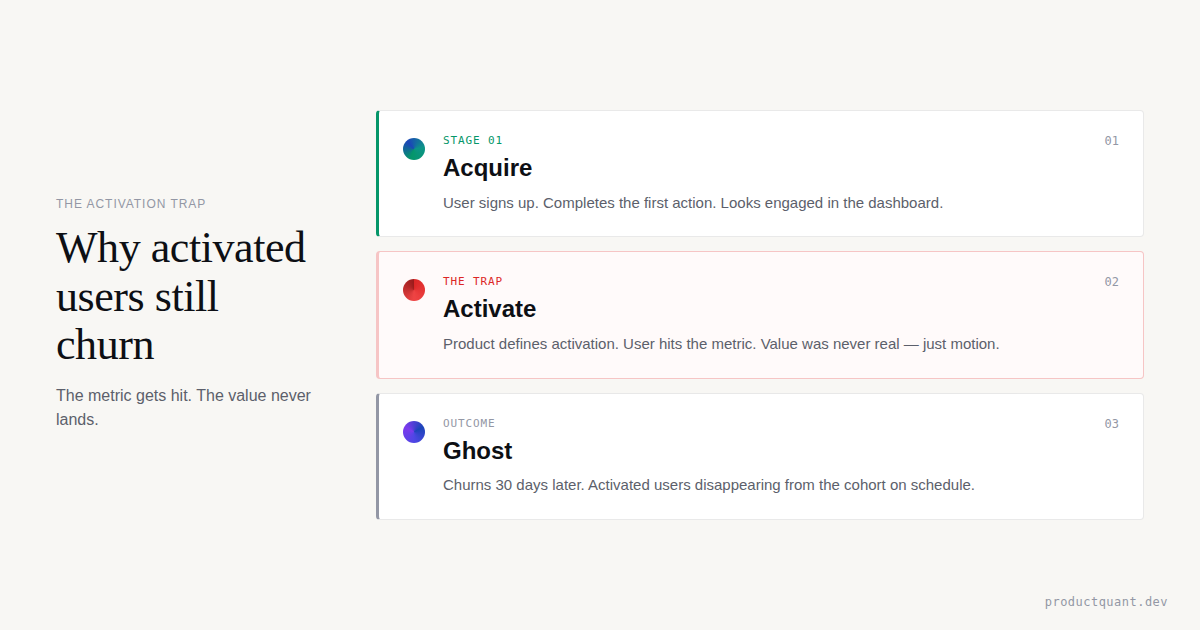
If your activation metric is “Completed Onboarding Tour,” you are tracking compliance, not value. A user can click Next through five tooltips and still have no idea why your product exists or what it does for them.
How to Calculate Activation Rate
The calculation is straightforward once you know what event you’re measuring:
Activation Rate = (375 ÷ 1,000) × 100 = 37.5%
Two variables make this calculation meaningful:
- The activation event itself — what you define as “value realized.” (More on choosing this below.)
- The time window — within how many days does a healthy user reach it? Without a time bound, the metric is too loose to act on.
Most B2B SaaS teams measure activation within the first 7–14 days of signup. Some complex enterprise products extend to 30 days. The right window is the one that reflects how quickly your best users typically reach value.
What Counts as Activation: Examples by Product Type
Activation events are product-specific. The right event for a CRM is different from the right event for an analytics tool or a support platform. Here is what the pattern looks like across common B2B SaaS categories:
| Product Type | Common Activation Event | Why It Signals Value |
|---|---|---|
| CRM / Sales | First deal created and moved to a second pipeline stage | User has mapped their real workflow into the product |
| Analytics / BI | First dashboard viewed with live connected data | User sees their own numbers, not sample data |
| Project Management | First task assigned to a team member who then completes it | Collaboration has occurred — the product is in use by the team, not just the admin |
| Email Marketing | First campaign sent to real contacts | User has imported data and taken the core action |
| Support / Helpdesk | First ticket resolved through the platform | A real customer interaction has been handled end-to-end |
| Data / ETL | First successful pipeline run with real source data | Integration is live and delivering value, not just configured |
Notice the pattern: activation events are almost always about real data, real action, real output. Sample data, test accounts, and admin setup don’t count.
Why Activation Matters: The Math of Growth
Activation is the highest-leverage metric in your funnel. It is the multiplier that either amplifies or dilutes everything you spend on acquisition.
1. The Leading Indicator of Retention
Research from Contentsquare and Userpilot confirms that activation is the primary predictor of long-term revenue. Users who find real value within their first session or first 48 hours retain at significantly higher rates than those who don’t. This is not correlation — users who experience the Aha Moment have a clear reason to come back.
The inverse is also true: users who never activate almost never convert. They expire. They churn silently. Your activation rate tells you how many of your signups ever had a real chance of becoming customers.
2. The Capital Efficiency Lever
Improving activation is more efficient than improving acquisition. If you lift your activation rate from 20% to 30%, you’ve grown your pool of genuinely engaged users by 50% without spending an extra dollar on marketing. That is a revenue multiplier, not just a product improvement.
The math compounds in the other direction too: if your activation rate is 20% and you double your marketing budget, you’ve doubled the number of people who fail to experience value. You’ve spent money to grow your ghost-town cohort.
2026 Benchmarks: Where the Industry Stands
If you don’t measure activation, you have no baseline to improve from. Here is where the industry sits, per Userpilot’s 2025 SaaS Metrics Report and Lenny’s Newsletter’s 500+ product survey:
| Metric | Industry Average | Elite (Top 10%) |
|---|---|---|
| Activation Rate | 36–37.5% | 65%+ |
| Month 1 Retention | 46.9% | 60%+ |
| Onboarding Completion | 19.2% | 45%+ |
| Time-to-First-Value | 36 hours | Minutes |
The critical insight: Onboarding completion sits at 19.2% while activation sits at 37.5%. Users are finding value despite traditional onboarding flows, not because of them. Many users skip the guided tour entirely and find the Aha Moment on their own. This means fixing your onboarding checklist is not the same as fixing your activation rate.
Find your real Aha Moment — the event that actually predicts retention.
The Onboarding Teardown Kit helps you identify the behavioral event that correlates with Month 6 retention, then trace the path users take to reach it.
How to Define Your Activation Event
This is where most teams get stuck. The activation event should not be chosen by intuition or committee. It should be identified from your data.
Step 1: Pull your retained users
Identify users who signed up 6+ months ago and are still active today. These are your best customers. What did they do in their first 7–14 days that lapsed users did not?
Step 2: Find the behavioral difference
In your analytics tool (Mixpanel, Amplitude, PostHog), compare the first-14-day event sequences of retained vs churned cohorts. Look for events where the frequency gap between the two groups is largest. That is your activation signal candidate.
Step 3: Check for causation, not just correlation
Some events correlate with retention because they indicate intent, not because they deliver value. An example: users who invite a teammate within 7 days might retain better — but is that because team use drives value, or because only serious users bother inviting teammates? Test it. Can you design an intervention that gets more users to that event? Does the retention improvement follow?
Step 4: Set a time bound
An activation event without a time window is not actionable. “User created their first report” is different from “User created their first report within 7 days of signup.” The time-bound version tells you whether your onboarding is working right now, not just eventually.
Per Lenny’s Newsletter survey, roughly 60% of companies track activation within a defined time window. The other 40% are measuring a metric that is hard to move because it has no urgency attached to it.
The ProductQuant Framework: The Milestone Ladder
We don’t view activation as a single jump. We view it as a ladder of behavioral milestones — each one reducing friction for the next:

- Connectivity: The user connects their data, integrates their tools, or imports their existing context. Without this, the product is running on sample data and the user has no skin in the game.
- Comprehension: The user understands what the product will do for them. They can articulate the problem it solves in their context — not just repeat back your marketing copy.
- Competence: The user performs the core action independently. They don’t need guidance. They could teach someone else.
Successful B2B SaaS products architect a sequence of micro-wins that make reaching the top of this ladder feel inevitable, not effortful. Each rung reduces the cognitive load required to reach the next one.
Common Activation Mistakes
Most activation problems are definitional before they are operational. The metric is broken before anyone tries to improve it.
- Treating onboarding completion as activation. Completing a checklist is not the same as experiencing value. Users who click through an onboarding tour have demonstrated compliance, not engagement.
- Setting the milestone too early. “Verified email” or “completed profile” tells you nothing about value delivery. These are identity events, not value events.
- Setting the milestone too late. If your activation event requires 30 days of regular use, you are measuring retention, not activation. The signal arrives too late to act on for new users.
- No time bound. Without a window (e.g. “within 7 days”), you cannot measure whether changes to onboarding are actually moving the metric faster.
- One definition for all personas. In B2B SaaS, a product admin and an end user reach value differently and at different speeds. Forcing a single activation event across both dilutes the signal from both.
FAQ
Is activation rate the same as conversion rate?
No. Activation is a product metric — did the user experience value? Conversion is a revenue metric — did they pay? Activation is the leading indicator of conversion. Users who reach their Aha Moment within the trial window convert at significantly higher rates than those who don’t.
What is a “good” activation rate for B2B SaaS?
For most B2B SaaS products, 35% to 45% is a healthy range. Below 25% indicates a structural problem in your onboarding or value delivery. The benchmarks vary by product complexity — see the full benchmark breakdown by industry.
How do you calculate activation rate?
Divide the number of users who reached your activation event (within your defined time window) by total new users in the same period, then multiply by 100. If 375 of 1,000 new users reach activation within 14 days, your activation rate is 37.5%.
How do you choose the right activation event?
Find the behavioral event in your analytics that correlates most strongly with Month 3 or Month 6 retention. Compare the first-14-day event sequences of your best-retained users against churned users. The event where the gap is largest is your signal. Then test whether you can design your way to more users reaching it faster.
Does AI change how activation should be measured?
Yes. AI-native onboarding is collapsing time-to-first-value from days to minutes in some products. If your activation event is still measured in days, your definition may be too broad — the product may already be delivering value faster than your metric reflects.
Next Steps: Audit Your Aha Moment
If you can’t name the specific behavioral event in your product that predicts long-term retention, you’re optimizing the wrong thing.
- Identify your retention event: Pull your retained cohorts and find the behavioral event that best separates them from churned users in the first 14 days.
- Set a time bound: Attach a window to your definition. “User created first report within 7 days” is an actionable metric. “User created a report” is not.
- Benchmark your performance: Compare your current rate against the 2026 industry medians by category.
- Design toward it: Once you know the event, ask: what is the shortest, lowest-friction path a new user can take to reach it? That is your onboarding design problem.
Free tools: Calculate your activation rate and benchmark against industry averages → Activation Rate Calculator · Map every drop-off in your funnel → Onboarding Funnel Calculator

About the Author
Jake McMahon writes about the structural layer underneath SaaS growth: activation, pricing, buyer-user alignment, retention, and the systems that connect them. ProductQuant helps teams identify the right activation event, measure it correctly, and design the path that gets more users there faster.
Related Reading


Start measuring activation, not just signups.
If you can’t identify the behavioral event in your product that predicts long-term retention, you’re optimizing the wrong stage of the funnel. The Teardown Kit helps you find it.