

TL;DR
- Activation pattern matters more than trial length. A 14-day trial can be perfect for one product and structurally wrong for another.
- There are 4 common activation patterns: instant, gradual, team-dependent, and data-dependent. Each needs a different trial and onboarding model.
- Most activation mistakes are mismatch mistakes. Teams run self-serve trials for products that need team invites, integrations, or guided setup before value exists.
- The right fix is usually design, not pressure. Change the timer, the setup path, the success metric, or the support model to match how value actually appears.
Most B2B SaaS teams treat activation like a funnel problem.
Trial-to-paid is low. So they rewrite onboarding copy. They reduce the number of setup steps. They add more reminder emails. They launch a checklist. The number moves a little, then stalls again.
The more useful question is simpler: Did the user even have a fair chance to reach value?
If the product needs real data, a configured workflow, or a few teammates before it becomes useful, then a short self-serve trial is not neutral. It is a structural mismatch. The product is being judged before it can actually demonstrate itself.
That is the activation trap. Teams keep trying to optimize conversion on top of a setup that was never designed for the product they have.
"Teams rarely have an onboarding problem in isolation. They usually have a value-timing problem the trial was never designed to handle."
— Jake McMahon, ProductQuant
This is why activation belongs next to growth motion fit and pricing model fit, not in a narrow onboarding bucket. If the product takes longer to prove itself than the trial allows, your funnel is not underperforming. It is mis-specified.
The teams that get stuck here usually have decent intent and decent UX. What they lack is an honest model of how value appears. They are optimizing session completion when the real job requires data arrival, teammate participation, or repeated use over time. That is why activation work has to start with pattern recognition rather than interface cleanup.
What Are the 4 Activation Patterns?
Activation is not "created an account" or "completed onboarding." It is the first moment the product delivers the thing it promised. That moment arrives through different mechanisms depending on the product.
1. Instant activation
A single user gets value in one session, usually without involving anyone else, importing data, or connecting infrastructure. The product proves itself quickly and the user's next question is whether they want more of it, not whether it works at all.
2. Gradual activation
A single user gets an early win quickly, but the full value arrives over multiple sessions. The product gets better as habits, content, workflows, or context accumulate. The activation event is real, but it is not the whole story.
3. Team-dependent activation
The product does not become valuable to one person alone. A champion signs up, but real value only appears once other teammates join, collaborate, or respond. In this case activation is a group event, not an individual one.
4. Data-dependent activation
The product needs live data, integrations, or configuration before it can show anything useful. The setup work is not an annoyance around the product. It is a prerequisite for the product to exist in a meaningful way.
| Pattern | What has to happen before value appears | Best-fit trial logic |
|---|---|---|
| Instant | One user completes the core action in session one | Short self-serve trial or freemium |
| Gradual | One user returns enough times for habit and context to build | Longer trial plus milestone-based nudges |
| Team-dependent | Champion gets teammates in and group behavior starts | Invite-first trial, team pilot, or delayed timer start |
| Data-dependent | Integrations, imports, or baseline data are in place | Guided pilot, seeded environment, or longer assisted trial |
The mistake is assuming one trial format can cover all 4. It cannot.
Use the activation teardown to diagnose whether your first-session path is realistic.
If the first meaningful value event takes longer than the product experience allows, the problem is upstream of email sequences and UI polish.
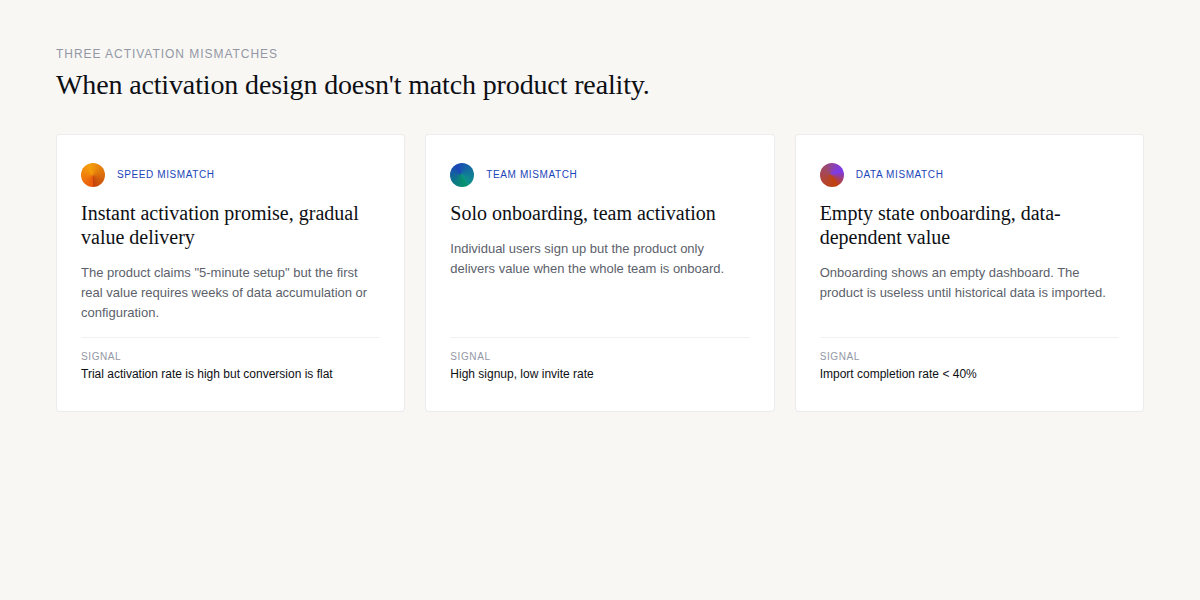
3 Activation Mismatches That Quietly Kill Conversion
The short timer on a long activation product
This is the classic mistake. A product with gradual, team-dependent, or data-dependent activation runs a standard 14-day trial because that is what SaaS products are "supposed" to do.
The number looks normal on the site. The behavior underneath it is not. Users sign up, do some of the work, and time out before the product gets a fair evaluation window. Internally, the team reads this as low conversion. In reality, many of those users never got to the point where conversion was even a reasonable question.
Self-serve onboarding on a configuration-heavy product
Some products need setup work that is genuinely non-trivial: integrations, taxonomy design, permissions, data imports, workflow mapping. If a new user lands in an empty system and is expected to figure all of that out alone, the issue is not usually motivation. It is setup burden placed in the wrong channel.
This is common in analytics, operations, compliance, and infrastructure tools. The product is useful after setup. The product experience before setup feels blank, abstract, or incomplete. That gap is where many trials die.
Single-user prompts for a team activation problem
Team-dependent products often send onboarding emails as if the champion's job is to keep logging in alone. That is the wrong job. The champion's real job is to bring the rest of the team, make the case internally, and get enough participation for the product to become real.
When the emails ignore that, they create noise instead of momentum. The better sequence gives the champion tools to invite, explain, and start a lightweight pilot. That is what actually moves activation forward.
If the setup is wrong for the activation pattern, better copy and more reminders usually just help users fail faster.
What Public Product Examples Actually Show
Public product pages and docs are useful because they reveal the setup assumptions baked into the product. You do not need to copy the company. You need to understand what their activation pattern demands.
Calendly: instant activation can tolerate short evaluation windows
Calendly's setup path is short because the value event is short: connect a calendar, share a link, book a meeting. That is a product that can support fast self-serve evaluation because the activation burden is low and the value event is obvious.
Slack and Figma: collaboration changes the activation unit
Collaboration products tell you something important immediately: the real value lives in shared behavior. Slack's channels, messaging, and workflows are not meaningful in a solo environment. Figma's real utilize appears when files are shared, reviewed, and discussed. In both cases the trial should be designed around team participation, not just individual signups.
Datadog and analytics platforms: the product is empty until data arrives
Monitoring and analytics tools make the setup dependency explicit. Datadog's getting-started flow is about installing agents and sending telemetry. Analytics tools like Mixpanel or Amplitude need event data flowing before the dashboard becomes decision-ready. That is a data-dependent activation pattern, not a standard self-serve one.
The lesson across all of these is the same: trial design should be derived from the mechanism of value, not from an arbitrary industry default.
What to Do Instead
If activation is underperforming, start by changing the structure around it.
- Redefine activation around real value. Stop using easy proxy actions if they do not predict the user getting to something useful and repeatable.
- Match the timer to the product. Instant products can use shorter self-serve windows. Gradual or data-heavy products need longer windows, assisted evaluation, or a different model entirely.
- Design onboarding for the real job to be done. If the champion needs teammates, help them invite teammates. If the user needs data, help them get data in. If configuration is required, decide whether that work belongs in self-serve at all.
- Segment pre-activation churn from post-activation churn. These are different problems. One is about getting to value. The other is about what happens after value appears.
- Tie activation back to the broader system. Use the Product DNA framework and the DISCOVER framework to look at activation alongside pricing, growth motion, and retention rather than treating it as an isolated onboarding metric.
If the problem is structural, the answer is usually to remove friction from the activation path or change the evaluation model so the product can actually demonstrate itself.
Activation problems usually need diagnosis before redesign.
The free activation teardown is the fastest way to identify whether your issue is trial length, first-session design, activation metric quality, or a deeper mismatch between product and onboarding.
What to Measure Instead of "Completed Onboarding"
One reason activation work gets stuck is that teams measure the easiest event instead of the most meaningful one. "Completed onboarding" is tidy. It is also often useless.
A better metric asks whether the user has crossed into a state where the product can now start compounding value. For an instant product that may be one completed action. For a team-dependent product it may be multiple active participants. For a data-dependent product it may be the moment real data is flowing and a first useful insight appears.
This is where activation and retention should meet. If the metric does not correlate with users sticking around, it is probably a setup milestone, not a value milestone.
- For instant products: measure the first completed value event, not just signup.
- For gradual products: measure repeated use within the first 7 to 30 days, not just one successful session.
- For team products: measure champion-to-team activation, not just individual setup completion.
- For data-dependent products: measure integration completion and first meaningful output, not merely account configuration.
The simplest test is this: if a user hits your activation metric and still has not seen a reason to come back, the metric is too early. Move it closer to real value.
How to Instrument Activation Without Lying to Yourself
Activation metrics usually fail in one of two ways. Either they are too early, which makes the funnel look healthier than it is, or they are too late, which makes teams wait too long to find friction. The goal is not one perfect event. It is a clean sequence from setup to first value to repeat value.
- Track elapsed time to first value. Not just whether users eventually get there, but how long it actually takes by activation pattern.
- Separate setup completion from value creation. Inviting teammates, importing data, and connecting tools are prerequisites. They are not value on their own.
- Measure repeat behavior after the first win. A product that gets one nice moment and then loses the user has not really solved activation.
- Review activation by pattern instead of one blended benchmark. Instant, team-dependent, and data-dependent flows should not all be judged the same way.
This is usually the point where teams discover their reported activation rate is really a setup rate. Once that becomes visible, the roadmap gets clearer. You can decide whether to change the timer, the onboarding path, the support model, or the product itself.
FAQ
Is a 14-day trial always bad for B2B SaaS?
No. It is fine for products that can clearly prove value in that window. It becomes a problem when the product needs more time, more participants, or more setup than the trial structure allows.
How do I know whether my activation metric is wrong?
If users can hit the metric and still fail to experience meaningful product value, the metric is too shallow. Activation should track the behavior that indicates the product is actually working for the user.
What is the fastest fix for a team-dependent product?
Stop treating the initial signup as the real evaluation start. Design the trial around the moment enough teammates join for the product to become useful, and give the champion tools to make that happen.
What should data-dependent products do if self-serve trials are failing?
Either extend the evaluation window, seed the environment with demonstrative data, or move the setup into a guided pilot. If the product is empty before data arrives, the trial has to account for that reality.
Sources

About the Author
Jake McMahon writes about the structural layer underneath SaaS growth: activation, pricing, buyer-user alignment, retention, and the systems that connect them. ProductQuant helps teams diagnose where value is actually supposed to appear before they spend months tuning the wrong stage of the funnel.
This article is part of the Product DNA series, which turns broad strategy questions into practical diagnostics teams can use.
Related Reading
Fix the activation path before you keep adding more trial pressure.
If your product needs more time, more teammates, or more setup than the trial allows, the right response is structural. Diagnose that first.