
TL;DR
- Per-seat pricing on a single-player product is usually flat-rate with extra billing friction.
- Usage-based pricing only works when consumption and customer value actually rise together.
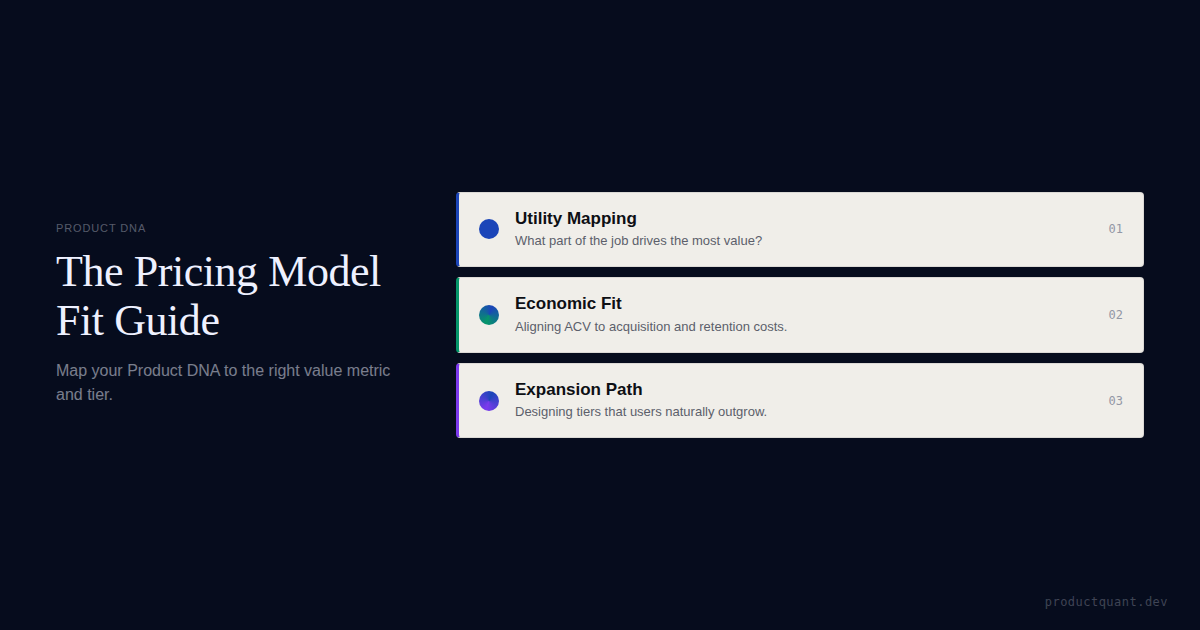
- Pricing model fit depends on 3 structural things: user topology, value metric, and buyer tolerance for complexity.
- The right fix is usually not "charge more." It is choosing a pricing unit that matches how your product expands inside an account.

Most SaaS teams talk about pricing as if the main lever is the number on the page. Should the starter plan be $29 or $49? Should annual billing get a 15% discount? Should enterprise be quote-only?
Those are surface decisions.
The deeper question is whether the pricing model matches the product at all. Per-seat, usage-based, flat-rate, tiered, hybrid. Each model assumes something specific about how value is created and how revenue should expand inside an account. If that assumption is wrong, the model quietly fights the product for years.
A single-user workflow tool copied from a per-seat SaaS leader will look normal on the pricing page and broken in the numbers. Expansion stalls. The average account never adds users. Customer success gets asked to "drive more seat growth" even though the product was never multiplayer in the first place.
"If the pricing unit and the expansion unit are different things, the model will create friction no matter how polished the page looks."
— Jake McMahon, ProductQuant
That is why pricing has to be treated as product architecture, not packaging polish. It shapes activation friction, upgrade mechanics, buyer objections, and your ceiling on expansion revenue. This is the part most teams skip when they borrow a model from a company with very different product DNA.
The operational symptoms show up quickly. Discounting starts creeping up. Sales asks for plan exceptions. Finance cannot get comfortable with forecast quality. Product starts hearing that "customers do not understand the pricing," when the deeper truth is often that the pricing model does not understand the product.
How Do You Tell If a Pricing Model Actually Fits the Product?
The fastest way to tell whether your pricing model fits is to look at 3 structural layers: who gets value, what expands, and what the buyer will tolerate. If those 3 are aligned, the pricing model feels obvious. If they are misaligned, the model turns ordinary growth into avoidable friction.
1. User topology decides whether seats make sense
If your product is naturally multiplayer, seats are a real expansion unit. A CRM, ticketing platform, or cross-functional workflow tool often gets more valuable as additional people participate. In that case, per-seat pricing matches the way adoption spreads.
If your product is effectively single-player, per-seat pricing is usually cosmetic. It implies expansion that never really comes. The account might technically have 2 or 3 users, but if one person gets almost all of the value, the seat count is not your value metric. It is just admin overhead disguised as pricing strategy.
This is the first structural test in the Product DNA framework: is value individual, team-based, or network-based? Pricing should follow that answer, not the market leader you happen to admire.
2. The pricing unit has to track the value event
Usage-based pricing can be excellent. It can also be a mess. The difference is whether the usage unit rises when customer value rises. Transactions, API calls, messages sent, and resolved conversations can all work when they are tightly connected to the outcome the customer cares about.
When the usage unit is only loosely connected to value, billing complexity rises but strategic clarity does not. Customers start asking what they are really paying for. Finance teams struggle to forecast. Sales gets pulled into explaining metering instead of value.
That is why the pricing question is not "Can we meter something?" It is "Does the billable unit move in the same direction as customer success?" If not, the model will feel clever internally and frustrating externally.
3. Buyer tolerance matters more than founders want to admit
Two models can both fit the product and still perform differently because the buyer has a different tolerance for budget uncertainty. Teams buying infrastructure, support, compliance, or finance software often need predictability. They can accept variable spend, but only if the mechanism is understandable and the upside is obvious.
This is where many hybrid models go wrong. The company is trying to capture more value, but the model becomes hard to explain in 60 seconds to a finance lead. Once that happens, deal friction moves upstream. The pricing page might still look sophisticated. The close rate says otherwise.
4. Packaging should reflect the upgrade path
Good packaging does not invent upgrade reasons. It reveals them. If a product expands through more teammates, seat growth should be visible in the model. If it expands through automation depth, admin controls, or higher-compliance workflows, those boundaries should sit in the tiers. If it expands through actual consumption, the usage unit should capture that cleanly.
When packaging ignores the real upgrade path, plans become arbitrary feature piles. The "good-better-best" ladder exists on the pricing page, but it does not map to how customers actually grow. That is when 80% of accounts bunch into one plan and nobody can explain why the middle tier exists.
Run a pricing-model audit before you rewrite the pricing page.
The right question is not whether the page copy is persuasive. It is whether the pricing unit matches user topology, upgrade triggers, and buyer constraints in the first place.
4 Public Pricing Patterns Worth Studying
The easiest way to understand pricing fit is to compare models against the products underneath them. Public pricing pages are useful here because they show what the company believes the expansion unit really is.
| Company | Pricing signal | What it assumes | What would break if you copied it blindly |
|---|---|---|---|
| Salesforce | Per-user tiers | Department rollout is a real expansion mechanic | Single-player products would inherit seat friction without real seat growth |
| Stripe | Transaction and metered revenue tools | Volume rises with customer success | Products with flat usage patterns would add forecasting pain without upside |
| Basecamp | Fixed price with unlimited users | Simplicity is a strategic advantage and expansion is not seat-led | Highly variable value products would leave too much revenue uncaptured |
| Intercom | Seat base plus outcome-based AI charge | Core platform access and AI outcomes are separate value events | Weak buyer education would make a hybrid model feel opaque and risky |
Salesforce: seats fit a team rollout product
Salesforce's CRM pricing is explicitly framed around a per-user structure. That makes sense for a product where the unit of expansion is people and teams adopting the system across a revenue organization. The model is not interesting because it is common. It is interesting because the product is actually multiplayer enough to support it.
Stripe: usage works when value and volume move together
Stripe's platform exposes both transaction pricing and usage-based billing infrastructure. That is a strong example of a product family built around measurable economic events. The important lesson is not "do usage-based." It is "charge on the thing that actually grows when the customer grows."
Basecamp: flat-rate can be a strategic position, not a compromise
Basecamp's pricing explicitly offers a fixed package with unlimited users. That tells you something important: the company is choosing simplicity as part of the product strategy. Flat-rate does cap some expansion potential. It can still be exactly right when simplicity is the thing the market is buying.
Intercom: hybrid works when each unit maps to a different value layer
Intercom's pricing separates seat-based access from Fin's outcome-based AI pricing. That is a useful pattern because it shows a hybrid model with a logic a buyer can follow. One part prices platform participation. The other prices an AI-driven outcome. If both layers are visible and forecastable, the hybrid model earns its complexity.
Public pricing pages are useful as evidence of structure, not as templates to clone. The same model that accelerates one product can quietly cap another.
What to Do Instead
If your pricing model is fighting the product, do not start by changing the number. Start by auditing the expansion logic.
- Map first value. Identify whether the product creates value for one user, a team, a workflow, or a transaction stream. That tells you what should and should not be billable.
- Name the upgrade event. What causes spend to increase in a healthy account: more users, more usage, more advanced controls, or more business-critical workflows? The model should be built around that answer.
- Stress-test buyer tolerance. Ask whether a finance lead can explain the pricing model in plain language. If not, the model may be too clever for the buying motion you actually have.
- Separate packaging from pricing unit. Tiers are useful when they map to real customer segments. They are noise when they exist only because every pricing page is expected to have 3 columns.
- Plan migration, not just launch. Model changes affect existing customers, plan positioning, and internal forecasting. Treat the shift like a product change with rollout logic, not a copy update on the site.
If you want a cleaner way to diagnose this, start with the DISCOVER framework and then narrow to pricing, activation, and expansion. Pricing rarely breaks alone. It usually breaks in combination with onboarding, packaging, and buyer-user alignment. The activation article is the natural companion when trial design and packaging problems are bleeding into each other.
Pricing problems are usually structural before they are copy problems.
The Pricing Audit is designed for teams that need a clearer model, cleaner packaging, and a stronger link between product usage and expansion revenue.
What Pricing Misfit Looks Like in the Numbers
Good pricing models make the business easier to read. Bad ones create noise, exceptions, and a lot of explanation. If you are not sure whether the model fits, look at the expansion behavior around your accounts rather than the headline price point on the page.
- Seat growth stays flat even in healthy accounts. That usually means the product is not truly multiplayer, even if the pricing assumes it is.
- Most upgrades depend on sales intervention instead of natural product expansion. Humans are creating the commercial logic that the pricing unit should have captured.
- Accounts cluster in one plan while the tier ladder gets ignored. The packaging exists, but it does not map cleanly to how customers mature.
- Finance keeps pushing for predictability that the model cannot provide. This is common when usage pricing is loosely connected to value and hard to forecast.
These signals are useful because they shift the conversation away from taste. The question stops being whether the pricing page looks modern and becomes whether the model produces clean expansion behavior inside real accounts.
FAQ
How do I know whether per-seat pricing is wrong for us?
If most accounts have 1 to 3 users and one user gets most of the product value, per-seat is probably not your real expansion mechanism. It is just how the invoice happens to be formatted.
When does usage-based pricing actually make sense?
When the billable unit is measurable, forecastable, and tightly connected to value. If the customer grows and the usage unit grows with them, the model can work. If usage is flat or loosely tied to value, it usually creates friction without upside.
Is flat-rate pricing always a bad idea because it caps expansion?
No. Flat-rate can be a deliberate strategic choice when simplicity is part of the product's appeal and the product does not naturally expand through seats or metered usage. The tradeoff just needs to be explicit.
Should we copy the pricing model used by our category leader?
Only if the product structure is genuinely similar. If the category leader has multiplayer adoption, variable consumption, or a different buyer profile, copying the model imports their assumptions without their product mechanics.
Sources

About the Author
Jake McMahon writes about the structural layer underneath SaaS growth: pricing, activation, buyer-user alignment, retention, and decision systems. ProductQuant helps teams figure out where the real constraint sits before they spend another quarter fixing the wrong lever.
This article is part of the Product DNA series, which translates strategy questions into diagnostics teams can actually use.
Related Reading
Fix the pricing model before you keep tuning the pricing page.
If the expansion mechanic is wrong, better copy will not save it. Start with the pricing unit, the upgrade trigger, and the buyer motion.