

TL;DR
- Try the self-service fundamentals first: install a product analytics tool, build 3 core dashboards, run 3 experiments, write your ICP definition, and map your customer journey. These take 2–4 weeks and cost almost nothing.
- Hire a consultant if you've done all 5 and: nothing has moved in 60–90 days, your team disagrees on priorities despite having data, you've plateaued for 2+ quarters, or investors are asking questions you can't answer.
- The biggest waste of consultant money is hiring one to install a tool. If you hire a consultant to set up PostHog and build 3 dashboards, you're paying $15K for a free tool and 8 hours of work. Install it yourself first — then hire the consultant to design the event taxonomy and build the dashboards, which is the hard part.
- The biggest waste of DIY time is persisting when you're stuck. If you've been trying to figure out your activation event for 3 months without progress, a consultant will solve it in 2 days. That's the ROI.
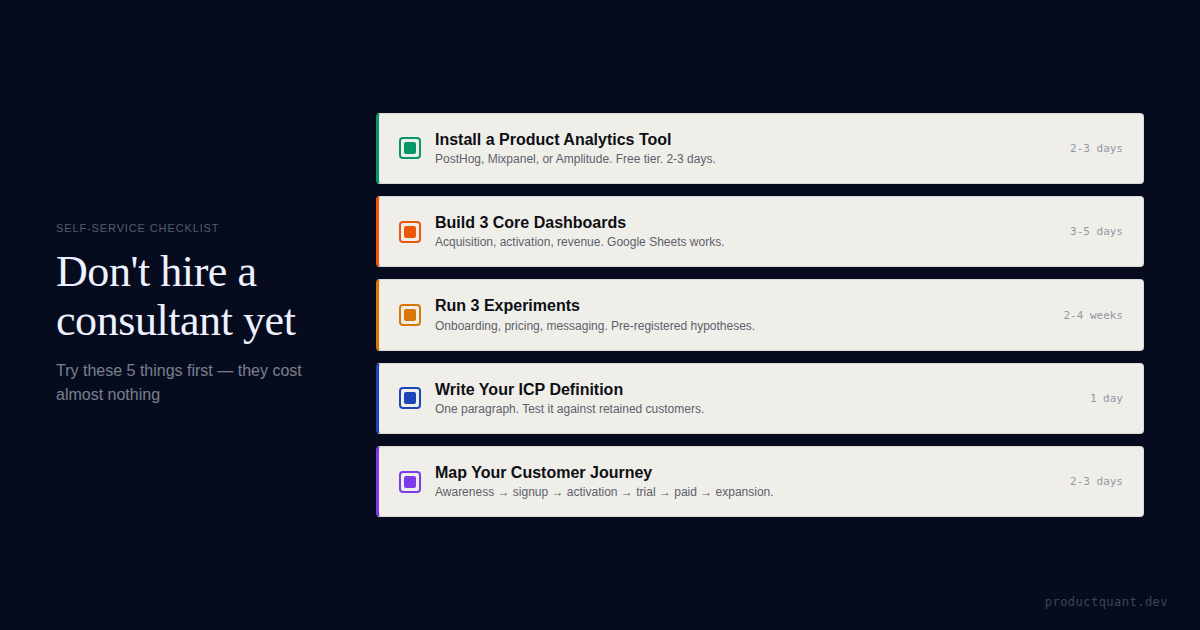
The Self-Service Checklist
Before you hire a consultant, do these 5 things. They take 2–4 weeks total and cost almost nothing. If you complete all 5 and your growth metrics improve, you didn't need a consultant — you needed to do the basics. If you complete all 5 and nothing moves, you have a deeper problem that a consultant can diagnose.
1. Install a Product Analytics Tool (2–3 days)
Install PostHog on the free tier, which gives you 1 million events per month, or Mixpanel or Amplitude, both of which have generous free tiers. PostHog is our default because it combines product analytics, session replay, feature flags, and A/B testing in one platform — the same tool stack we build in a consultant engagement. Enable autocapture and you'll start collecting pageviews, clicks, and form submissions immediately.
This gives you raw data about what users do in your product. What it doesn't give you is answers. Data without analysis is just noise. But it's the noise you need before you can find the signal. For a complete setup guide, see our PostHog beginner's guide.
2. Build 3 Core Dashboards (3–5 days)
Build these 3 dashboards from your analytics data: an acquisition dashboard that shows signups by day and week, signup source, and time to activation by source; an activation dashboard that shows activation rate by cohort, time to activation at the median and at the 75th and 90th percentiles, and feature adoption in the first 14 days; and a revenue dashboard that shows MRR by plan type, subscription upgrades and downgrades and cancellations, and expansion revenue versus contraction revenue.
These dashboards give you visibility into your growth funnel. What they don't give you is diagnosis. Dashboards show what is happening. They don't tell you why or what to do. For ready-made dashboard templates, see our PostHog dashboard templates.
3. Run 3 Experiments (2–4 weeks)
Design and run 3 A/B tests on your highest-impact growth lever. An onboarding experiment that compares a new onboarding flow against your current one, measuring activation rate. A pricing experiment that compares a new pricing page against your current one, measuring trial-to-paid conversion. And a messaging experiment that compares a new homepage headline against your current one, measuring signup rate.
Each experiment should have a pre-registered hypothesis, a calculated sample size, and a pre-agreed stopping rule. These experiments give you data on what works and what doesn't. What they don't give you is strategy. Experiments test tactics. Strategy decides which tactics to test. For a starting point, see the first 10 A/B tests every B2B SaaS should run.
4. Write Your ICP Definition (1 day)
Write a one-paragraph ICP definition that includes company size, industry, use case, budget, and the decision-maker role. Then test it: of your retained customers, what percentage match this definition? If it's below 60%, your ICP is wrong. Rewrite it.
This gives you clarity on who you're selling to. What it doesn't give you is validation from the market. Your ICP is a hypothesis until retention data confirms it. But writing it down forces you to be specific, and specificity is the first step toward accuracy.
5. Map Your Customer Journey (2–3 days)
Map the journey from first touch to revenue: awareness, signup, activation, trial, paid, and expansion. For each step, note the conversion rate and the biggest drop-off point. This gives you a visual of your growth funnel with the bottleneck identified. What it doesn't give you is the fix for the bottleneck. Knowing where the bottleneck is is half the battle. Fixing it is the other half.
If you complete all 5 items and your growth metrics improve, you didn't need a consultant. If you complete all 5 and nothing moves, you have a deeper problem — and that's when a consultant earns their keep.
The Signals That Tell You It's Time to Hire
If you've done all 5 things on the checklist and any of the following are true, it's time to hire a consultant. Each signal points to a specific type of problem that a consultant is uniquely positioned to solve.
Signal 1: No Improvement After 60–90 Days
You installed analytics, built dashboards, ran experiments, defined your ICP, and mapped your journey. But nothing has moved. Activation rate is the same. Trial-to-paid conversion is the same. NRR is the same. You're measuring, but you're not improving.
What the consultant does is diagnose why your experiments aren't moving the needle. Usually it's one of three things: the wrong metric, the wrong experiment design, or the wrong bottleneck. A consultant who has seen this pattern dozens of times can identify the issue in a day or two — something that could take your team months of trial and error.
Signal 2: Team Disagreement Despite Data
You have dashboards. You have experiment results. But your team still argues about what to do next. The data is there, but the interpretation isn't shared.
What the consultant does is provide an outside perspective that cuts through internal politics. "The data says X" is harder to argue with than "I think we should do Y." A consultant's independence is their most valuable asset in this situation — they don't have a stake in the internal debate, so they can evaluate the data objectively.
Signal 3: Two or More Quarters of Plateau
Your growth has been flat for two or more quarters. You've tried new channels, new messaging, new features. Nothing has worked. You're doing everything right and getting no results.
What the consultant does is find the blind spot — the thing your team can't see because they're too close to it. Usually it's a fundamental assumption about your ICP, your value proposition, or your pricing model that's wrong. The consultant brings pattern recognition from dozens of engagements, and they've seen this exact plateau before. They know which lever to pull.
Signal 4: Investors Are Asking Questions You Can't Answer
Your investors want to know your activation rate, your NRR, your CAC payback, and your expansion revenue. And you can't answer because the data isn't instrumented or the dashboards don't exist.
What the consultant does is build the analytics infrastructure and the investor-ready metrics dashboard in 2–4 weeks. This is a focused engagement with a clear deliverable and a clear timeline. It's the fastest way to turn "I don't know" into "here's the dashboard."
The Biggest Mistakes
The most common mistake companies make when considering a consultant is hiring one to do what their team could have done in 2 weeks. If you hire a consultant to install PostHog and build 3 dashboards, you're paying $15K for a free tool and 8 hours of work. We've seen this 12 times: a founder hires a consultant because "we need analytics help," and the consultant's first 4 weeks are spent installing a tool and building dashboards that the team could have built themselves using PostHog's free tier and publicly available dashboard templates.
The second biggest mistake is the opposite: persisting with DIY when you're clearly stuck. If you've been trying to figure out your activation event for 3 months without progress, a consultant will solve it in 2 days. That's the ROI. The self-service checklist is a diagnostic tool — it tells you whether your problem is fundamentals or something deeper. If the checklist doesn't move the needle, stop iterating and bring in a consultant.
The third mistake is hiring a consultant without a clear scope. A consultant engagement without a specific deliverable — an event taxonomy, a set of dashboards, an experiment design, a 90-day roadmap — is a conversation, not an engagement. Define the deliverable before you hire. If the consultant can't commit to a specific output, they're not the right consultant.
FAQ
How much does a consultant engagement cost relative to the self-service checklist?
The self-service checklist costs almost nothing: PostHog's free tier is $0, Google Sheets is free, the JTBD interview guide is free, and experiment design frameworks are free. Your time is the only real investment. A focused consultant engagement costs $5K–$15K for a diagnostic and $10K–$25K for implementation. The ROI calculation is simple: if the consultant saves you more than their cost through faster growth, reduced churn, or avoided mistakes, the engagement pays for itself. If you're unsure, start with the diagnostic — it's the lowest-risk way to find out.
What if we're a solo founder?
The self-service checklist is actually easier for a solo founder because there's no team alignment to manage. Install the tool, build the dashboards, run the experiments, write the ICP, map the journey — all of this is doable by one person in 2–4 weeks. If you complete the checklist and nothing moves, hire a consultant for a diagnostic. The consultant will save you months of solo trial and error.
Sources
- PostHog Documentation — Product analytics, session replay, feature flags, A/B testing.
- Mixpanel Pricing — Free tier: 1M events/month.
- Amplitude Pricing — Free tier: 50K MTUs.

Jake McMahon builds growth infrastructure for B2B SaaS companies — analytics, experimentation, and predictive modeling that turns product data into revenue decisions. He's run self-service growth frameworks across multiple engagements and connected them to consultant diagnostics. Book a diagnostic call to discuss whether you need a consultant.