
TL;DR
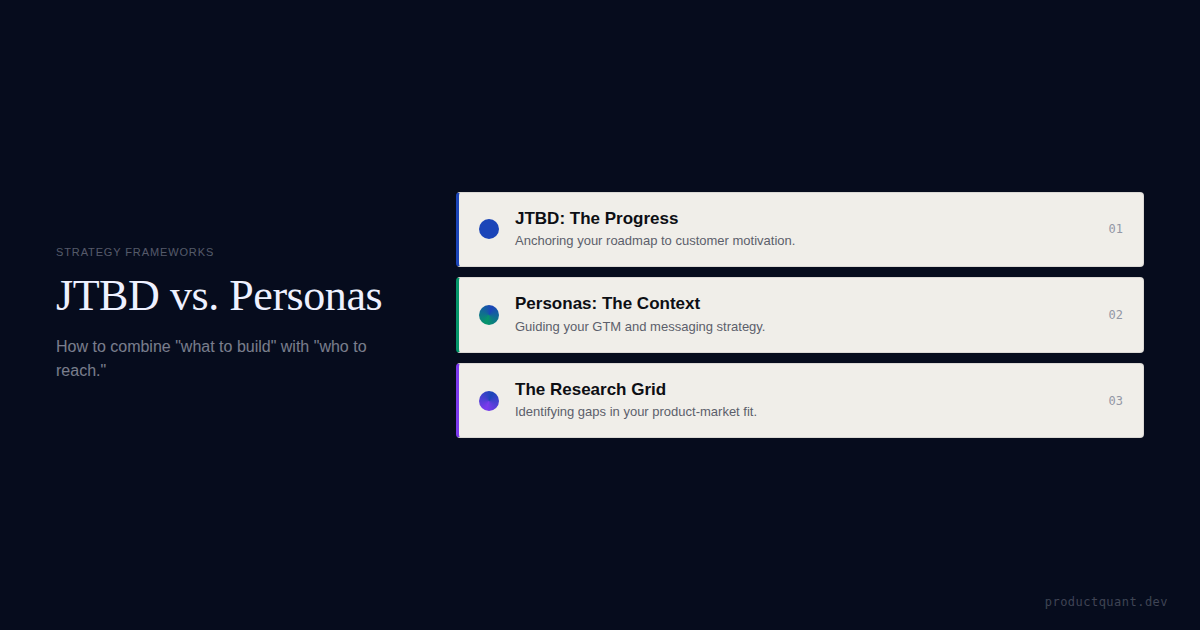
- JTBD describes what users are trying to accomplish (the progress they want to make in a specific situation). Personas describe who users are (their role, company size, goals, frustrations).
- JTBD without personas: you build the right features but position them for the wrong audience. Personas without JTBD: you position the right message but build the wrong features.
- JTBD is stable over time. The job of "compile a defensible report for the board meeting" does not change whether the user is a VP at a $50M company or a founder at a $5M company. Personas change as roles and markets evolve.
- Use JTBD for product decisions (what to build, what to prioritize, what to kill). Use personas for go-to-market decisions (how to position, which channels to use, what language to speak).
- The combined framework: start with JTBD to identify the core job. Then create personas for each segment that shares that job but has different contexts, anxieties, and decision criteria. For the complete JTBD framework, see the JTBD complete guide.
The False Debate
Two frameworks. One argument. Zero winners.
The product management world has been arguing for years: "Should we use JTBD or personas?" It is the wrong question.
JTBD answers: "What are we building?"
Personas answer: "Who are we building it for and how do we reach them?"
You would not build a product without knowing what it does (JTBD). And you would not launch a product without knowing who it is for (personas). The question is not which framework to use. It is how to use both.

The confusion comes from treating JTBD and personas as competing approaches to the same problem. They are not. They solve different problems. JTBD solves the "what should we build?" problem. Personas solve the "how do we reach the people who need it?" problem. When you use only one, you get half the picture -- and half a picture is how teams ship the wrong thing to the right audience or the right thing to nobody.
What Each Framework Does
Two frameworks. Two different problems. Let us see what each one produces.
Before combining them, it helps to see clearly what each framework produces on its own.
JTBD: The "What" Framework
JTBD describes the progress a customer is trying to make. Here is an example:
"When my board meeting is in 3 days, I want to compile our key metrics into a defensible narrative so I can answer any question the board asks."
What JTBD tells you:
- What features advance this job -- build them
- What features do not advance this job -- do not build them
- What job your product actually serves -- your core positioning
- What job your competitors serve -- your competitive map
What JTBD does not tell you:
- Who to target first (VP of Analytics or Founder?)
- What channel to reach them on (LinkedIn or conference?)
- What language resonates ("revenue intelligence" or "board-ready metrics"?)
These gaps are exactly where personas fill in.
The insight: JTBD alone tells you what to build but leaves every go-to-market decision unanswered.
Personas: The "Who" Framework
Personas describe the people who share the same job but have different contexts. Here is the key insight: the job can be identical across personas while the context, anxiety, and language are completely different.
| "Data-Driven Dana" | "Gut-Feel Gary" | |
|---|---|---|
| Role | VP of Analytics | Founder/CEO |
| Company Size | $50M ARR | $5M ARR |
| Job | Compile board-ready metrics | Compile board-ready metrics |
| Anxiety | Looking unprepared in front of the board | Looking like they do not know their numbers |
| Decision Criteria | Statistical rigor, auditability | Speed, simplicity, narrative |
| Channel | LinkedIn, industry conferences | Twitter/X, podcasts, peer referrals |
| Language | "Statistical significance," "confidence intervals" | "Story the data tells," "what the numbers mean" |
Notice: the job is the same. The context, anxiety, and language are different. This is why you need both frameworks.
What personas tell you:
- Who to target first (the segment with the most acute job and the budget to pay)
- What channel to reach them on (where they already spend time)
- What language to use (the words they use, not the words you use)
- What anxieties to address in your messaging
What personas do not tell you:
- What features to build (that is JTBD)
- What to prioritize on your roadmap (that is JTBD + Kano)
- Whether a feature request is worth building (that is JTBD -- does it advance the job?)
The insight: Personas alone produce pretty positioning for a product nobody needs.
Build personas anchored to jobs
The SaaS Persona Canvas gives you a structured way to create personas that connect directly to the jobs your customers are hiring you to do.
The Four Quadrants
Four combinations. Only one wins.
Here is what happens when you use each framework alone, both, or neither. The pattern explains why most SaaS companies are building the right thing for an audience they cannot reach.

| Has JTBD | No JTBD | |
|---|---|---|
| Has Personas | Strong. You know what to build and who to build it for. | Pretty but wrong. Great messaging for a product nobody needs. |
| No Personas | Right but invisible. Great product for an audience you cannot reach. | Lost. Building things for nobody and reaching nobody. |
Most SaaS companies are in the bottom-left quadrant: right product, invisible to the right audience. They have JTBD (they know what their retained customers are trying to accomplish) but no persona strategy (they do not know how to reach the next segment that shares the same job).
When to Use JTBD Alone
There are situations where JTBD is sufficient and personas are overhead.
- Early-stage product (under $2M ARR): You have 1 segment. The job is the only thing that matters.
- Technical infrastructure product: Your buyer and user are the same person (developer, data engineer). Personas add little beyond "senior engineer vs. junior engineer."
- Commoditized product: If your product serves a universal job with no meaningful segment variation, personas are marketing decoration, not strategic tools.
The insight: JTBD alone is sufficient when you have one segment and one buyer type. Everything else needs personas.
When Personas Matter Most
There are 3 situations where personas become critical to growth.
- Multi-segment product: Your product serves the same job for VPs, founders, and individual contributors -- but each segment has different buying criteria and budgets.
- Enterprise sales: The buyer (CFO), the user (analyst), and the champion (VP) are different people with different jobs and different personas. You need all 3.
- International expansion: The job is the same across markets, but the personas (roles, language, channels, compliance concerns) are completely different.
The insight: Every additional segment with a different buying criteria multiplies the cost of getting personas wrong.
personas is the sweet spot. More than 4 and nobody on your team can remember them. Fewer than 2 and you probably have 1 persona with a name tag rather than meaningful segmentation.
Map jobs to personas with the SaaS Persona Canvas
A structured canvas that anchors every persona to the jobs your customers are hiring you to do. Stop guessing who to build for.
How to Combine JTBD and Personas
Four steps. No shortcuts.
The combined framework works in 4 steps. Each step builds on the previous one, and the output is a product and go-to-market strategy that connects what you build to who you build it for.
Step 1: Find the Core Job (JTBD)
Run 10-15 switch interviews with retained customers. Extract the job statement that they all share. This is your core job. If you need the exact interview questions for each phase, see the JTBD interview script.
The insight: The core job is the one thing every retained customer was trying to accomplish. If you cannot find it in 15 interviews, you are looking too broadly.
Step 2: Segment by Context (Personas)
Within your retained customers, identify the segments that share the core job but have different roles and responsibilities, company sizes and stages, decision criteria and anxieties, and channels and language. Each segment becomes a persona.
The insight: Two customers with the same job but different buying criteria are two different personas. Same job, different path to purchase.
Step 3: Map Features to Jobs, Messaging to Personas
For each persona, answer 3 questions. What features does this persona need? The features that advance the core job for their specific context. How do we position these features? The language, channel, and anxiety that this persona responds to. What is the pricing this persona can afford? The price that matches their budget authority and perceived value.
The insight: The same feature can be positioned completely differently for each persona. The feature serves the job. The messaging serves the persona.
Step 4: Validate with Data
Once you have the mapping, validate it against real behavior.
- Are customers in Persona A using the features you built for their job? JTBD validated.
- Is Persona A converting at a higher rate from your messaging? Persona validated.
- Is Persona B churning faster than Persona A? Either the job is not served well for Persona B, or you are acquiring the wrong segment.
The insight: Data does not lie. If your persona mapping predicts behavior and the behavior does not match, your personas are wrong, not the data.
The most common mistake is using personas to decide what to build. "Our enterprise persona wants advanced reporting" sounds like a product decision, but it is really a positioning assumption. The JTBD question is: "Does advanced reporting advance the core job?" If the core job is "compile a defensible narrative for the board," then yes. If the core job is something else, then no -- and you just built a feature for a persona, not for the job.
For teams that want to connect this combined framework to feature prioritization, the JTBD + Kano Workshop adds ODI scoring and Kano classification on top of the JTBD-plus-personas foundation.
FAQ
Can I replace personas with JTBD?
No. JTBD tells you what to build. Personas tell you who to build it for and how to reach them. If you only have JTBD, you will build the right product for an audience you do not know how to reach.
The insight: JTBD without personas is a great product with no distribution.
Can I replace JTBD with personas?
No. Personas tell you who your customers are and how to communicate with them. If you only have personas, you will position the right message for a product with the wrong features.
The insight: Personas without JTBD is a great landing page for a product nobody needs.
How many personas should I have?
2-4. More than 4 and nobody on your team can remember them. Fewer than 2 and you probably have 1 persona with a name tag rather than meaningful segmentation.
The insight: If your team cannot name all personas from memory, you have too many.
How often should I update my personas?
Every 12-18 months. Roles change, markets evolve, and the anxieties that drove purchase decisions last year may not drive them this year. The core job, however, is stable -- update it only when you see a shift in what retained customers are trying to accomplish.
The insight: Personas expire faster than jobs. Check them every year, not every decade.
How often do jobs change?
Core jobs are stable over years, sometimes decades. The job of project management has not changed in 50 years. Only the tools have changed. What changes is the context (remote work, AI, new regulations) and the desired outcomes (faster, more accurate, more collaborative). The job itself persists.
The insight: When you think the job has changed, ask whether the context changed or the job itself. Usually it is the context.
Sources
- Nielsen Norman Group: Personas vs. Jobs-to-be-Done -- When to Use Each
- SVPG: Personas vs. Jobs to Be Done -- Product Management Perspective
- Customer Science: JTBD vs. Personas -- When to Use Each Framework
- Product Management World: Why JTBD Delivers Clearer Evidence Than Personas
- Intercom: Jobs to Be Done -- A Product Perspective

About the Author
Jake McMahon builds growth infrastructure for B2B SaaS companies -- analytics, experimentation, and predictive modeling that turns product data into revenue decisions. He has combined JTBD and persona frameworks across multiple engagements to connect product decisions to go-to-market strategy. His approach starts with JTBD to anchor what to build, then layers personas on top to determine who to build it for and how to reach them. The combination is what turns research into revenue.
The job is the anchor. The persona is the sail. You need both to move.
JTBD tells you where to point the boat. Personas tell you how to catch the wind. Start with 10 switch interviews to find your core job. Then build 2-4 personas around it. Your product and your go-to-market will finally work together.