
TL;DR
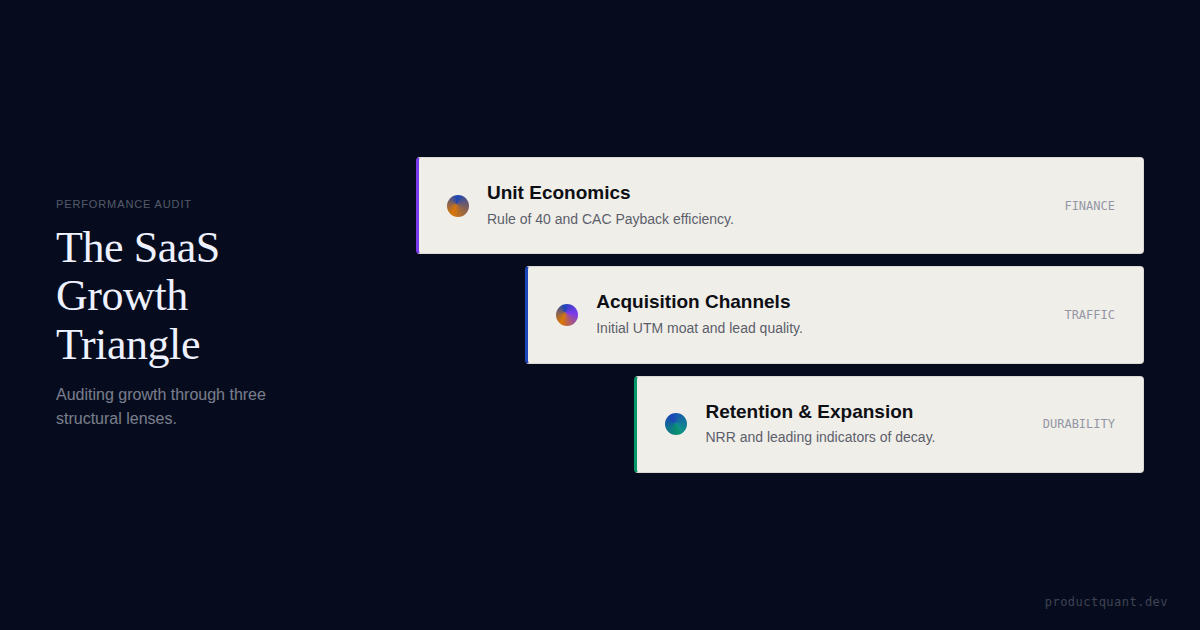
- The 'Triangle' Audit: Evaluating growth through three lenses: Financials (Rule of 40), Acquisition (LTV:CAC), and Retention (NRR).
- Rule of 40 (2026 Edition): A score of 50+ is the new benchmark for "Healthy" companies over $10M ARR.
- Activation is the Fulcrum: A 10% increase in activation has a 3x larger impact on valuation than a 10% increase in traffic.
- SaaS Sprawl: Auditing for redundant tools—the average enterprise now uses 112+ apps, creating data silos that kill growth velocity.
- Retention-First Acquisition: Shifting budget to channels with the highest 12-month NRR, not just the lowest cost-per-signup.
1. The New Era of 'Efficient Growth'
In early 2026, SaaS valuations shifted from "Growth at All Costs" to "Efficient Growth." Investors no longer care about your top-line revenue if your Efficiency Ratio is below 1.0. To win in this market, you must identify and fix the structural leaks in your growth engine before you attempt to scale.
A SaaS growth audit is a systematic review of your entire customer journey—from the first ad click to the third year of expansion revenue. This guide provides the exact 21-point checklist we use at ProductQuant to evaluate Series A-C companies, often acting as a GTM Strategy Consultant for healthcare and fintech platforms scaling to $20M+ ARR.

2. Section 1: The Financial & Metric Audit (The Triangle)
Most audits stop at "Revenue." We look at the SaaS Triangle: Gross Margin, Rule of 40, and NRR. These three numbers tell the real story of your company's health.
| Metric | The Red Flag | The 2026 Benchmark |
|---|---|---|
| Gross Margin | Below 70% | 75% - 85% (Accounting for AI costs) |
| Rule of 40 | Below 30 | Score 50+ (Growth % + Profit %) |
| NRR | Below 100% | 110% - 125% (Top quartile) |
| CAC Payback | Above 18 months | < 12 months (SMB) |
"A company with 100% growth and -60% margins is just an expensive hobby. In 2026, efficiency is the only moat that lasts."
— Jake McMahon, ProductQuant
3. Section 2: The Acquisition & Content Audit
In 2026, search intent has shifted. Users no longer click on "What is [X]" articles; they look for "How to solve [X] with [Y]" research. We audit your acquisition engine for Content-Led Growth.
The 'Initial UTM' Moat
We've found that users who first discover your product through an "Educational Pillar Page" have a 25% higher 12-month retention rate than those who discover you through a "Direct Offer" ad. Education builds a mental model of value that survives the first UI frustration. Your audit must verify that your budget is weighted toward these high-LTV channels.
By shifting 40% of the budget from broad social ads to high-intent SEO and LinkedIn ABM, we increased trial-to-paid conversion by 34% for a Series B healthcare platform.
4. Section 3: The Retention & Expansion Audit
Churn is a lagging indicator. Your audit must look for the Leading Indicators of Decay. We use PostHog to identify "Zombie Users"—people who are paying but have zero core feature usage.
Expansion Revenue Targets
In a healthy SaaS company, 40% of new ARR should come from your existing base. If you aren't hitting this, your product DNA is likely "Tool-based" (single use) rather than "Platform-based" (multi-use). We audit your pricing tiers to ensure they naturally drive "Land and Expand" motions.
5. The 2026 SaaS Growth Checklist (21 Points)
Run your company through these 21 checkpoints. Each "No" is a bottleneck that is likely costing you millions in valuation.

Financials (4 Points)
- ✅ Is your Gross Margin >75% after all cloud/AI costs?
- ✅ Is your Rule of 40 score >40?
- ✅ Is your CAC Payback <12 months for SMB or <18 months for ENT?
- ✅ Do you have a documented LTV:CAC for each primary channel?
Acquisition (6 Points)
- ✅ Are you tracking 'Initial UTM' to measure retention-by-channel?
- ✅ Does your blog feature 'Product-Led Content' (showing the product in action)?
- ✅ Is your LinkedIn ABM list updated monthly based on ICP success?
- ✅ Are you winning 'Zero-Click' search (featured snippets / AI citations)?
- ✅ Is your trial-to-paid conversion >15% (for Opt-In)?
- ✅ Do you have 'Competitive-Alternative' pages for your top 3 rivals?
Activation (5 Points)
- ✅ Is your Time-to-First-Value (TTFV) <24 hours?
- ✅ Do you have a 3-step milestone funnel instrumented in PostHog?
- ✅ Have you audited your 'Silent Failures' (UX bugs) in the last 30 days?
- ✅ Is your UI suppressed for new users based on their primary job?
- ✅ Do you use behavioral triggers (not time-based) for re-engagement?
Retention & Ops (6 Points)
- ✅ is your Net Revenue Retention (NRR) >110%?
- ✅ Do you have a behavioral health score that predicts churn 45 days out?
- ✅ Is your 'SaaS Sprawl' audited (redundant tools removed)?
- ✅ Is your CRM data synced in real-time with your product analytics?
- ✅ Do you have an automated 6-modal cancellation flow?
- ✅ Is your team running weekly 'Growth Sprints' to review the truth layer?
FAQ
How often should we run a growth audit?
A comprehensive audit should happen every 6 months. SaaS markets move too fast for annual reviews. An acquisition channel that was efficient in Q1 can become a "money pit" by Q3 due to competitor activity or ad platform shifts.
What is the most common bottleneck you find?
Activation Decay. Most companies have "Signups" but lack "Activated Users." They focus 90% of their energy on getting people in the door and only 10% on helping them find value. Flipping this ratio is the fastest way to increase valuation.
Is the 'Rule of 40' still relevant for early-stage SaaS?
Yes, but the weighting is different. For Seed/Series A, growth % is the priority. But as you hit Series B and beyond, investors expect the "Efficiency" part of the equation to balance out the burn.
Sources

About the Author
Jake McMahon is a PLG & GTM Growth Consultant who has led 50+ growth sprints for Series A-C SaaS companies. He specializes in unit economics, funnel optimization, and building the "Growth Operating Systems" required for high-efficiency scaling.