
TL;DR
- 80.3% of AI projects fail. 95% of GenAI pilots never reach production. The problem is not that teams can't build AI features. It's that they build the wrong ones — or build ones nobody trusts enough to use regularly.
- Existing frameworks (RICE, WSJF, MoSCoW) assume the feature is buildable and the approach is correct. For AI, both assumptions are frequently wrong. A feature can score high on RICE and be impossible to deliver with acceptable accuracy.
- The right question is not "which AI feature first?" It's "should this feature use AI at all?" Most teams skip this and discover 6 months later that the problem didn't need a model — it needed a better workflow.
- 62% of AI projects have user adoption below 40% in the first 6 months. Users try the feature once, shrug, and never come back. Not because the model is bad — because the integration into their workflow is bad.
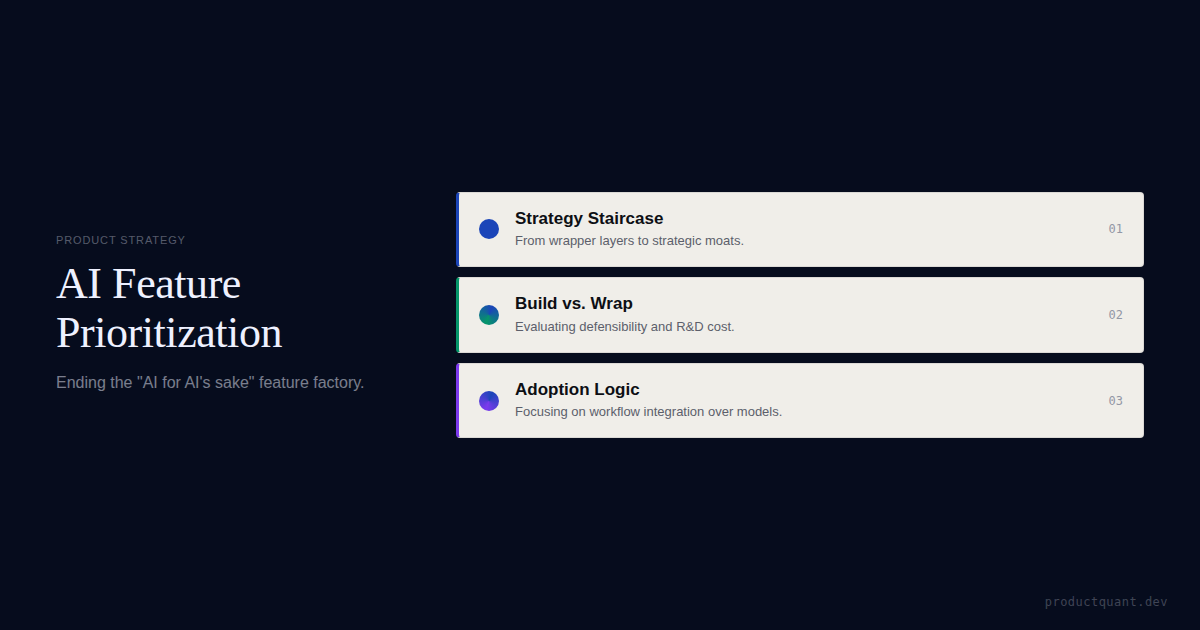
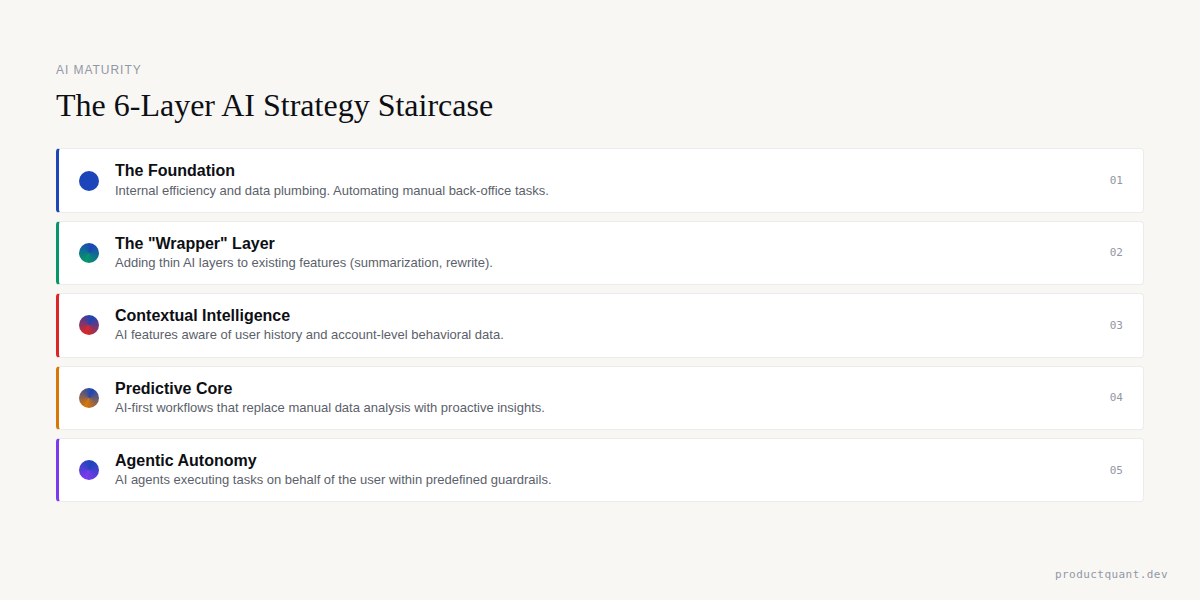
- The framework we use has 6 layers: Problem-AI Fit, Data Readiness, UX Trust, Build vs Buy vs Wrap, Competitive Moat, and ROI. A feature must pass each layer before it earns a spot on the roadmap.
- Organizations with AI-ready data reach production in 10-14 weeks. Unprepared teams take 6-18 months and scrap 46% of POCs. The data audit is not optional — it's the difference between shipping and shelving.
The AI Feature Graveyard
Every product roadmap in 2025 and 2026 has the same line item: "Add AI." Every board deck has the same slide: "Our AI Strategy." Every competitor's press release has the same phrase: "AI-powered."
And 80.3% of those projects fail.
Not "fail" as in the model didn't train. Fail as in users tried the feature once, shrugged, and never came back. The numbers are brutal when you look at them together:
- 95% of GenAI pilots never scale to production — only 5% make it, per Pertamina Partners
- 42% of companies abandoned at least one AI initiative in 2025 — up from 17% the year before, per SR Analytics
- 60% of users stop using AI apps after the first month (AI Tools Oasis)
- 62% of projects report user adoption below 40% in the first 6 months (Pertamina Partners)
- 46% of AI proofs of concept are scrapped before reaching production (SR Analytics)
The median time to failure: 13.7 months. A full year of engineering time spent on a feature nobody uses.
Existing prioritization frameworks — RICE, WSJF, MoSCoW — were designed for features where the build approach is known and the data requirements are clear. AI features don't fit those assumptions.
Why RICE, WSJF, and MoSCoW Fail for AI
Most teams prioritize features using RICE (Reach, Impact, Confidence, Effort), WSJF (Weighted Shortest Job First), or MoSCoW (Must, Should, Could, Won't). These are good frameworks for normal features. AI features are not normal features. Three specific assumptions break down.
RICE's "Confidence" Problem
RICE asks you to score "Confidence" on a scale of 50-100%. For a normal feature — "add export to CSV" — confidence is high. You know how to build CSV export. You've done it before.
For an AI feature, confidence is a guess. You're estimating how well a model will perform on data you haven't fully analyzed, to solve a problem you haven't fully scoped, using an approach you haven't validated. Scoring "confidence" at 80% for an AI feature is not data-driven — it's optimism with a number.
The insight: RICE confidence scores for AI features are guesses dressed up as data. Until you validate data readiness and approach, confidence should be capped at 50%.
The "Buildable" Assumption
Every prioritization framework assumes the feature is buildable. Put it on the roadmap, engineers build it, it ships.
AI features can be unbuildable. Not because your team lacks talent. Because your data doesn't support the use case. You need 2 years of labeled behavioral events to train a useful churn prediction model. You have 4 months of pageview data. No amount of prioritization fixes that gap.
The insight: A feature that scores high on RICE but lacks the data to support it is not a priority — it's a trap. Data readiness must be validated before roadmap commitment.
The "Right Approach" Assumption
Prioritization frameworks assume AI is the right approach for the problem. They rank AI features against other AI features. But many problems that get labeled "AI opportunities" don't need AI at all.
They need a better workflow, a clearer UI, or a rule-based automation — not a model. The teams that skip this question discover it 6 months into development.
The insight: Before ranking AI features, ask whether AI is the right tool at all. The cheapest, fastest solution is often a workflow change — not a model.
"AI adoption stalls not because the technology isn't ready, but because organizations are trying to fit AI into workflows designed for human judgment — without redesigning the workflows."
— Erin Eatough, Keith Ferrazzi, Wendy Smith, and Shonna Waters, Harvard Business Review
RICE, WSJF, and MoSCoW were built for a different problem
If your roadmap has AI features ranked by scores that assume buildable features and known data requirements, those scores are guesses. We help you replace them with a framework designed for AI.
The 6-Layer AI Prioritization Framework
Here's the framework we use with every B2B SaaS company that wants to add AI to their product. A feature must pass each layer — in order — before it earns a spot on the roadmap.
Layer 1: Problem-AI Fit — Should This Feature Use AI at All?
The question is whether this is a problem where AI creates a meaningful advantage over a rule-based alternative. If you can solve the problem with an if-then rule, a workflow change, or a clearer UI, do that instead. AI is worth the complexity only when the problem involves pattern recognition at scale, natural language understanding, prediction from multiple signals, or personalization that adapts to individual behavior.
What we score: problem complexity (does it require recognizing patterns humans can't easily codify), alternative cost (what would a non-AI solution cost), user willingness to tolerate imperfection (AI is probabilistic — if the use case requires 100% accuracy, AI is the wrong tool), and frequency of use (a feature used daily by every user justifies more investment than a feature used monthly by admins).
The most common failure mode: teams prioritize AI features that solve problems their users don't actually have. They build recommendation engines for products where users already know what they want. They build chatbots for workflows that take 3 clicks to complete.
The problem was never the interface. It was that the team wanted to say "AI-powered."
The insight: If a rule, workflow, or UI change solves the problem, AI is the wrong choice. The best AI feature is the one that didn't need to exist.
Layer 2: Data Readiness — Can We Actually Build This?
Before prioritizing any AI feature, run a data readiness assessment to check if your data meets the minimum threshold for production. This is where 46% of AI proofs of concept die — not because the algorithm is wrong, but because the training features don't exist in the real data pipeline.
Gartner predicts that 60% of AI projects lacking AI-ready data will be abandoned through 2026. AI-ready data means: aligned to specific use cases, actively governed at the asset level, supported by automated pipelines with quality gates, managed through live metadata, and continuously quality-assured. For a deeper assessment, see our ML Readiness Audit framework.
What we score: data volume (do you have enough labeled examples — minimum 6 months of event data for behavioral prediction), data quality (are the signals clean, or buried in noise and inconsistent event naming), label availability (do you know which outcomes are "good" and "bad"), data freshness (can the pipeline support real-time inference, or is it a monthly batch job), and data preparation time (61% of AI project timelines go to data prep, per Pertamina Partners).
Organizations with AI-ready data ship in 10-14 weeks. Unprepared teams take 6-18 months. The gap is not talent — it's data infrastructure.
The insight: Data readiness is the single biggest predictor of whether an AI feature ships or gets scrapped. Audit data before you commit to a build timeline.
The single biggest time sink in AI projects is not model training. It's cleaning, labeling, and structuring the data that feeds the model. If your data isn't ready, nothing else matters.
Layer 3: UX Trust — Will Users Actually Use It?
This is the layer nobody scores in their prioritization framework. And it's why 60% of users stop using AI apps after the first month. 84% of AI implementations have no consequences for users who ignore AI recommendations. If a user can skip the AI suggestion and do things the old way with no friction, they will. Every time.
What we score: explainability (can you tell the user why the AI made this recommendation — if not, trust collapses), error recovery (when the AI is wrong, can the user easily correct it, or does it break their workflow), transparency level (does the user know they're interacting with AI — hidden AI features create distrust when users discover them), and trust trajectory (high initial acceptance followed by a steep drop-off means the feature overpromised and underdelivered).
Successful AI initiatives achieve 71-73% user adoption. Failed or IT-focused projects achieve 29-34%. The difference is not model accuracy — it's whether AI was designed into the workflow or bolted onto the side of it.
The insight: Users don't abandon AI features because the model is bad — they abandon them because the integration is bad. Design for workflow fit first, accuracy second.
Layer 4: Build vs Buy vs Wrap — What's the Right Technical Bet?
The question is whether to build this from scratch, buy an API, or wrap an existing model with your own UX and data. GenAI production costs average 380% over pilot projections, and integration complexity averages 2.4× original estimates (Pertamina Partners). The build decision is not just technical — it's a budget and timeline bet.
Build means a custom model, trained on your data, optimized for your use case. Highest accuracy, highest cost, highest maintenance burden. Justified when the feature is core to your product differentiation.
Buy means a third-party API (OpenAI, Anthropic, Google) — fast to ship, pay-per-use, no model ownership. Fine for features where the API's general capability is sufficient.
Wrap means taking an existing model, adding your data layer, your UX patterns, your guardrails, your feedback loops. The sweet spot for most B2B SaaS companies.
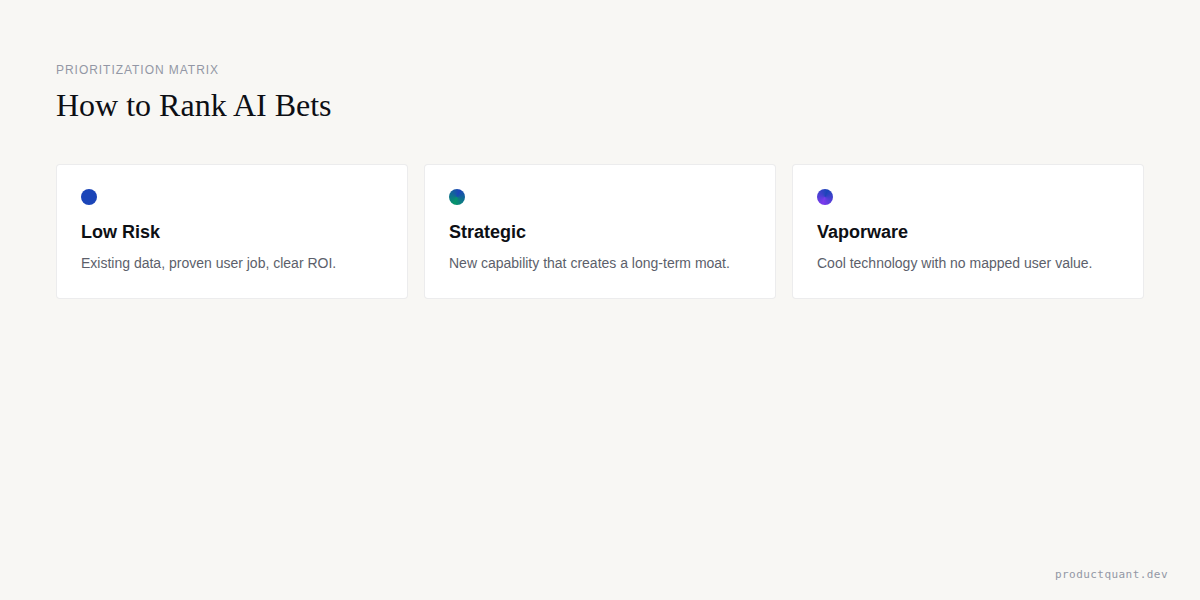
The rule: if the AI feature is not a core differentiator, buy. If it is core but the data is not unique to you, wrap. Build only when the model itself is the moat. See our AI Feature Launch guide for the full decision framework.
The insight: Most B2B SaaS companies should wrap, not build. GenAI costs average 380% over budget — the build decision is a budget bet, not just a technical one.
| Decision | When to Choose | Timeline | Cost Risk |
|---|---|---|---|
| Build | Core differentiator, unique data, high accuracy required | 4-9 months | Highest — 380% over budget avg. |
| Wrap | Core feature, shared base model, your UX layer | 6-12 weeks | Moderate — API costs scale with usage |
| Buy | Commodity feature (summarization, translation, Q&A) | 1-3 weeks | Lowest — predictable per-use pricing |
The Build vs Buy vs Wrap decision is not just a technical choice — it's a bet on budget, timeline, and maintenance burden. Most B2B SaaS companies should wrap, not build.
Layer 5: Competitive Moat — Does This Create a Defensible Advantage?
If you ship this, can competitors replicate it in 90 days? If the answer is yes — and for most API-wrapped AI features, it is — the feature is table stakes, not a moat. That doesn't mean you shouldn't build it. It means you should prioritize it differently: as a defensive necessity, not a growth driver.

What we score: data moat (does your proprietary data make the feature better than any competitor using the same base model), workflow moat (is the AI embedded in a workflow that's hard to replicate — your unique onboarding sequence, your specific integration graph), and switching cost moat (does using the AI feature create data or feedback loops that make the product stickier over time).
The pattern: most AI features are copyable in weeks. The ones that aren't copyable are the ones trained on proprietary behavioral data, embedded in unique workflows, and continuously improved through user feedback loops. The moat is not the model. It's the data flywheel.
The insight: If competitors can replicate your AI feature in 90 days, it's table stakes — not a moat. Prioritize it as a defensive necessity, not a growth driver.
Layer 6: ROI — Is It Worth the Investment?
This is where you finally apply something like RICE. But now the inputs are informed by the previous 5 layers, not guesses.
Reach (how many users will interact — Layer 1 told you frequency). Impact (what changes for the user or the business — Layer 3 told you trust trajectory). Confidence (now you can actually score this — Layers 2 and 4 told you data readiness and technical feasibility). Effort (not a guess — Layer 2 told you data prep time, Layer 4 told you build/buy/wrap cost).
The median time to AI project failure is 13.7 months. A feature that looks like a 3-month build on your roadmap takes 13.7 months on average before teams abandon it. The 6-layer framework exists to make sure you're not building the wrong thing for 13.7 months.
The insight: Now RICE inputs are informed by reality — data readiness, trust trajectory, and technical feasibility. A feature that survives all 6 layers is worth building. One that doesn't just saved you 13.7 months.
How to Apply This to Your Roadmap
Here's the practical process for running your existing roadmap through the 6-layer framework:
- List every AI feature on your roadmap. All of them. The "nice to haves" and the "board asked for this" items.
- Run each through Layer 1 (Problem-AI Fit). Kill any feature that can be solved with a rule, workflow, or UI change. This typically eliminates 30-50% of the AI backlog.
- Run survivors through Layer 2 (Data Readiness). Kill any feature where the data doesn't exist or needs 4+ months of cleanup. This eliminates another 20-30%.
- Score the remaining features on Layers 3-6. Now you have a ranked list based on real constraints, not optimism.
- Pick the top feature. Not the top 3. The top 1. Build it, ship it, measure trust trajectory, and learn before you touch the next one.
88% of companies report regular AI use, per Harvard Business Review. But employees experiment with AI tools without deeply integrating them into daily workflows. The gap between "we use AI" and "AI is embedded in how we work" is prioritization discipline.
From Problem-AI Fit to Production in 2 Weeks
We run your AI feature candidates through the 6-layer framework, kill the ones that shouldn't exist, and build a production plan for the ones that should. Fixed price: $4,997.
The Anti-Prioritization List
Some AI features fail the 6-layer test so consistently that they should be pre-flagged before you even start scoring:
- AI chatbots for simple support questions. Rule-based FAQ bots work better for structured queries. Users don't trust LLM chatbots for factual answers they can find in documentation.
- AI-generated content summaries for products with short content. If your content is under 500 words, a summary adds no value. If it's over 5,000 words, your product has a different problem.
- "Smart" recommendations for products with under 1,000 items. Recommendation engines need scale. Below 1,000 items, curated editorial picks beat algorithmic recommendations.
- AI-powered "insights" dashboards. Auto-generated charts that tell you "usage went up 12% this week" are noise. If the insight doesn't drive a specific decision, it's decoration.
None of these are bad ideas in every context. They're bad ideas when prioritized because they're AI — not because they solve a validated user problem.
FAQ
How do I know if my product needs AI or just a better workflow?
Run the Problem-AI Fit test: can you solve the user's problem with an if-then rule, a workflow redesign, or a clearer UI? If yes, start there. AI adds value when the problem requires pattern recognition at scale, natural language understanding, prediction from multiple signals, or adaptive personalization. If your problem doesn't fit those categories, AI is a solution looking for a problem.
The insight: Most "AI opportunities" are actually workflow problems. Test the rule-based alternative first — if it works, you just saved months of model development.
What's the minimum data I need to build an AI feature?
Minimum data requirements vary by use case. For behavioral prediction (churn, activation, expansion), you need minimum 6 months of labeled event data. For classification tasks, you need at least hundreds of labeled examples per category. For generative features, the data requirements are lower but the quality bar is higher — garbage in, obviously wrong out. Run a data readiness assessment before you commit to a build timeline.
The insight: The data audit should happen before the roadmap commitment, not after the pilot fails. 46% of POCs are scrapped due to data gaps discovered mid-build.
Should we build our own model or use an API?
If the AI feature is core to your product differentiation and your data is unique, build. If it's a commodity feature (summarization, translation, basic Q&A), buy. For most B2B SaaS companies, the answer is wrap: take an existing model, add your data layer, UX patterns, and guardrails. GenAI production costs average 380% over pilot projections — so budget accordingly.
The insight: Wrap is the answer for most B2B SaaS companies. Build only when the model itself is your moat — otherwise you're spending 380% over budget on something an API already does.
How do we measure if an AI feature is successful?
Not by launch day adoption. By trust trajectory: do users who try the feature in week 1 still use it in week 4, week 8, week 12? 62% of AI projects have adoption below 40% in 6 months — meaning most features get tried once and abandoned. Measure weekly active usage of the AI feature, not cumulative users who have "tried" it.
The insight: 62% of AI features get tried once and abandoned. If you're measuring cumulative "tried" instead of weekly active usage, you're measuring the wrong thing.
What's the most common mistake teams make with AI prioritization?
Putting AI features on the roadmap before assessing data readiness. 46% of AI proofs of concept are scrapped before production because teams discover data gaps mid-build, not pre-build. The data audit should happen before the roadmap commitment, not after the pilot fails.
The insight: 46% of POCs die from data gaps discovered mid-build. The data audit is the cheapest insurance you can buy against wasting 13.7 months of engineering time.
Sources
- Pertamina Partners: AI Project Failure Statistics 2026 — Complete analysis of 80.3% failure rate, 13.7-month median time to failure, and 380% cost overrun data
- SR Analytics: Why 95% of AI Projects Fail and How Data Fixes It — MIT Project NANDA findings, Gartner predictions on data readiness
- AI Tools Oasis: AI Apps Face User Retention Crisis — 60% drop-off after first month usage data
- Harvard Business Review: Why AI Adoption Stalls, According to Industry Data — 88% regular usage vs. shallow workflow integration analysis
- Statsig: Data-Driven Roadmap Frameworks — Prioritization framework comparison

About the Author
Jake McMahon builds growth infrastructure for B2B SaaS companies — analytics, experimentation, and predictive modeling that turns product data into revenue decisions. He's designed AI feature prioritization frameworks that help teams ship features users actually adopt, not just try once. His 6-layer framework has helped B2B SaaS teams eliminate 30-50% of bloated AI roadmaps before wasting engineering time on features that shouldn't exist. Get an AI Feature Launch engagement — $4,997, 2 weeks, from Problem-AI Fit to launch. Or book a diagnostic call to discuss your AI feature roadmap.
Before You Put AI on Your Roadmap, Run It Through 6 Layers
The ones that survive are worth building. The ones that don't just saved you 13.7 months. We run this assessment in 2 weeks for a fixed price of $4,997.