

TL;DR
- Product DNA is not static. As a company moves upmarket through $5M, $10M, $20M, and $50M+ ARR milestones, several structural dimensions shift at once — buyer map, activation path, pricing model, and growth motion.
- The usual pattern is the same: buyer-user map becomes more layered, activation gets phased instead of instant, pricing moves from self-serve to quote-based, and the growth motion becomes hybrid.
- Many scale problems are really misclassification problems. Teams keep running the earlier-stage playbook against a product that now serves a different buyer with a different rollout path and different buying committee.
- Reclassifying Product DNA periodically is a strategic requirement, not a branding exercise. The company that refuses to update its operating model after the context changes is the company that stalls.
The playbook that got you to $5M ARR can break at $20M.
Founders often read that as a criticism of the original model. It is usually not. The earlier motion worked because it matched the product and buyer at that stage. The later friction appears because the company's structural reality changed and the operating model did not.
That change is easy to miss because the product may look similar from the outside. The website still says PLG. The team still talks about self-serve. The onboarding still assumes one user. But procurement is entering the deals, rollout is crossing departments, security review is slowing time-to-value, and enterprise controls are starting to matter.
"The common scale trap is not abandoning the winning playbook too soon. It is keeping it long after the buyer and rollout reality have changed."
— Jake McMahon, ProductQuant
That is why Product DNA has to be reclassified over time. Otherwise teams start treating structural shifts like random execution problems. They blame the sales team, the marketing, the product — when the real issue is that the playbook no longer matches the product's actual operating context.
The data backs this up. Bessemer's Cloud 100 benchmarks show that median SaaS companies see a structural shift in buyer complexity between $10M and $20M ARR, where multi-stakeholder buying increases from roughly 20% of deals to over 60%. The buying committee grows, but most companies' playbooks do not.

Which Product DNA Dimensions Usually Change as You Scale?
Several dimensions tend to move together as companies grow into larger accounts and more complex buying environments. Understanding how each dimension shifts at each ARR milestone is the difference between reclassifying deliberately and discovering the shift after it has already caused friction.
1. Buyer-user map gets more layered
Earlier on, the buyer and user may be the same person or close enough that self-serve conversion feels clean. As account size rises, IT, finance, procurement, security, and departmental leaders enter the process. The buyer map becomes more multi-level.
At $5M ARR, the typical deal involves 1-2 stakeholders. By $20M, the buying committee expands to 4-6 people across functions. At $50M+, procurement and legal are mandatory participants, not occasional ones. The buyer map changes before the company admits it has.
The insight: the buyer map does not just add people — it adds new decision criteria. What was a product evaluation becomes a risk evaluation.
2. Growth motion becomes more hybrid
A motion that started as founder-led or product-led often needs sales-assist as the account size and buying friction increase. That does not mean the original motion failed. It means the product now serves accounts whose structural needs are different.
The shift is not all-or-nothing. Many companies at $10M-$20M ARR run a hybrid where self-serve handles smaller accounts while a light sales team supports mid-market expansion. The problem is when the team still describes itself as purely PLG while over half its new revenue comes from sales-assisted deals.
The insight: hybrid motion is not a failure of PLG. It is the natural consequence of serving accounts with different buying structures.
3. Activation gets more phased
Small-team activation can be fast. Departmental or enterprise activation often requires rollout planning, permissions, integration work, or internal training. The product may still have a fast core action, but the account-level activation path is now longer and more coordinated.
At $5M ARR, activation might mean one user completes a core action within 5 minutes. At $20M, activation means a department of 20-50 people is using the product within 30 days, with SSO configured and at least one integration connected. The definition of "activated" changes with scale.
The insight: activation is not one event. It is a sequence — individual activation first, then team activation, then organizational adoption. Most companies measure only the first and wonder why enterprise deals stall.
4. Complexity increases
As the product serves larger buyers, demands around compliance, security, data controls, admin features, and implementation quality increase. Complexity can rise even if the core product experience stays relatively clean.
ChartMogul's analysis of SaaS growth odds shows that companies moving from $1M to $10M ARR face fundamentally different operational demands than those scaling from $10M to $100M. The later stage requires infrastructure the earlier stage did not need.
The insight: complexity is not a product problem. It is a buyer requirement problem. Larger buyers demand more controls, not because they are difficult, but because their internal risk tolerance is lower.
5. Pricing becomes less self-serve
What worked as transparent self-serve packaging for smaller accounts may no longer fit procurement-heavy or contract-heavy deals. The monetization model often needs more flexibility, larger-account packaging, or quote-based structures.
Maxio's 2025 SaaS benchmark data shows that companies with purely self-serve pricing models see NDR plateau around 105-110% at the mid-market stage, while companies that introduce quote-based or tiered enterprise pricing see NDR expand to 115-130%. The pricing model ceiling is real and measurable.
The insight: pricing flexibility is not a concession to enterprise. It is a structural requirement of serving accounts with different procurement processes and budget cycles.
| DNA Dimension | At $5M ARR | At $20M ARR | At $50M+ ARR |
|---|---|---|---|
| Buyer map | Buyer ≈ user. 1-2 stakeholders. Individual decision. | Committee of 4-6. IT and finance enter. Risk assessment begins. | Procurement mandatory. Legal required. Multi-department signoff. |
| Growth motion | PLG or founder-led. Direct relationship with early adopters. | Hybrid emerging. Self-serve for small, sales-assist for mid-market. | Sales-led for enterprise. PLG becomes top-of-funnel, not full motion. |
| Activation | Individual core action in 5 minutes. Self-serve onboarding. | Department rollout: 20-50 users in 30 days. SSO + integration required. | Enterprise phased rollout: pilot, department, org-wide. 60-90 day cycles. |
| Complexity | Low operational burden. Minimal admin overhead. | Security reviews, SOC 2 requests, admin controls needed. | Compliance requirements, data residency, custom SLAs, dedicated support. |
| Pricing | Transparent self-serve. Monthly or annual. Credit card checkout. | Annual contracts. Volume discounts. Quote-based for larger accounts. | Custom enterprise agreements. Multi-year commitments. Procurement negotiation. |
The table above is not aspirational — it is descriptive. These shifts happen whether the company plans for them or not. The question is whether the operating model updates in step with the structural reality, or whether the company discovers the gap after deals start stalling.
What Does This Look Like in Practice?
Public examples make the pattern easier to see. Slack's early adoption path was deeply product-led: one team starts, invites others, and experiences value quickly. As the company moved upmarket, enterprise buying introduced security review, multi-department rollout, and procurement complexity. The product did not stop being product-led in origin. But the account-level motion became more hybrid.
Atlassian shows a similar shift. The famous "no sales" period fit an earlier account profile and earlier commercial environment. As the company expanded into larger organizations, the buyer environment changed. The later motion needed more enterprise support, even though the original self-serve DNA still mattered.
Zoom also followed this path. Free meetings and low-friction product experience drove widespread adoption. Later expansion into larger, more complex offerings and environments increased the need for sales-assist and broader organizational buying support.
of deals at $20M+ ARR involve 4+ stakeholders, compared to roughly 20% at the $5M stage. The buying committee grows faster than the product team expects.
The common mistake is binary thinking. Teams ask whether they are "still PLG" or "now enterprise." The better question is which dimensions have shifted enough to require a new operating model.
Not sure whether your Product DNA has shifted?
A 10-minute audit can reveal whether your buyer reality has diverged from your team's playbook. Most companies at $10M-$20M ARR discover at least two dimensions that have already changed.
The insight: most teams suspect the shift before they name it. The audit just confirms what the deal data already shows.
That is also why internal confusion rises during scale. Marketing writes to the original adopter. Sales talks to the new buyer. Product splits the roadmap between simplicity and enterprise demands. Leadership says the company is one thing while the operating signals show something else.
Periodic reclassification cuts through that confusion. It lets the company admit that it now serves different layers of demand than it did 18 or 24 months earlier.
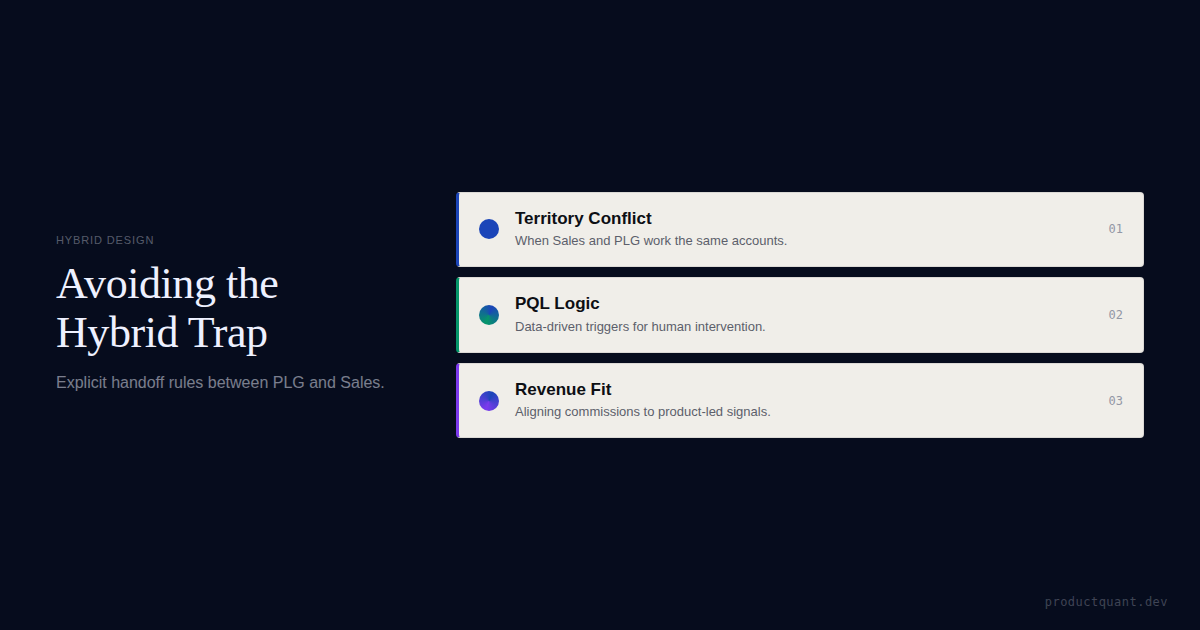
The Hybrid Motion Trap
Most companies at $10M-$20M ARR are running a hybrid model without naming it. That unnamed state creates friction across every team — marketing, sales, product, and support.
The insight: naming the hybrid motion is the first step to designing it intentionally instead of tripping over it.
What Should You Do Instead?
Reclassify Product DNA at meaningful growth stages. That does not require a giant rebrand. It requires an honest review of what has shifted in the buyer, rollout, and monetization reality.
The pattern that separates companies that scale cleanly from those that stall is not product quality. It is willingness to update the operating model when the structural reality changes.
Two anonymized patterns from ProductQuant's work
Company A reclassified at $12M ARR. They identified that their buyer map had shifted from individual self-serve to a 4-person committee including IT and finance. They redesigned their trial flow to support multi-user evaluation, added security documentation to their sales support assets, and introduced quote-based pricing for accounts over 50 seats. Within 6 months, their NDR moved from 108% to 122%. The product did not change. The operating model did.
Company B did not reclassify until $25M ARR. They kept running their self-serve playbook while enterprise deals required procurement, security review, and phased rollout. The result was 6-month sales cycles that everyone blamed on "enterprise sales being slow," when the actual issue was that the trial, onboarding, and pricing were all designed for a buyer that no longer existed. Reclassification finally happened after a board review revealed that 70% of stalled deals had stalled at the procurement stage — not the product evaluation stage.
The insight: the cost of not reclassifying is not a branding problem. It is a revenue problem — measured in stalled deals, extended sales cycles, and NDR that plateaus below target.
The practical reclassification process
The practical reclassification process is straightforward:
- Audit the current buyer map. Who actually signs off on deals now? Not who signed off 18 months ago — who signs off today.
- Map the activation path for the largest accounts. Not the fastest individual activation — the full organizational rollout sequence.
- Compare pricing flexibility to buyer requirements. Can the largest accounts buy the way they need to buy, or does procurement have to negotiate every deal?
- Update the operating model to match reality. Rewrite handoff rules. Redesign trial and onboarding around the later-stage activation path. Adjust packaging and sales-support assets.
The insight: reclassification is not an annual planning exercise. It is a structural response to a changed operating context — and the companies that do it early scale faster because they stop fighting the reality of their buyer.
Treat the scale shift as a structural change rather than a temporary friction patch.
The practical rule is simple: do not keep running the earlier-stage playbook just because it once worked. Reclassify the product as the product's buyer reality changes.

FAQ
Does changing Product DNA mean the company failed at its original motion?
No. It usually means the company succeeded into a new operating context. The earlier motion fit the earlier stage. The problem starts when the company refuses to update the playbook after the context changes.
How often should Product DNA be reclassified?
At least when the company meaningfully changes segment, ACV, rollout model, or growth motion. It does not need to happen every quarter, but it should happen whenever account reality starts diverging from the existing strategy narrative.
Can a company stay product-led as it scales?
Yes, but product-led often becomes product-led plus sales-assist, not pure self-serve end to end. The origin of adoption may still be PLG while the account expansion path becomes more complex.
What is the clearest warning sign that the DNA has shifted?
When procurement, security, admin requirements, or phased rollout start showing up repeatedly in deals, but the team is still operating as if individual self-serve conversion is the whole motion.
Sources
- Bessemer: Cloud 100 Benchmarks Report
- ChartMogul: SaaS Growth — The Odds of Making It
- Rework: SaaS Growth Stages
- BloomVP: Scaling SaaS from $1M to $20M and Overcoming
- Maxio: 2025 SaaS Benchmark Report Trends
- Eagle Rock CFO: SaaS Finance Metrics Benchmarks
- Run a Product DNA Audit in 10 Minutes
- The Hybrid Motion Trap

About the Author
Jake McMahon writes about Product DNA, scale transitions, and the structural reasons strong earlier-stage playbooks fail at later milestones. At ProductQuant, he has reclassified the operating models of B2B SaaS companies across $5M-$50M ARR, identifying where the buyer reality diverged from the team's playbook. His work focuses on helping teams name the shift they are already in and redesign their growth system around it.
Related Reading

If the old playbook is slowing down, reclassify the product before fixing the funnel.
Many scale-stage problems are really Product DNA drift. Start with the product structure, then redesign the growth system around the current buyer reality.