
TL;DR
- NDR is partly hardcoded. Different expansion models create different natural ranges.
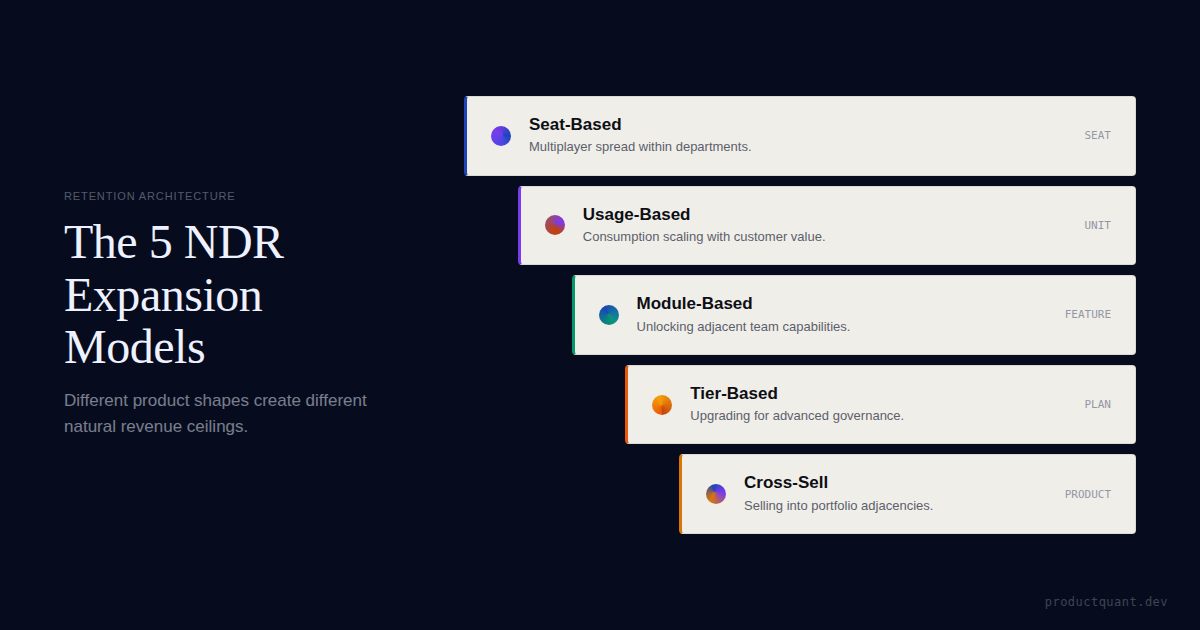
- Seat, usage, module, tier, and cross-sell expansion are not interchangeable.
- If the ceiling is structural, execution alone will not close the gap.
- The right question is: what expansion model does the product actually support today?
Your NDR target can be unrealistic even if your team is competent.
That sounds uncomfortable because NDR is often treated like a pure execution score. Push sales harder. Improve lifecycle campaigns.
Build better playbooks. But those fixes only go so far if the product itself does not contain the right expansion mechanic.
A seat-based product , a usage-based infrastructure product , a modular platform , and a tier-upgrade workflow tool do not share the same natural expansion profile. Expecting them to land in the same range is a category mistake.
"A world-class sales team cannot squeeze 130% NDR out of a single-player utility tool. The ceiling was set before the first quota was assigned."
— Jake McMahon, ProductQuant
This is why Dimension 9 of Product DNA matters so much. If the company is aiming at a retention or expansion benchmark that belongs to a different expansion model , the problem may not be revenue leadership at all. It may be that the product has a different ceiling than the dashboard assumes.
The 5 Expansion Models and Their Natural Ranges
The simplest way to diagnose NDR expectations is to ask how revenue is supposed to grow after the first purchase . Based on 2025 benchmarks from Maxio and High Alpha, the natural ceiling for expansion is rarely a result of sales grit alone—it is a function of the product's node structure .
1. Seat-based expansion
The insight: seat expansion has a hard ceiling — the relevant org size. Once every relevant role has a seat, NDR growth stops unless you cross into adjacent departments.
Slack is the canonical example. Their pricing page charges per active user, and their expansion is tied to the viral spread of the product within a company. Every time a new department is invited to a workspace, NDR rises automatically. Their ceiling is simply the total employee count of their customers.
The ceiling here is the relevant organization size . If you sell a tool for DevOps engineers, your expansion stops when you run out of DevOps engineers in that company. Strategic growth in this model requires crossing into adjacent departments — from Engineering to Product, from Product to Design.
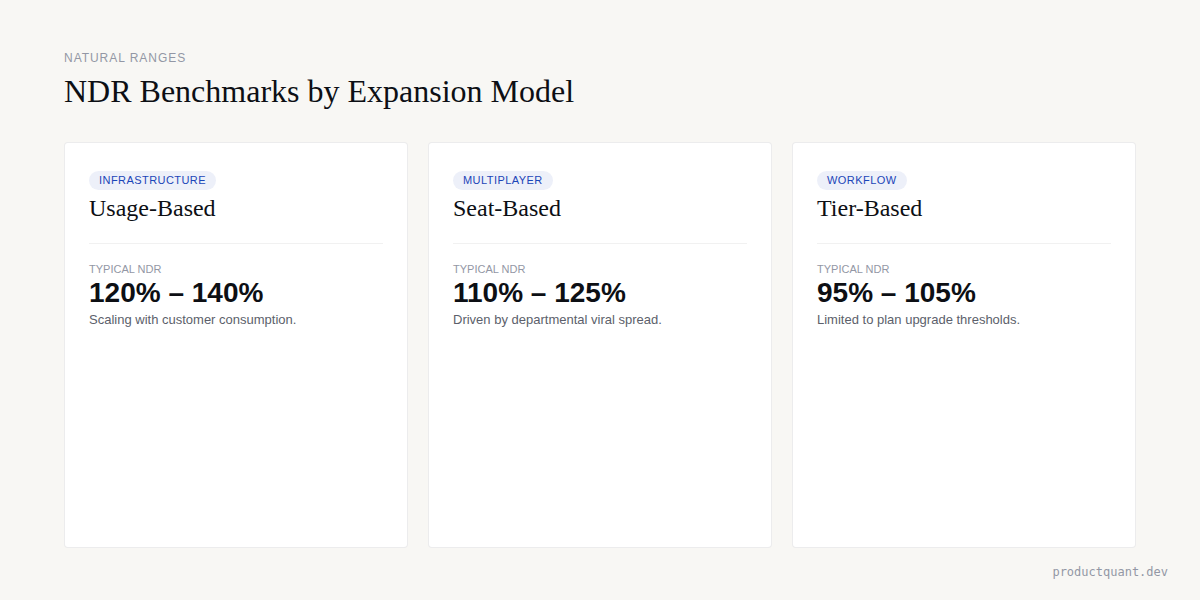
Natural Range: 110 % – 125 % . SaaS Capital's 2025 benchmark of over 1,000 private SaaS companies found median NRR at 104 %, with the 90th percentile reaching 118 %. Seat-based products typically land in the middle of this range because expansion is bounded by the relevant organization size.
Revenue rises as more relevant people adopt the product inside the account. This usually fits multiplayer products where each added user creates additional value.
2. Usage-based expansion
The insight: usage-based expansion scales with the customer's own growth, not with your sales team's effort. That is the structural advantage.
According to a16z's analysis of usage-based pricing with operators from Fivetran and Alchemy, the model becomes more predictable over time than traditional seat-based SaaS — once the right processes and infrastructure are in place. The key is building the forecasting discipline that matches the consumption pattern.
Twilio charges per API call or message. If a Twilio customer grows from 1,000 to 1,000,000 users, Twilio's revenue grows by 1,000 x without a single sales interaction. This is why usage models often report NDR north of 140 %.
Maxio's 2025 benchmark found that 73 % of SaaS companies with usage-based models actively forecast variable revenue for financial predictability. That is not a coincidence — usage-based companies treat expansion as an operational system, not a sales motion. The same report found that expansion ARR now accounts for 40 % of total new ARR, up from just 25 % in 2022. The dependency on existing-customer growth has doubled in two years.
Natural Range: 120 % – 140 % . This model has the highest ceiling because it scales with the customer's own success . As their volume increases, your revenue increases without a single "upsell" conversation.
Revenue rises as customers consume more. This fits best when value and usage scale together and usage varies materially across customers.
3. Module or feature expansion
The insight: module expansion runway is directly proportional to platform depth. One module means binary expansion. 10 modules means 10 years.
This model relies on a "Land and Expand" motion where the initial entry point is purposely narrow. The risk is that if the first module does not deliver obvious value, the expansion runway never opens.
Salesforce is the archetype. Their "Core Cloud" strategy lands with Sales Cloud, then expands into Service Cloud, Marketing Cloud, Commerce Cloud, and Tableau. Each module targets a different budget holder inside the same enterprise.
The expansion is driven by organizational footprint, not seat count. High Alpha's 2024 benchmark of 800+ SaaS companies found that 76% of founders report go-to-market as their top concern — and module expansion is fundamentally a GTM coordination problem, not a product problem.
Natural Range: 115 % – 130 % . The ceiling is the depth of the platform . If you only have one module, your expansion is binary. If you have 10 modules, you have 10 years of expansion runway.
Revenue rises when additional teams or stakeholders need adjacent capabilities. This is common in platform-style products serving multiple workflows or user types.
4. Tier-based expansion
The insight: tier-based expansion is a one-time event per customer. Without a secondary lever, the ceiling is the top tier.
This is the model with the lowest natural ceiling. The Maxio benchmark data shows tier-based products typically land around 102 % median NDR — barely above flat. If your board expects 120 % from a tier-based product, they are asking for a different product.
Zoom is the clearest example. While Zoom has seats, a huge portion of their expansion comes from moving companies from "Pro" to "Business" or "Enterprise" to access SSO, recording storage, and admin controls. Their ceiling is reached once the entire company is on the top tier. After that, the only expansion lever is headcount growth at the customer.
Natural Range: 95 % – 105 % . Because upgrades are often gated by governance or security needs — the "Enterprise" tier — they tend to be one-time events. Once a customer hits the top tier, expansion stops unless you have a secondary lever like seats or usage.
Revenue rises when customers move from one plan level to a higher one. This works when the value boundaries between tiers are clear and meaningful.
5. Cross-sell expansion
The insight: cross-sell only works as an expansion model when the products share a platform. Otherwise you are just selling two products, not expanding one.
Maxio's 2025 pricing trends report found that companies using hybrid models — combining subscription with usage or module add-ons — report the highest median growth rate at 21 %. Cross-sell works best when it is part of a hybrid motion, not a standalone strategy. The products must share a platform, a buyer, and a data layer.
Natural Range: 110 % – 120 % . This is common in mature enterprise suites. The ceiling is the breadth of the portfolio . The challenge here is maintainable integration — if the products don't talk to each other, the cross-sell feels like a new sale every time.
Revenue rises by selling adjacent products to an existing buyer. This usually requires a stronger platform or portfolio dynamic than a single-product business has.
| Expansion model | What it depends on | Typical natural ceiling | 2025 Benchmark (Maxio) |
|---|---|---|---|
| Seat-based | Multiplayer topology and org size | Higher when departments spread | 112% Median |
| Usage-based | Value scaling with consumption | High when customer growth scales spend | 128% Median |
| Module-based | Platform depth and adjacent needs | Moderate to high depending on depth | 118% Median |
| Tier-based | Clear plan boundaries | Usually lower; upgrade-limited | 102% Median |
| Cross-sell | Portfolio fit and shared buyer | Strong when suite integration is real | 114% Median |
Expansion ARR now accounts for 40% of total new ARR, up from 25% in 2022. The dependency on existing-customer growth has doubled in two years. (Maxio 2025 Benchmark Report)
Expansion problems often start as product-shape problems.
The pricing audit is useful when the team is debating NDR targets, expansion levers, or whether the current model can support the board's expectations.
The insight: expansion problems often start as product-shape problems. — the key is aligning expansion expectations to the product's actual structure.
What the Ceiling Looks Like in Practice: 4 Case Examples
Public pricing pages reveal the structural bets companies have made on their expansion models. Analyzing these helps separate "growth hacks" from revenue architecture.
After that, the only expansion lever is headcount growth at the customer. This is why Zoom had to build adjacent products (Zoom Phone, Zoom Rooms) to create new expansion vectors. A pure tier-based model runs out of runway.
While Zoom has seats, a huge portion of their expansion comes from moving companies from "Pro" to "Business" or "Enterprise" to access SSO, recording storage, and admin controls. Their ceiling is reached once the entire company is on the top tier.
Zoom (Tier-Based)
This is the "land and expand" playbook at its most mature. The risk is that if the first module does not deliver obvious value, the expansion runway never opens. High Alpha's 2024 benchmark found that 76 % of founders report go-to-market as their top concern — and module expansion is fundamentally a GTM coordination problem.
Salesforce uses a "Core Cloud" strategy. They land with Sales Cloud, then expand into Service Cloud, Marketing Cloud, Commerce Cloud, and Tableau. Each module targets a different budget holder inside the same enterprise. Their expansion is driven by organizational footprint , not seat count.
The insight: tier-based expansion hits a wall when every customer reaches the top tier. You need adjacent products to create new expansion vectors.
Salesforce (Module-Based)
This is why usage models often report NDR north of 140 %. The customer's growth becomes your growth. According to a16z's analysis with Fivetran and Alchemy operators, usage-based pricing becomes more predictable over time than seat-based SaaS — but only when the right forecasting infrastructure is in place. Without it, the revenue swings are brutal.
Twilio charges per API call, per message, per minute. Their expansion is tied to the success of their customers' products . If a Twilio customer grows from 1,000 to 1,000,000 users, Twilio's revenue grows by 1,000 x without a single sales interaction.
The insight: module expansion is a GTM coordination problem, not a product problem. Each new module needs a different budget holder.
Twilio (Usage-Based)
The seat-based model works for Slack because the product is inherently multiplayer. Every message, every channel, every integration creates network effects that pull in more users. But once every relevant person in the organization has a seat, the expansion stops.
Slack's pricing page charges per active user. Their expansion is tied to the viral spread of the product within a company. By charging per seat, they ensure that every time a new department is invited to a workspace, NDR rises automatically. Their ceiling is simply the total employee count of their customers.
The insight: usage-based pricing turns your customer's growth into your revenue — but only if you build the forecasting infrastructure to match.
Slack (Seat-Based)

The insight: every public pricing page tells you the expansion bet the company has made. Read the pricing structure, not the marketing copy around it.
If the expansion model is weak, better playbooks only improve performance inside a limited range. They do not create a new range by themselves. A world-class sales team cannot squeeze 130% NDR out of a single-player utility tool.
What to Do Instead
If the expansion target feels detached from reality, audit the model before blaming the team.
- Name the true expansion mechanic. Do not assume the current pricing page reflects the real account-growth pattern.
- Check whether the product supports the target range. A tier-based product should not be treated like a usage-based infrastructure business without evidence.
- Separate execution from structure. If the model is strong and the numbers are weak, fix execution. If the model is weak, discuss product change.
- Make the board conversation explicit. If leadership wants a higher NDR range, tie that ambition to a product roadmap, not just a sales mandate.
The most honest framing is simple: our current Product DNA supports this expansion model, which implies roughly this range. If we want more than that, we need a different product shape.
That distinction matters operationally because teams otherwise keep trying to squeeze structural change out of quarterly tactics. Customer success gets pushed to find more seats where there are no natural collaborators. Sales gets pushed to upsell plans whose boundaries do not map to a real change in value.
Product gets asked for "expansion levers" when the actual missing ingredient is a broader workflow footprint or a new user group. A cleaner model read prevents all three functions from compensating for the same structural limit in different ways.
Expansion debates get easier once the product model is visible.
If NDR targets, pricing changes, and board pressure are all getting mixed together, start with the structural read before changing the playbook.
The insight: expansion debates get easier once the product model is visible. — the key is aligning expansion expectations to the product's actual structure.
The Boardroom Trap: Target vs. Structure Misalignment
Board pressure often turns this issue into a morale problem when it is really a classification problem . If a board sees a report showing that top-quartile SaaS companies hit 120% NDR, they may set that as the target for their portfolio company. However, if that company is a single-player workflow tool with a 105% natural ceiling, the team is set up to fail.
SaaS Capital's survey of 1,000+ private SaaS companies shows that bootstrapped companies in the $3M to $20M ARR range have a median NRR of 104 %, with the 90th percentile at 118 %. These companies are not burning cash to chase expansion targets. They are growing within their structural ceiling.
The High Alpha 2024 benchmark of 800+ SaaS companies found that 47 % of companies raised capital in the prior 12 months, up from 37 %. When capital becomes available, boards tend to reset targets upward. But if the expansion model hasn't changed, the target is disconnected from reality.
Maxio's 2025 benchmark data makes this gap visible. B2B SaaS companies planned to grow at 35 % in 2025 (median), but the actual median growth rate in 2024 was 26 % — a 9 percentage point gap. Companies that budget for higher growth than their expansion model can support end up burning cash on sales capacity that the product cannot monetize.
How to spot structural misalignment:
- The "One-and-Done" Pattern: Your upsell happens in month 3, and then revenue stays flat for the next 3 years. This indicates a tier-based ceiling.
- The ACV Convergence: Your expansion revenue only brings small accounts up to your average account size, but never takes average accounts into the "large" category.
- The Seat Satiation: You have 90% seat penetration in your target department, but no roadmap to move into the next department.
The cleaner conversation is: what expansion model do we have now, what ceiling does that imply, and what product change would be required to shift into a different model? That turns an emotional target discussion into a strategic one. If the board wants 130%, they need to fund the modules or the usage-based infrastructure required to get there.
The insight: if the expansion model is weak, better playbooks only improve performance inside a limited range. They do not create a new range.
Case Study: The $10M ARR Plateau
A B2B SaaS company in the project management space hit a plateau at $10M ARR. Churn was low (under 5% annually), but NDR was stuck at 102%. The board was pushing for 115%, citing "top-quartile" benchmarks for their revenue range.
The team tried every execution playbook: specialized expansion reps, automated email triggers for seat growth, and a "Customer Success" bonus tied to upsells. Nothing worked. The NDR refused to move.
The DNA Analysis: The product was a single-player workflow tool that individuals used to manage their own tasks. It had no collaboration features (no @mentions, no shared boards, no permissions). By charging per seat, the company was using a multiplayer pricing model for a single-player product.
The Fix: The company stopped trying to "force" seat growth. Instead, they built two modular add-ons : a reporting dashboard for managers and a security/compliance module for enterprise IT. They shifted from a seat-based model to a module-based model . Within 12 months, NDR rose to 114% because they finally gave customers a structural reason to pay more.
The lesson is not that the team failed. It is that they were trying to hit a 90th-percentile number with a 50th-percentile expansion model . No amount of sales playbook optimization closes that gap. The product shape had to change.
The Benchmark Context: SaaS Capital's 2025 data shows that bootstrapped companies at this revenue range have a median NRR of 104 %. The company was at 102 % — essentially at the median for their peer group. The board's 115 % target was closer to the 90th percentile ( 118 %), which would require a fundamentally different expansion model to achieve.
FAQ
Can a product support more than one expansion model?
Yes. Some businesses combine seat growth, module expansion, and cross-sell. The important question is which model actually drives most of the expansion today.
Does a low NDR always mean the expansion model is weak?
No. It can still be an execution problem. The point is to check whether the ceiling itself is realistic before diagnosing execution.
Can pricing changes alone raise the ceiling?
Sometimes, but only when pricing is currently misrepresenting an expansion mechanic the product already supports. Pricing alone cannot invent an expansion model the product does not have.
What is the fastest sign our board target may be structurally wrong?
When the target resembles the benchmark of a very different product category and nobody can explain what product behavior would actually create that number.
Sources
- Maxio 2025 SaaS Benchmark Report — NRR trends, expansion ARR growth, planned vs actual growth rates
- Maxio 2025 Pricing Trends Report — hybrid pricing growth rates, usage-based revenue forecasting
- High Alpha 2024 SaaS Benchmarks — 800+ company survey, NRR stabilization, GTM concerns
- SaaS Capital 2025 Bootstrapped SaaS Benchmarks — NRR, GRR, and growth rates for $3M-$20M ARR companies
- a16z Growth: Predicting Revenue in Usage-Based Pricing — Fivetran and Alchemy operator insights

About the Author
Jake McMahon writes about the structural layer underneath SaaS growth: pricing, expansion, activation, topology, and the revenue expectations teams often import from the wrong product models. ProductQuant helps companies align commercial targets to the product they actually have.
This article is part of the Product DNA series and is designed to sit next to the pricing and board-alignment pieces.
Related Reading


Set the expansion target after you classify the expansion model.
If NDR targets keep feeling disconnected from what the product actually does, start by identifying the ceiling the current product shape supports.