
TL;DR
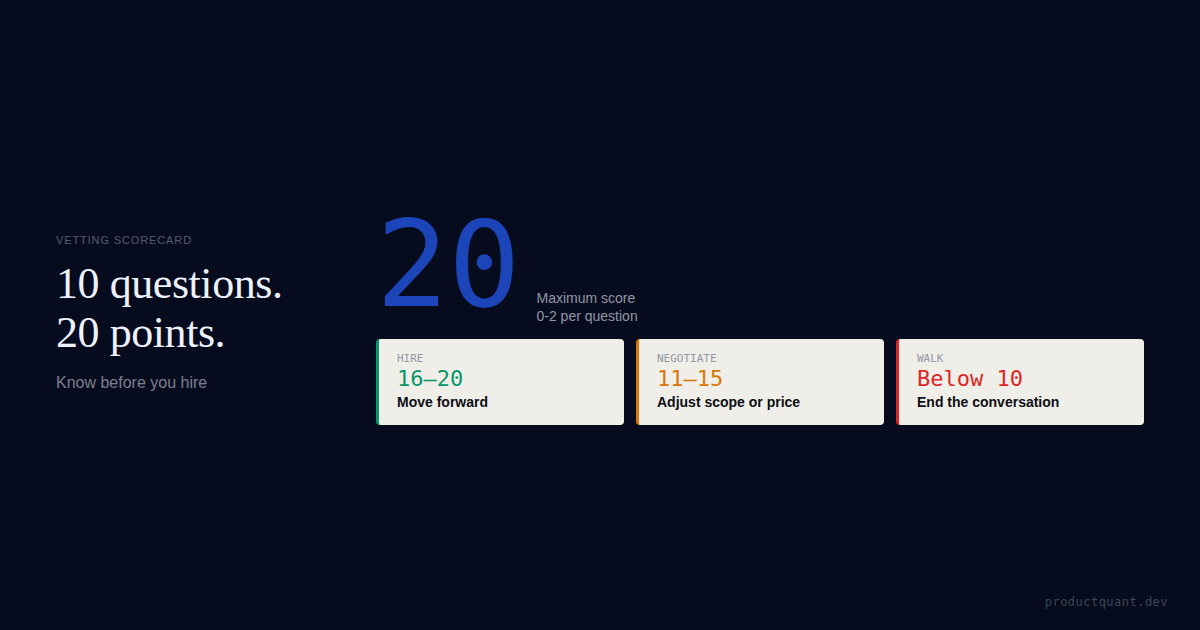
- The scorecard has 10 questions, each scored 0–2, for a maximum of 20 points. 16+ = hire. 11–15 = negotiate scope or price. Below 10 = walk.
- The questions cover: relevant experience, hands-on tool expertise, reference quality, diagnostic approach, deliverable clarity, timeline realism, team fit, documentation quality, post-engagement support, and pricing transparency.
- The 3 red flags that should end the conversation: (1) They guarantee specific outcomes ("we'll increase your activation by 20%"). (2) They demand 6+ month commitments before a diagnostic. (3) They can't name the specific tools they'll use and why.
- The best consultants lead with diagnosis, not solutions. They want to understand your data, your team, and your bottlenecks before they prescribe anything. The worst consultants lead with a pre-packaged solution and work backward to justify it.
The Scorecard


Score each question 0 (no), 1 (partially), or 2 (yes). Total out of 20.
1. Have they worked with companies at your stage and ARR range?
2 points: Yes — they've worked with 3+ companies in your ARR range ($500K–2M, $2M–5M, $5M–10M, etc.) and can describe specific challenges and outcomes.
1 point: They've worked with companies near your range but not exactly in it.
0 points: Their experience is mostly with enterprise companies or pre-revenue startups — neither of which matches your context.
Why it matters: A consultant who's only worked with $100M ARR companies doesn't know what a $2M ARR team can execute. A consultant who's only worked with pre-revenue startups doesn't know what scale looks like.
2. Can they name the specific tools they'll use and why?
2 points: They name specific tools (PostHog, Amplitude, Stripe, Statsig, etc.) and explain why each fits your situation.
1 point: They name tool categories ("product analytics," "experimentation platform") but not specific tools.
0 points: They say "we'll assess your current stack" without naming any tools they actually know.
Why it matters: A consultant who can't name tools doesn't have hands-on experience. They're selling strategy without execution capability.
3. Do they have 2–3 references you can actually call?
2 points: Yes — they provide 2–3 references from companies similar to yours, and the references respond to your call within 48 hours.
1 point: They provide references but they're from dissimilar companies or the references are slow to respond.
0 points: They say "references available upon request" but don't volunteer them.
Why it matters: A consultant who can't produce responsive references is either new or hiding something.
4. Do they lead with diagnosis or with a pre-packaged solution?
2 points: They want to see your data, talk to your team, and understand your bottlenecks before they recommend anything.
1 point: They have a framework they want to apply, but they're open to adjusting it based on your context.
0 points: They present a pre-packaged solution ("we'll redesign your onboarding") before understanding your problem.
Why it matters: The consultant who diagnoses before prescribing is solving your problem. The one who prescribes before diagnosing is solving their problem (selling the engagement they want to sell).
5. Are their deliverables specific and measurable?
2 points: "An event taxonomy document, 4 dashboards, an experiment design for trial-to-paid conversion, and a 90-day roadmap" — specific, measurable, and time-bound.
1 point: "A GTM strategy and analytics recommendations" — directional but vague.
0 points: "Growth acceleration" or "revenue optimization" — meaningless.
Why it matters: Vague deliverables produce vague results. Specific deliverables produce specific results.
6. Is their timeline realistic?
2 points: 2–4 weeks for diagnostic, 4–8 weeks for implementation. They explain what happens in each week.
1 point: 4–6 weeks total but no weekly breakdown.
0 points: "We'll have you grown in 30 days" or "this is a 6-month engagement" without explaining why 6 months.
Why it matters: Unrealistic timelines are the #1 cause of failed consulting engagements. If they promise results in 30 days, they're selling. If they demand 6 months before a diagnostic, they're padding.
7. Will they work with your existing team?
2 points: Yes — they'll collaborate with your PMs, engineers, and analysts, and transfer knowledge so your team can maintain the system after they leave.
1 point: They'll work alongside your team but don't have a structured handoff plan.
0 points: They work in isolation and deliver a document.
Why it matters: The consultant's goal should be to make themselves unnecessary. If they don't plan to transfer knowledge, they're building dependency, not capability.
8. Do they document everything?
2 points: They show you examples of past documentation: diagnostic reports, event taxonomies, dashboard specs, experiment designs. It's thorough, clear, and accessible.
1 point: They say they document but can't show you examples.
0 points: "We share our findings in meetings" — no written deliverables.
Why it matters: If the consultant gets hit by a bus, your team should still have everything they need. Verbal findings evaporate. Written documentation endures.
9. What happens after the engagement ends?
2 points: They offer 30 days of post-engagement support (email, 2 check-in calls) included in the price.
1 point: They offer post-engagement support at an additional hourly rate.
0 points: No post-engagement support.
Why it matters: The first 30 days after the consultant leaves are when your team applies the playbook independently. Having the consultant available for questions during this period is the difference between adoption and abandonment.
10. Is their pricing transparent?
2 points: They give you a clear price range ($15K–25K) with a breakdown of what each phase costs and what's included.
1 point: They give you a range but no breakdown.
0 points: "We'll scope it and send a proposal" — no price discussion before the proposal.
Why it matters: A consultant who won't discuss price upfront is either unsure of their value or planning to inflate it in the proposal.
The Score
| Total | Interpretation |
|---|---|
| 16–20 | Hire. This consultant is experienced, transparent, and diagnostic. |
| 11–15 | Negotiate. Scope the engagement more specifically, ask for references, or push for a shorter diagnostic phase. |
| Below 10 | Walk. This consultant is selling, not solving. |
The 3 Red Flags

If the consultant does any of these, end the conversation:
Red Flag 1: They Guarantee Specific Outcomes
"We'll increase your activation rate by 20% in 90 days." No one can guarantee this. The best consultants give you a range of expected outcomes based on their experience with similar companies — but they never guarantee.
Red Flag 2: They Demand 6+ Months Before a Diagnostic
A diagnostic takes 2–4 weeks. If the consultant wants a 6-month commitment before they've looked at your data, they're selling retention, not results.
Red Flag 3: They Can't Name Specific Tools
"We'll use your existing analytics stack" — without naming any tools they actually know how to use. This is a consultant who sells strategy but can't execute.
The Pattern We See Across 50+ Consultant Evaluations
After evaluating dozens of growth consultants and agencies, two patterns emerge consistently:
The best consultants lead with diagnosis, not solutions. They want to understand your data, your team, and your bottlenecks before they prescribe anything. The worst consultants lead with a pre-packaged solution and work backward to justify it.
Documentation quality is the single best predictor of engagement success. A consultant who shows you thick, clear diagnostic reports from past engagements will produce the same quality for you. A consultant who says "we share findings in meetings" will leave you with nothing actionable when they leave.
Run 10 questions, narrow to 3 finalists, hire 1. The scorecard eliminates the bottom 50% immediately. The references eliminate another 30%. The diagnostic approach reveals the winner.
FAQ
Should I use this scorecard for agencies too?
Partially. The scorecard works for individual consultants. For agencies, add questions about team composition (who actually does the work), account management (who you talk to), and escalation (what happens when the team underperforms).
How many consultants should I interview?
3–5. Fewer than 3 and you don't have enough data to compare. More than 5 and you're optimizing for marginal differences.
What if the best consultant scores a 14?
A 14 is good — it means they're strong in most areas but have gaps in 2–3. Negotiate the gaps: if they lack references at your stage, ask for references at a nearby stage. If their deliverables are vague, ask them to make them specific before signing.
Sources
- SaaSHero — Evaluate Growth Consultant — Marketplace evaluation framework.
- Bain — Consultant Evaluation — Bain insights on consultant selection.
- Clutch — Consulting Services Guide — How to evaluate consulting services.
- ProductQuant — What a GTM Consultant Actually Does — Scope, pricing, and engagement breakdown.
- ProductQuant — How to Evaluate a Product Analytics Consultant — Specific evaluation criteria for analytics consultants.

About the Author
Jake McMahon builds growth infrastructure for B2B SaaS companies — analytics, experimentation, and predictive modeling that turns product data into revenue decisions. He has evaluated dozens of consultants and agencies across multiple engagements. Book a diagnostic call to discuss your growth leadership needs.
Related Reading

Get The Foundation in 4–6 Weeks
Specific deliverables, transparent pricing, a 2–4 week diagnostic, and 30 days of post-engagement support. Score us against the scorecard. We think we'll pass.