
TL;DR
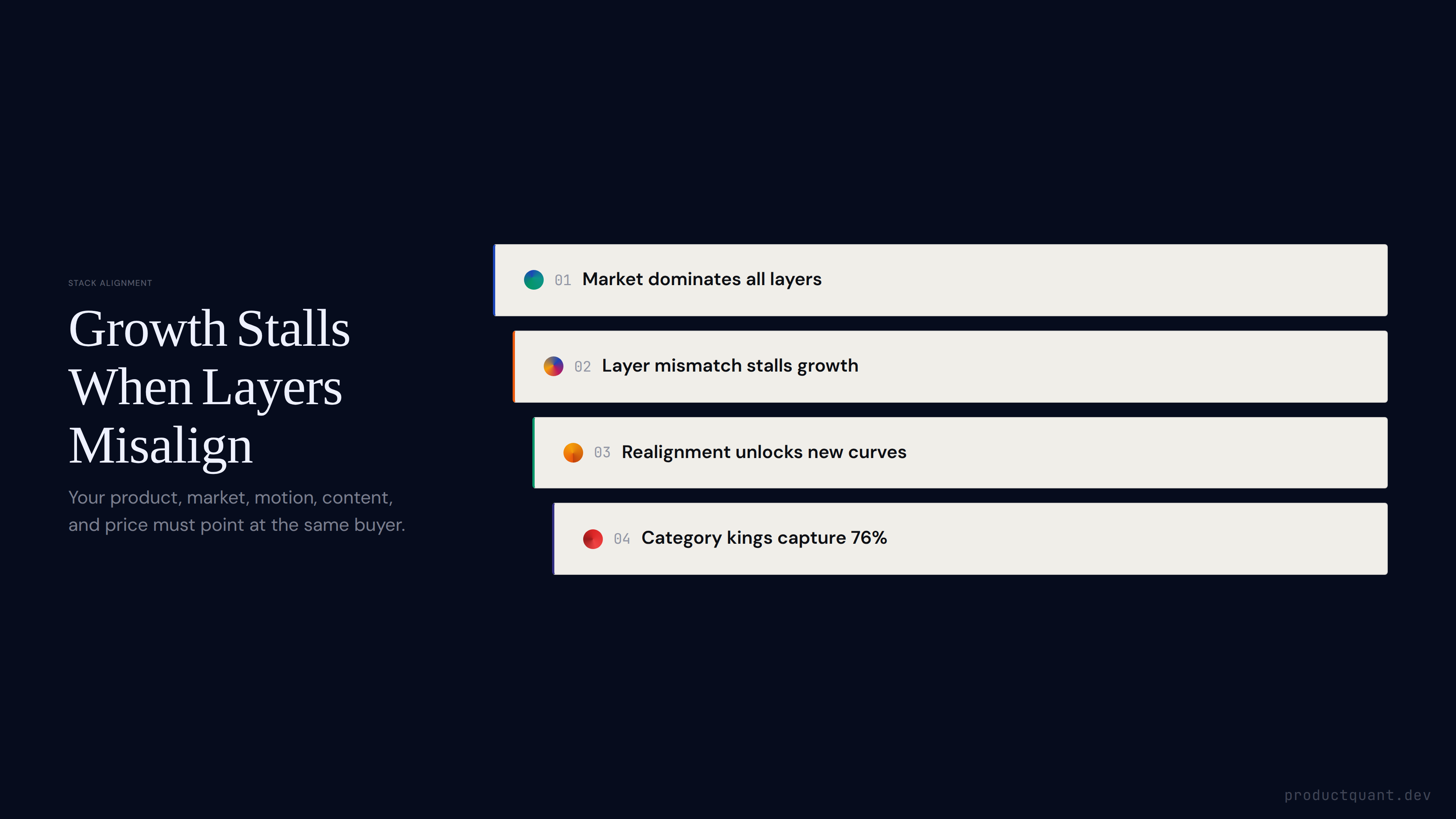
- Execution is not the bottleneck. Stalled B2B SaaS growth usually traces to misalignment between market, product, motion, content, and price. Each layer can be strong and still fight the others.
- Category kings take 76% of market cap. Play Bigger's research shows the leader's stack points at one category, and everyone else splits the rest.
- Realignment is the growth move. Jasper AI, Copy.ai, and ClickUp each stalled at a layer boundary, then re-aligned: new ICP, new motion, new pricing. The product wasn't the problem.
- The $20M to $30M ARR inflection is a motion-layer signal. a16z documented that top-down sales starts in this range for PLG companies. When the motion doesn't match the product's go-to-market, growth plateaus.
The top layer gets all the blame
When B2B SaaS growth stalls, the board asks about execution. Is the product roadmap slipping? Is sales quota attainment down? Are we shipping fast enough? Those questions assume the top layer is broken. In most stalled companies, the top layer is fine. The product works, the team ships, the sales reps dial. What is broken is the alignment between layers.
The evidence points to the stack, not the effort. Rachleff's Law, popularized by Marc Andreessen says market is the dominant layer: a great team meets a lousy market, market wins. That is often misread as "pick a great market and execution doesn't matter." The missing part is the rest of the stack. A great market still needs a product, motion, message, and price that point at the same buyer. If one of those points elsewhere, the market's gravity still pulls, but the company's orbit decays.
"When a great team meets a lousy market, market wins. When a lousy team meets a great market, market wins. When a great team meets a great market, something special happens." The market layer dominates. Alignment decides whether your team is in that third box.
Rachleff tells you the market matters. The DNA Diagnostic tells you where the misalignment is: market to product, product to motion, motion to content, price to the buyer. Each of those alignments is separate. You can have perfect product-market fit and still fail because the motion is enterprise sales for a self-serve product.
The five layers of a growth stack
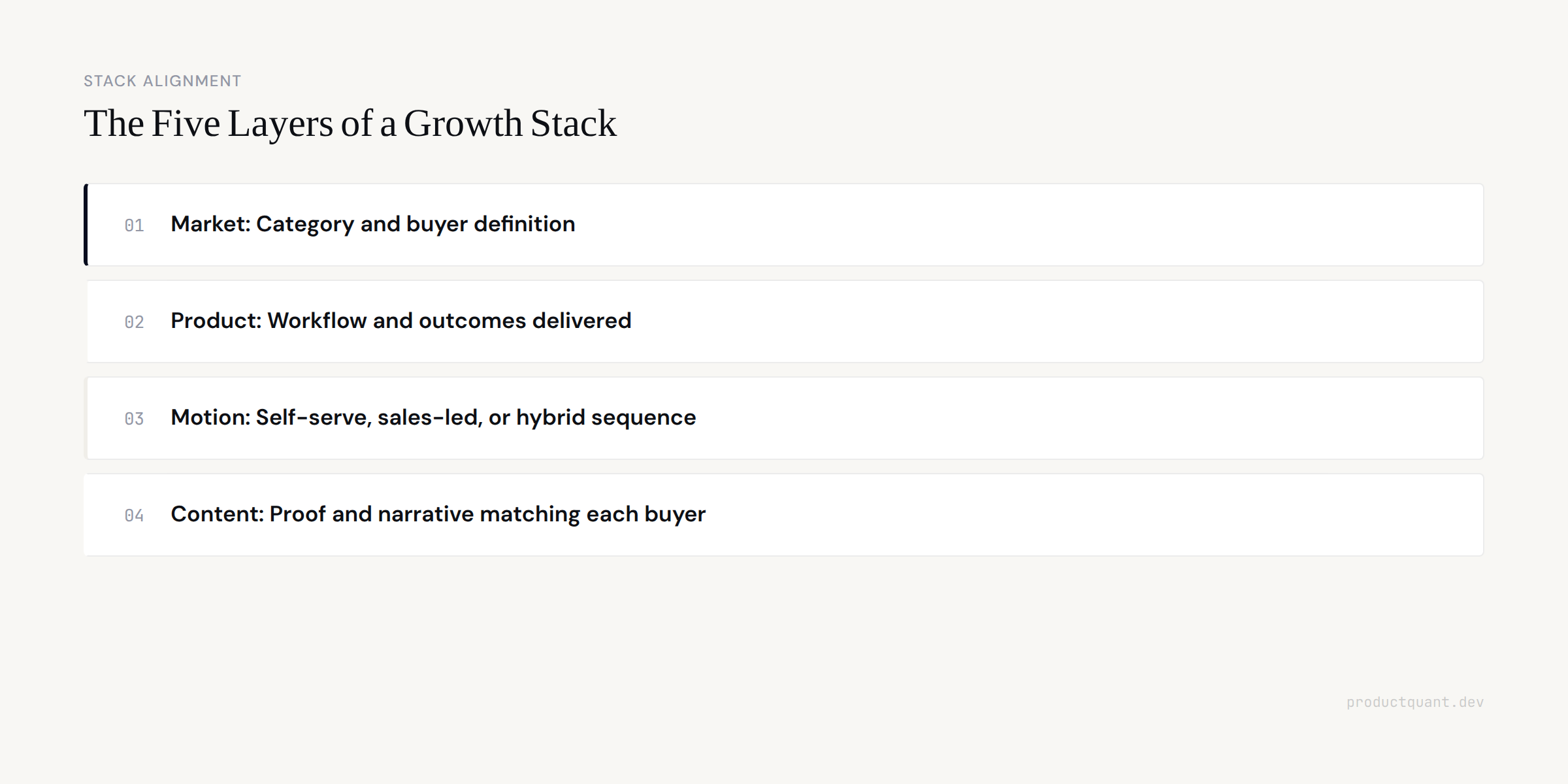
The growth stack has five layers. Market is who you serve and what you promise. Product is the software you build. Motion is how you acquire and convert: self-serve, sales-led, or a hybrid. Content is what you publish and say to the market. Price is what you charge and how the economics scale. Each layer has its own job. Growth happens when they align.
Alignment is not uniformity. A PLG product can absolutely be sold enterprise, but the motion has to sequence: free tier, then sales-assisted, then procurement. The content has to address the economic buyer, not just the user. The price has to support a sales team's cost. That is the a16z finding: bottom-up companies add top-down sales between $20M and $30M ARR.
- Market: the category you define and the buyer you serve.
- Product: the workflow and outcomes you deliver.
- Motion: self-serve, sales-led, or hybrid, and the sequence.
- Content: the proof and narrative that matches each buyer.
- Price: the ACV, packaging, and funnel economics.
The common stall pattern is a layer mismatch. A PLG product pushed through enterprise sales. An explosive market served with generic content. Enterprise ACV economics on a self-serve product. Each layer works in isolation. The stack fights itself.
Market dominance is measured in the stack
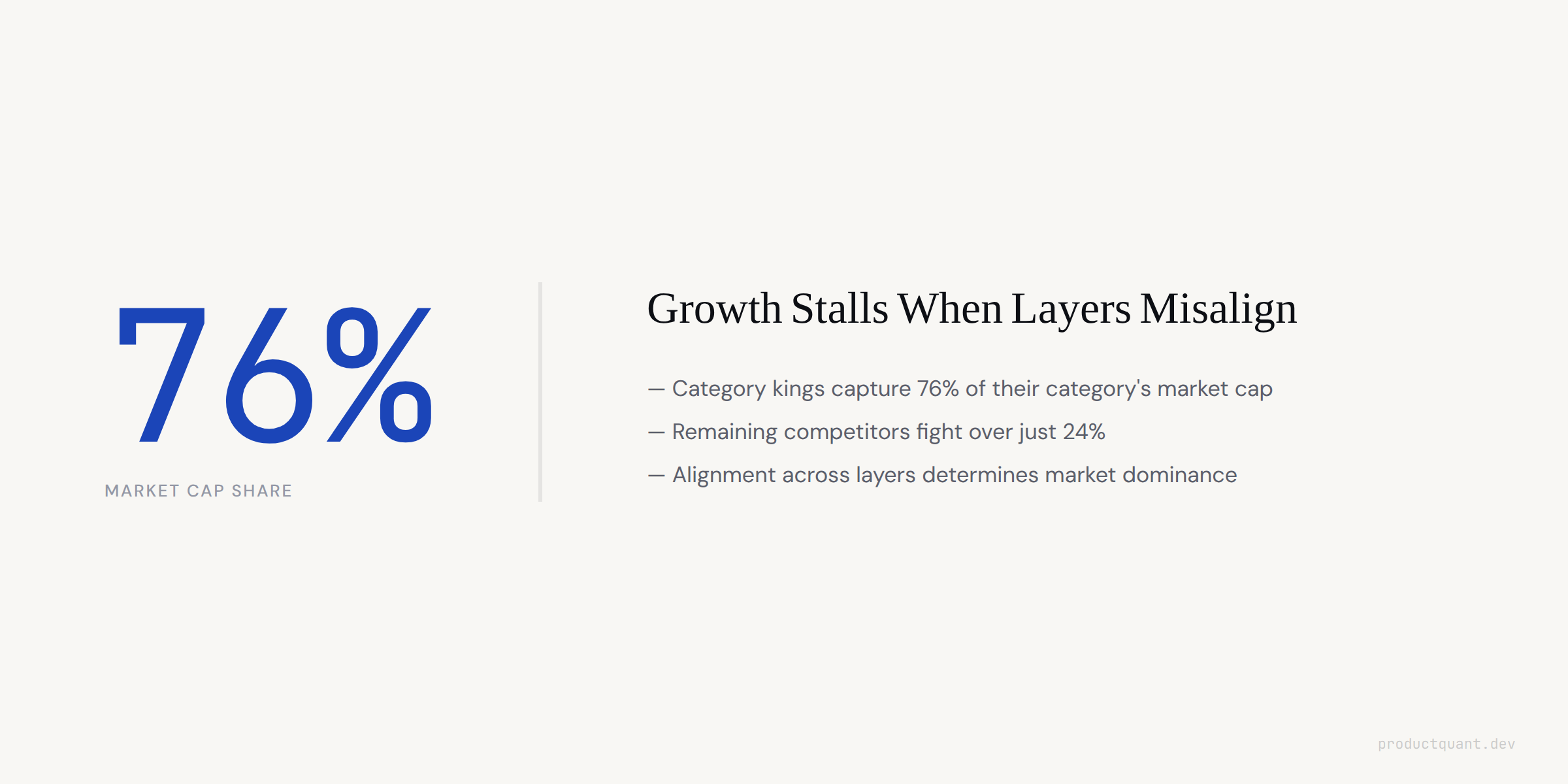
The market layer is the biggest lever. Play Bigger researchers documented that category kings absorb 76% of the category's market cap, leaving everyone else splitting 24%. That number has held since the 2016 book, restated in 2022 and 2025. The leader does not win by slightly better execution. It wins by defining a category and forcing every other layer to point at that same category.
Category kings capture 76% of their category's market cap, per Play Bigger (2016, restated 2022 and 2025). The remaining competitors fight over 24%. A misaligned stack is why a #2 or #3 looks competitive forever.
Product-market fit is measured inside the product layer. Sean Ellis's 40% test asks active users if they would be very disappointed without the product. That number distinguishes a product. It does not test motion, content, or price. A product can score 40% and still plateau because the motion sells to the wrong buyer, the content speaks to the wrong problem, or the price caps the account size.
So the path to the 76% is not a better product or more content. It is stack alignment: the market you pick, the product you build, the motion you run, the content you publish, and the price you set all reinforce the same category. When they do, the market's gravity generates the growth. When they don't, growth is stuck and blaming the top layer does nothing.
Realignment case: Jasper AI
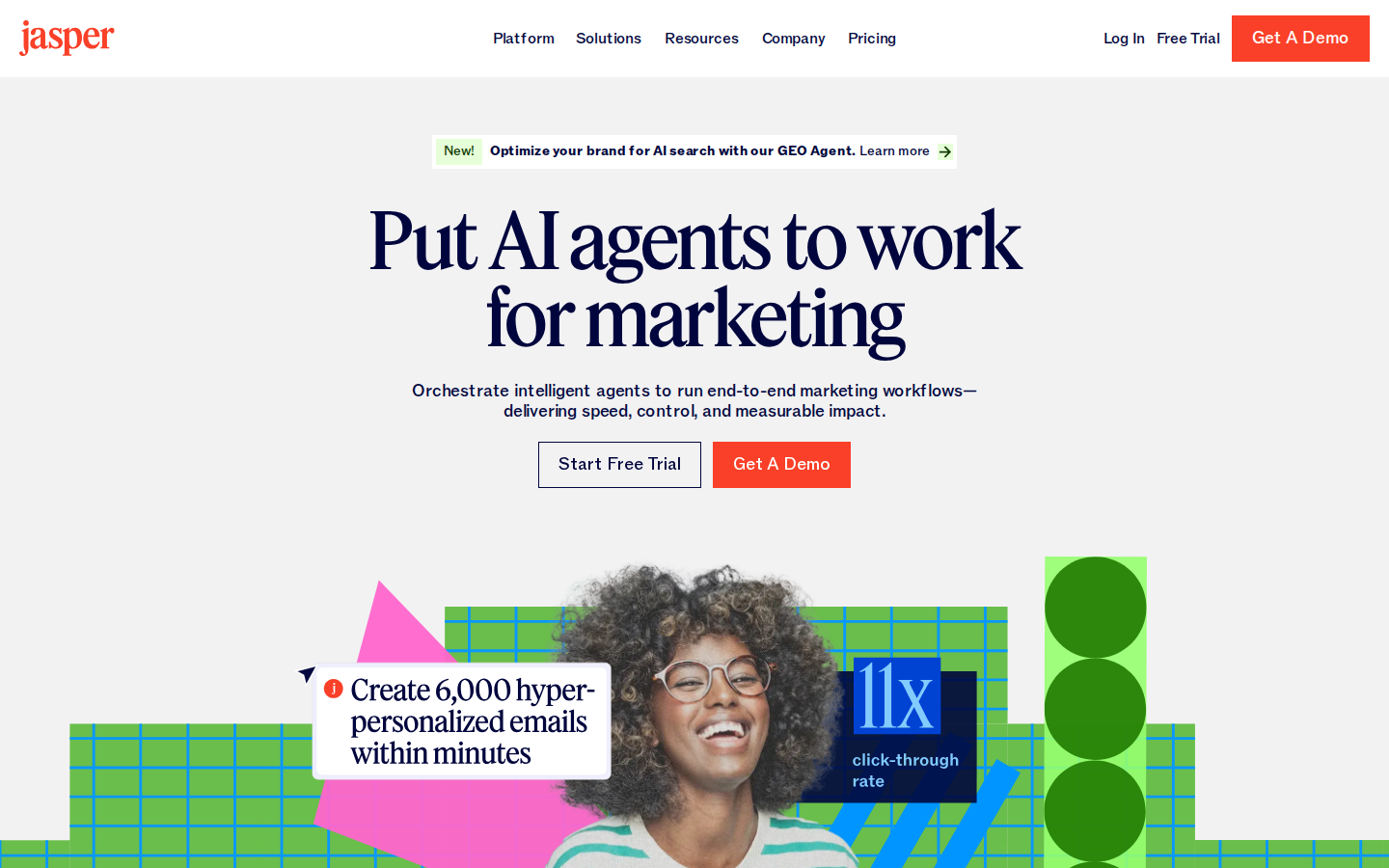
Jasper AI built a popular AI copywriting product for SMB marketers. Then ChatGPT launched and the bottom fell out. Why pay $49 a month for a standalone writer when a general assistant does it free? Revenue peaked near $120M in 2023, then dropped to about $55M by 2024. The product layer still worked. The market layer had evaporated.
Under a new CEO, Jasper re-aligned the stack. It moved from "AI writer for marketers" to an enterprise brand platform: brand voice, compliance, governance, and multi-user workflows. That is a market reposition. The motion shifted from self-serve to enterprise sales. The price moved up. The content started targeting brand and marketing operations teams, not individual copywriters.
Directional results from secondary sources: enterprise ARR reportedly quadrupled, with around 900 enterprise customers including Boeing, UPS, and Accenture, and projected 2026 revenue near $180M. A Forrester TEI study claims 342% ROI. Those figures are not audited, but the direction is consistent: the same product, aimed at a different buyer with a different motion and price, produced a different growth curve.
Realignment case: Copy.ai
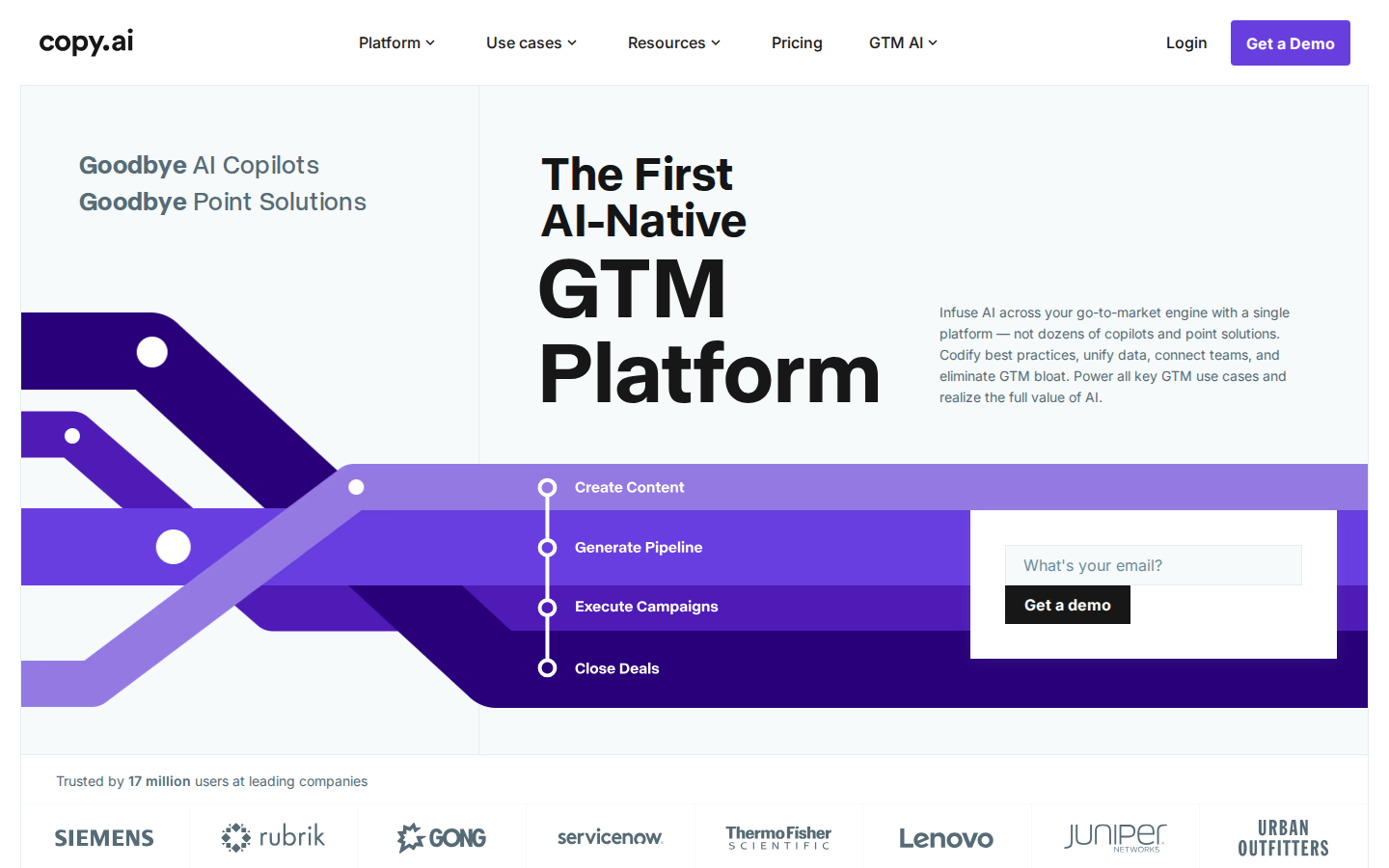
Copy.ai launched in 2020 as an AI copywriting tool for individual creators, priced around $36 a month. Same ChatGPT collapse: the self-serve copywriting motion stopped converting. The founder understood the top layer. The market had shifted from "write copy for me" to "run my go-to-market."
The re-alignment: reposition as an AI-native GTM platform for sales and revops teams. Pricing moved to $49 and $249 tiers aimed at teams. The free tier disappeared. The acquisition of Fullcast in October 2025 cemented the platform story. The result shows up in the review data: a 4.4 out of 5 on G2 from enterprise teams and a 1.9 out of 5 on Trustpilot from individual creators. Same product, different layer alignment. The market re-segmentation is visible in the scores.
This is not a simple growth fix. It is survival and repositioning. But it makes the point: the product did not need to be rewritten. The market, motion, content, and price needed to point at a buyer who had a budget for go-to-market workflow, not a content generator.
Realignment case: ClickUp
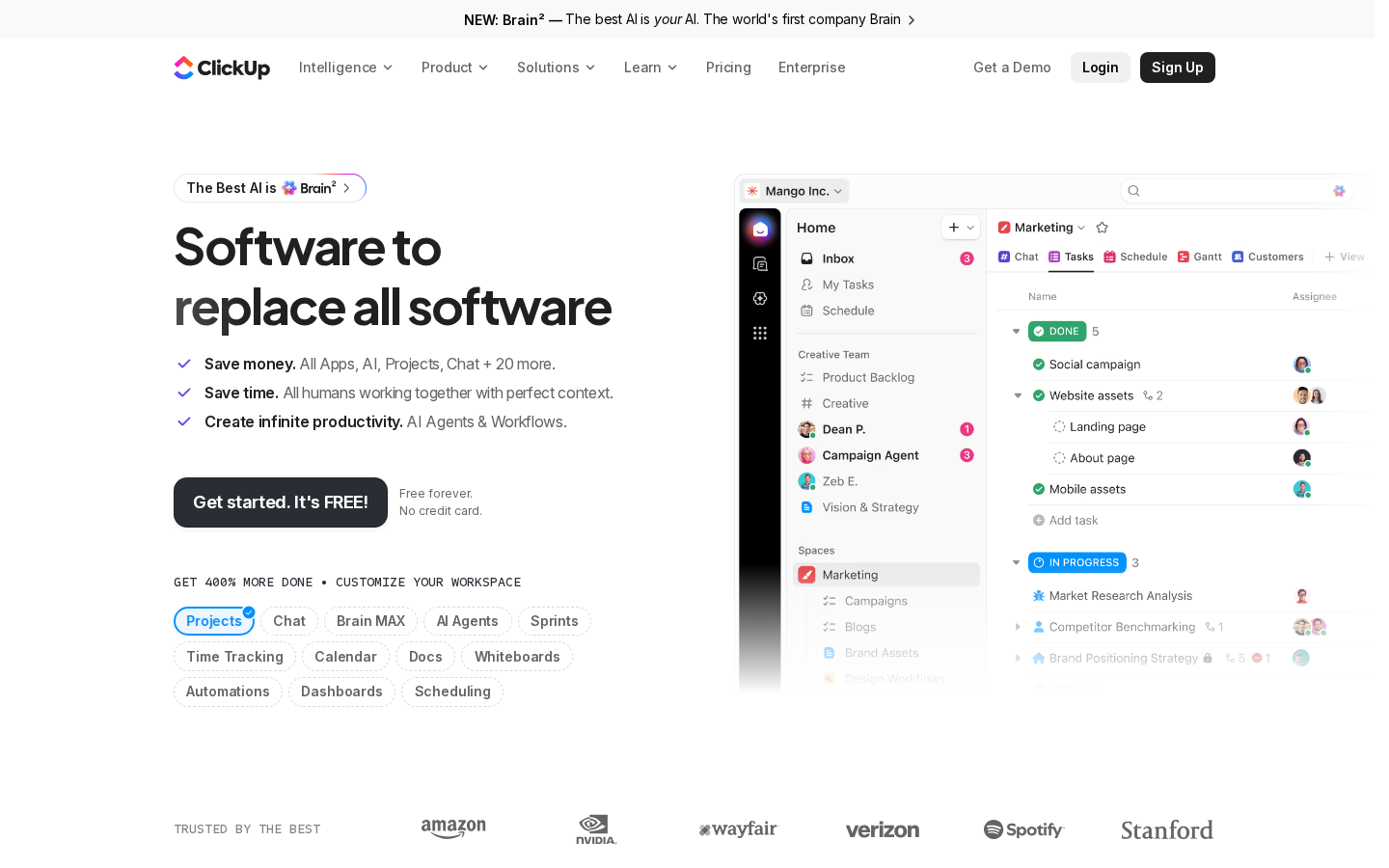
ClickUp hit around $300M ARR and hit a plateau. The company did not blame the product. In February 2026, it announced a deliberate motion-layer re-alignment. It hired a Global VP of Growth from Klaviyo to run the self-serve revenue engine, and a Global VP and GM of Enterprise from Smartsheet to run the upmarket motion. It also added GTM operations and marketing VPs. The COO said they were choosing re-acceleration.
This matches the a16z finding that PLG companies typically layer in top-down sales between $20M and $30M ARR. ClickUp is past that, but the principle is the same: a pure self-serve motion cannot carry enterprise deals, and an enterprise sales motion cannot efficiently acquire SMB self-serve customers. You need two engines, explicitly staffed and aligned to the appropriate buyer.
ClickUp reported roughly $300M ARR in September 2025. The February 2026 executive hires are a public acknowledgment that the next stage needs a dual motion: self-serve plus enterprise, not one motion trying to do both.
The result is not yet proven. The re-alignment was announced, not delivered. But the move is instructive. At scale, growth stalls when the motion layer does not map to two distinct buyers: the self-serve team and the enterprise procurement committee. ClickUp is lining the layers up on purpose.
The counter-take: execution isn't the cause
The mainstream take, from Jason Lemkin at SaaStr, is that SaaS is killing itself: and his diagnosis centers on execution failures rather than AI disruption. That frames the problem as execution and will. There is some truth. But it misses the structural cause.
The evidence shows companies like Jasper and Copy.ai did not fail because they shipped too little. They had products that worked. They failed because the market layer moved underneath them and the rest of the stack kept pointing at the old buyer. The solution was not to ship faster. It was to re-aim the stack.
When growth stalls, the first diagnostic is not effort. It is alignment. Measure the market you are serving, the product you are building, the motion you are running, the content you are publishing, and the price you are charging. If they do not point at the same buyer, no amount of top-layer execution will fix it.
What alignment looks like in practice
Two other examples reinforce the pattern. Airtable moved from prosumer to enterprise as its growth engine, with enterprise revenue growing about 100% year over year and an enterprise net dollar retention near 170%, versus Asana around 130% and Monday around 120%. Cursor stayed pure PLG past $200M ARR, then layered enterprise sales; corporate buyers went from roughly 25% of revenue in late 2024 to about 45% at $1B ARR and near 60% at $2B ARR. The motion layer aligned with the demand the product created.
In practice, alignment starts with a diagnostic. Answer five questions: Who is the buyer? What is the product outcome? How do they buy? What do we say to them? What do we charge? Write the answers as if they are one paragraph. If they are not, you have a layer gap. That is the gap the ProductQuant DNA Diagnostic measures: the Brand Persona DNA and GTM DNA each have an alignment score. The score does not tell you to work harder. It tells you where the stack is fighting.
The a16z benchmark helps with motion. If you are a PLG company between $20M and $30M ARR, expect to add top-down sales. If you are past that and still pure self-serve, your motion is behind the market. If you are below that and already building enterprise sales, your motion is ahead of the market. Alignment does not mean one motion forever. It means the motion matches the stage and the buyer.
Sources
- Play Bigger, "How Category Design Drives Scale" - Play Bigger, "How Category Design Drives Scale"
- pmfsurvey.com - pmfsurvey.com
- First Round Review, "How Superhuman Built an Engine to Find Product Market Fit" - First Round Review, "How Superhuman Built an Engine to Find Product Market Fit"
- a16z, "The $20M to $500M Question" - a16z, "The $20M to $500M Question"
- Marc Andreessen, "The Only Thing That Matters" - Marc Andreessen, "The Only Thing That Matters"
- Everything PR, "Jasper AI: The Enterprise Content Platform That Pivoted Into GEO" - Everything PR, "Jasper AI: The Enterprise Content Platform That Pivoted Into GEO"
- Copy.ai Review (Eyesift, backup for dead presenc.ai link) - Eyesift, Copy.ai Review (backup source)
- Eyesift, "Copy.ai Review" - Eyesift, "Copy.ai Review"
- Business Wire, "ClickUp Ushers in New Phase of Growth" - Business Wire, "ClickUp Ushers in New Phase of Growth"
- ARR.club, "ClickUp" - ARR.club, "ClickUp"
- SaaStr, "AI Isn't Killing SaaS. SaaS Is Killing Itself." - SaaStr, "AI Isn't Killing SaaS. SaaS Is Killing Itself."
- Sacra, "Airtable" - Sacra, "Airtable"
- SaaS Mag, "PLG in 2026: Product-Led Growth Evolves Into Full-Stack GTM" - SaaS Mag, "PLG in 2026: Product-Led Growth Evolves Into Full-Stack GTM"

About the Author
Jake McMahon is the founder of ProductQuant, a product strategy consultancy and platform for B2B SaaS teams. He builds the DNA Stack frameworks (Product, Market, GTM, Brand Persona) and runs pipeline systems for growth-stage companies.
Related Reading
Find the layer that's misaligned.
Run your stack through the DNA Diagnostic and see where the layers are fighting.