
TL;DR
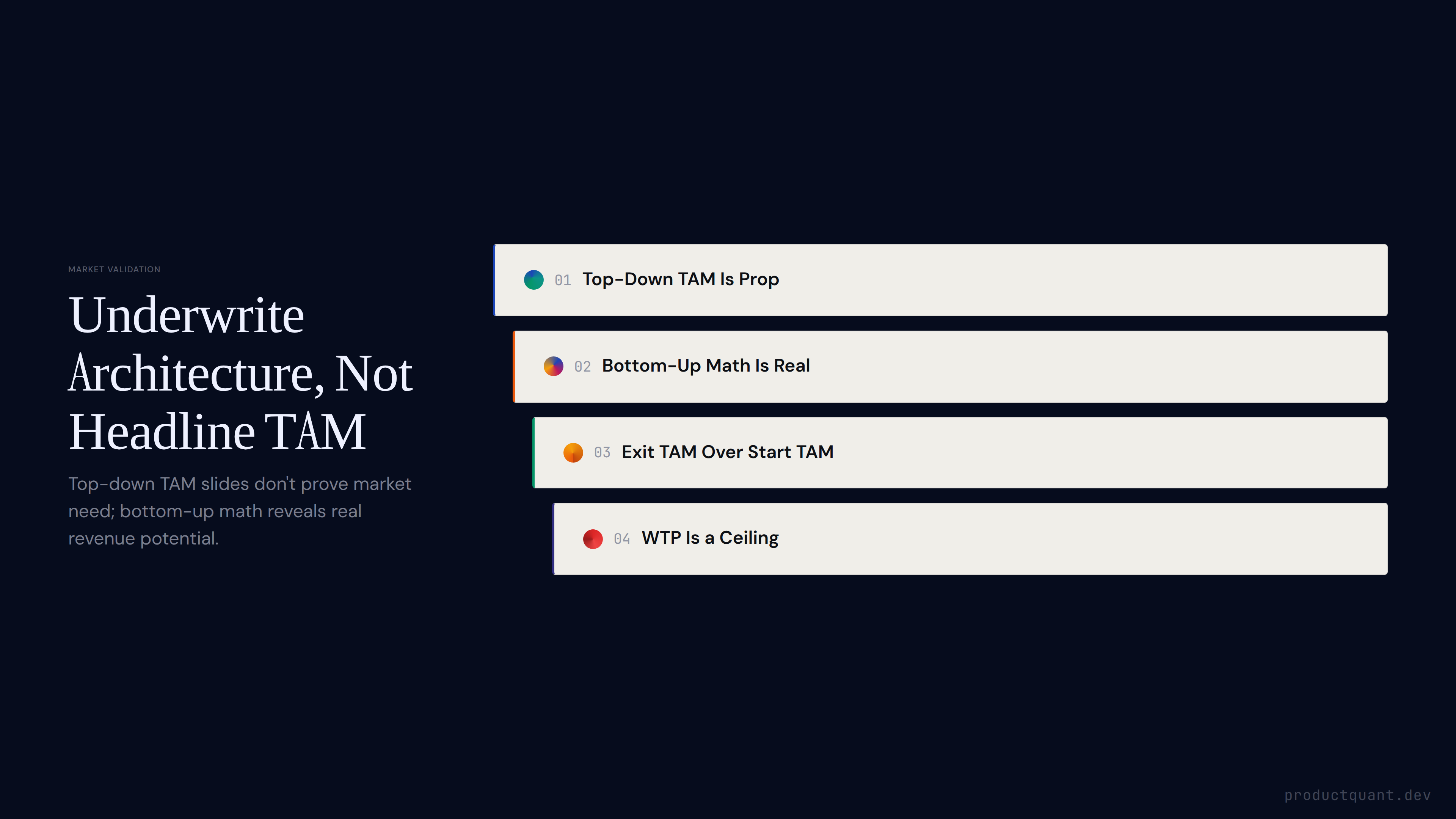
- Top-down TAM is a prop. A 1% of $50B slide never proves the market exists. 43% of failed startups fail from poor product-market fit, per CB Insights.
- Bottom-up math is the real model. Reachable customers times willingness to pay times capture rate. Paul Graham says build something a small number of people want a lot.
- Underwrite the exit TAM, not the start TAM. Ed Sim: it is not the TAM you start with, it is the TAM you exit with. ServiceTitan and Snyk prove it.
- WTP is a ceiling. Even OpenAI only converts about 5% of weekly users. Price the architecture, not the headline.
The Headline TAM Is a Prop
A top down TAM slide does not survive contact with a customer. It starts with a big number, takes a share, and calls it revenue. The share is a guess. Rachleff's Law, named for Andy Rachleff, says the number one company killer is lack of market. The slide never proves the market is real.
a16z's 16 More Startup Metrics makes the same point. The firm wants a bottom up analysis that accounts for target customer profile, willingness to pay, and go to market. A top down analysis calculates TAM based on market share and a total market size. They use the toothbrush in China test: a16z pushes back: if you claim 1% of a market, why not 40%? The architecture is missing.
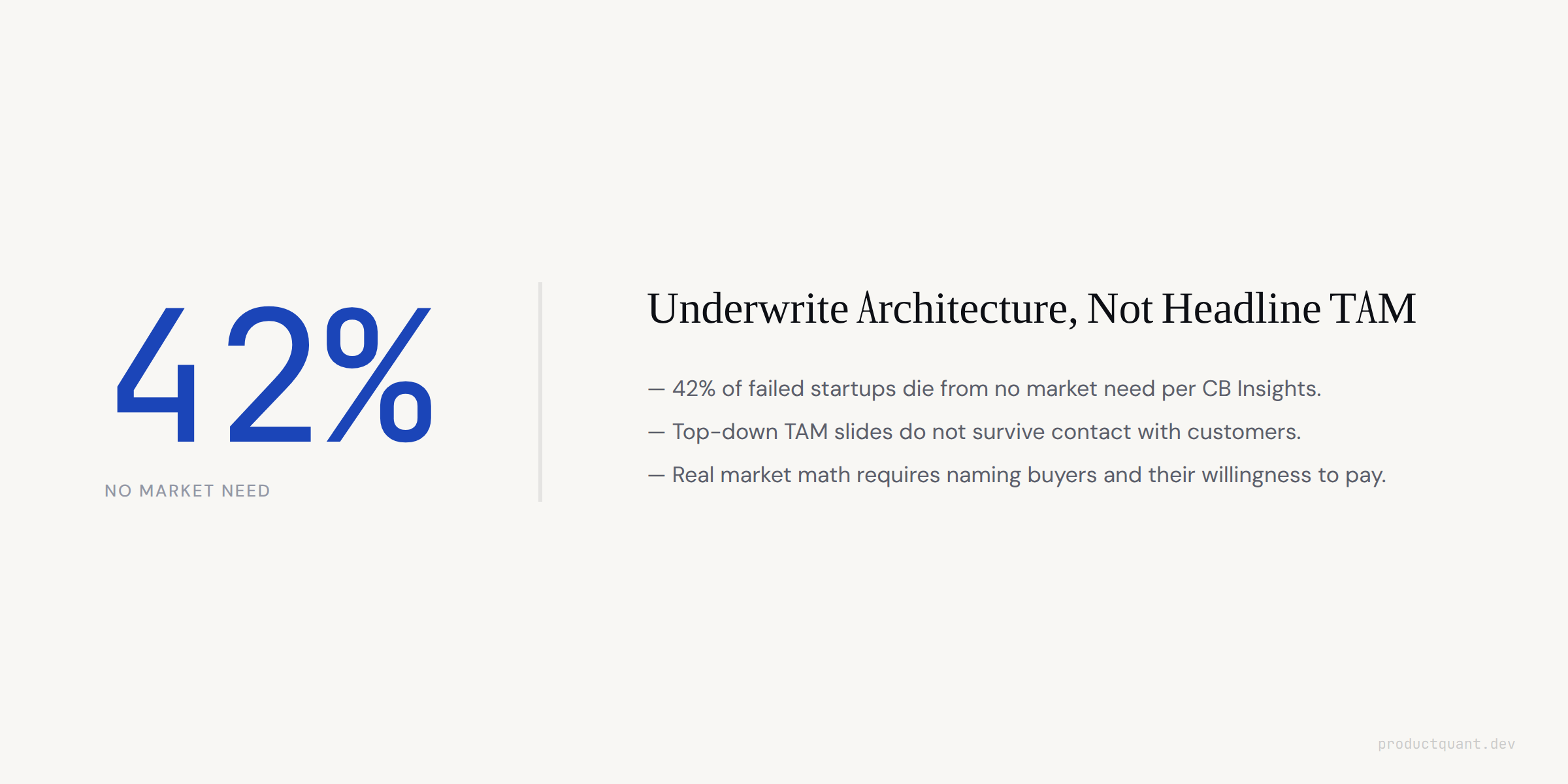
of failed startups fail from poor product-market fit, per CB Insights' latest report. The headline TAM did not convert to paying customers.
A bottom up estimate is built from a unit, a price, and a count. Suppose you sell a $40 per month compliance tool to property managers. You identify 8,000 mid sized firms in the US, each with two users. That is $7.68 million in annual recurring revenue. You can call twenty of those firms and ask if they already budget for this. When you do, the market either shows up or it does not. The top down slide cannot do that.
The Bottom Up Math
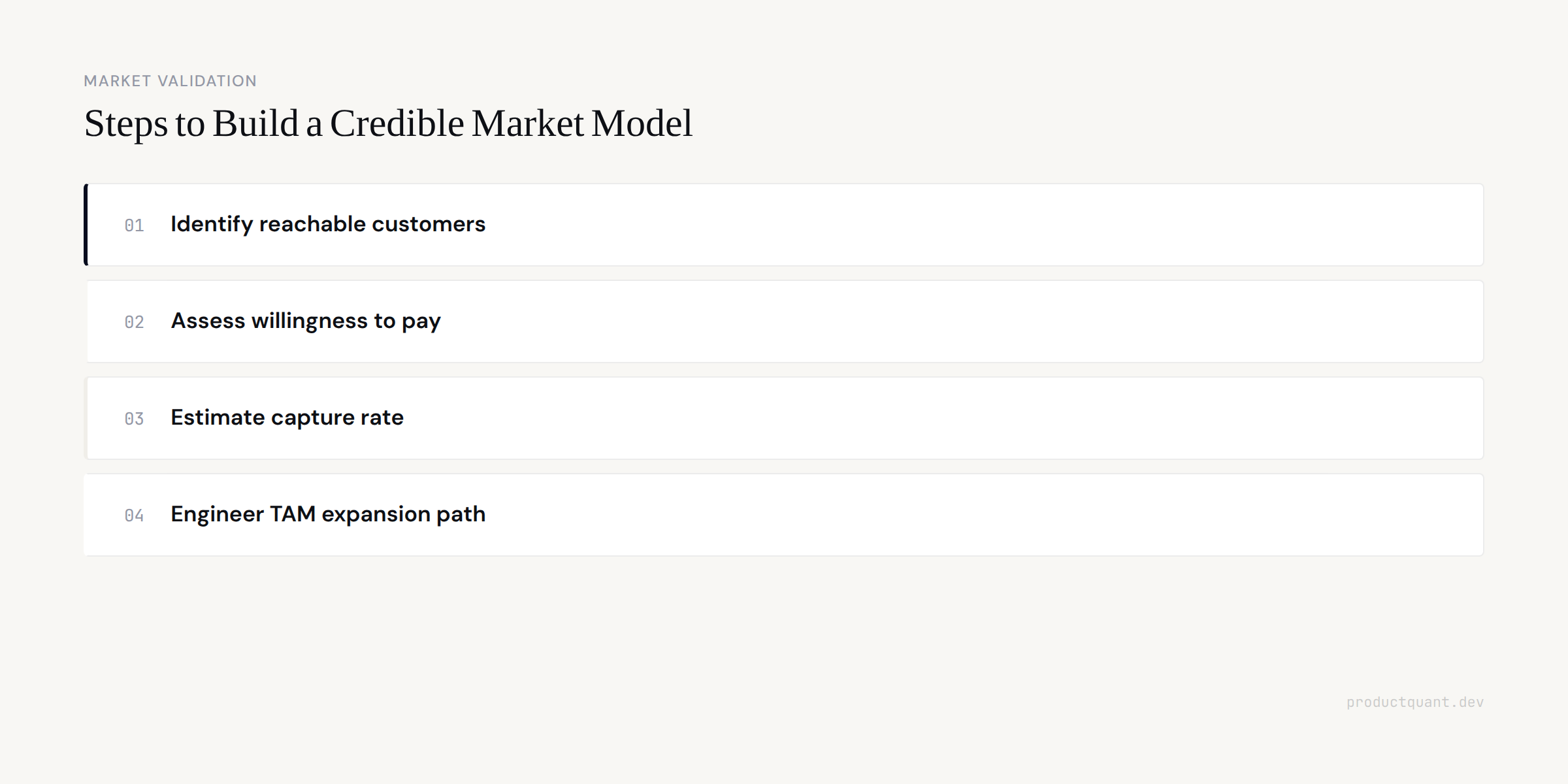
Bottom up math starts with a customer you can name. Reachable customers times willingness to pay times capture rate. Capture rate is your share of the customers you can actually serve. This is the math that survives a call with a buyer.
Paul Graham framed it as a graph. The x axis is all the people who might want what you make, and the y axis is how much they want it. He says build something a small number of people want a large amount, not the reverse. Mike Vernal of Sequoia calls it the market curve: how many potential customers are there and what might each customer be worth to you.
Bottom up math also makes you answer the go to market. a16z says willingness to pay plus how you will market and sell. If you cannot name the buyer and the price, you do not have a market, you have a category wish.
The TAM You Exit With
Ed Sim captured the investor frame: it is not the TAM you start with, it is the TAM you exit with. He wrote that in 2020, and the market math has not changed. Investors underwrite the path from the wedge to the platform, not the wedge alone.
Euclid Ventures backs this with data. They say many VCs overestimate the importance of massive TAMs early on and underweight how dynamic TAM is as a company grows. The ability to grow TAM matters more than TAM itself.
Take a concrete case: a company starts with a $40 million TAM for a single workflow in one department. In year two, it expands to a second department, doubling that to $80 million. By year five, it adds a data layer that serves the whole enterprise, putting the TAM at $600 million. Investors underwrite that progression. They discount the starting number and pay for the probability of compounding expansion. A founder who can show a credible, step-by-step path to a 10x TAM increase gets a different valuation multiple than one who simply picks a huge market and hopes to capture it.
ServiceTitan: The Architecture Underwrote the IPO

ServiceTitan is the cleanest proof. It started as plumbing software with a $7,000 ACV, won the right to grow, then expanded into adjacent trades and FinTech. By the IPO it was a roughly $70,000 ARPA platform (S-1 data shows active customers paid about $78K a year). Euclid uses this as the example of the wedge winning the right to grow.
At the IPO, ServiceTitan showed about $772M ARR, 24% year over year growth, and a TAM claim of $13B at roughly 10% penetration. That TAM is an expanded one. It was built from counted customers times ARPA, not from 1% of a software line item. The IPO raised $625M at a $7.59B implied valuation.
ACV expansion from the plumbing wedge to the full platform, the architecture the IPO underwrote.
The lesson is not that ServiceTitan had a huge market. The lesson is that the market was built by the architecture: a beachhead, ACV expansion, and new verticals. Investors underwrite that sequence. The TAM you exit with is the one you engineered.
Humane: The Fake Market Collapse

Humane is the counter proof. The company pitched a post smartphone category. The market math did not hold. Andrew Chen's fake market test asks what kind of X do you use. If your target customer cannot name the category, you have pre built demand of zero. Humane could not pass that test.
The numbers collapsed. Daily returns reportedly outpaced sales, the price dropped from $699 to $499, and in February 2025 HP bought the assets for $116M. Humane had raised $240M. The device was discontinued. A retrospective from Digital Trends said Humane grossly overestimated demand.
Less than half of the $240M Humane raised. HP bought the assets and killed the product.
The headline TAM for AI hardware was huge. The willingness to pay for this specific product was zero. Bottom up math would have surfaced that in customer development. A top down slide cannot.
Snyk: The Canonical Exit TAM Case

Snyk is the canonical exit TAM case. Most people dismissed it as a too narrow market for scanning and fixing vulnerabilities in open source packages for Node. Ed Sim, the seed investor, says it became an $8.6B company in six years.
The expansion went from OSS for Node to more languages, containers, cloud configuration, source code, and cloud security. The start TAM was microscopic. The exit TAM was the accumulated architecture.
Snyk's seed round was underwritten on a narrow but real market. The later rounds were underwritten on the architecture that kept expanding the market. That is the difference between a TAM slide and a market model.
The math is simple. If Snyk had stayed Node-only, its market might have topped out at $200M. Each new language roughly doubles the developer addressable base. Adding containers multiplies the attack surface per developer. By the time Snyk covered cloud security, the aggregate market was over $30B. The compounding happened because each step reused the same scanning engine and the same go-to-market motion. That's the mechanism behind an expanding TAM.
Even OpenAI Hits the WTP Ceiling
OpenAI is the cleanest illustration that revenue follows paying units. The company went from $5.5B annualized in December 2024 to $10B in June 2025, $12B in July 2025, and past $25B in March 2026. That revenue is real customers paying $20 and $200 a month.
But even OpenAI hits a willingness to pay ceiling. Only about 5% of weekly active users pay. A Deutsche Bank report found EU consumer ChatGPT subscription growth had stalled, which pushed OpenAI into ads. The TAM headline for AI is huge and mostly unrealized. The architecture of tiered pricing is what converts some of it.
of weekly active users pay for ChatGPT. Willingness to pay is a ceiling, not a slope.
For founders the lesson is that WTP is a ceiling, not a slope. You cannot assume the headline TAM will pay. You need a price point that enough customers accept, and the path to raise that acceptance over time.
How to Underwrite the Architecture
To underwrite the architecture, start with a named customer and a named price. Build the bottom up model: reachable customers, willingness to pay, capture rate. Then model the growth path from the first wedge to the expanded market.
- Name the beachhead. Which customer segment can you win with a 10x better product?
- Set the ACV. What is the real contract value for that wedge?
- Model the capture rate. How many of those customers can you reach in three years?
- Map the expansion. What adjacent products and verticals raise ARPA and widen the market?
a16z says do not game the TAM number. Many best internet companies started with modest TAMs. The market size you underwrite is the one you build, not the one you claim.
Euclid's conclusion is the summary: the ability to grow TAM is more important than TAM itself. That is the architecture. Investors and founders should underwrite it.
Sources
- Rachleff's Law, Pmarca Guide Part 4 - Rachleff's Law, Pmarca Guide Part 4
- Paul Graham, How to Get Startup Ideas - Paul Graham, How to Get Startup Ideas
- Mike Vernal, The Market Curve (Sequoia) - Mike Vernal, The Market Curve (Sequoia)
- a16z, 16 More Startup Metrics - a16z, 16 More Startup Metrics
- Euclid VC, Market Sizing in Vertical Software (Part I) - Euclid VC, Market Sizing in Vertical Software (Part I)
- Ed Sim on TAM you exit with - Ed Sim on TAM you exit with
- What's Hot in Enterprise IT/VC #277 - What's Hot in Enterprise IT/VC #277
- Andrew Chen, Is your market actually big? - Andrew Chen, Is your market actually big?
- CB Insights, Startup Failure Reasons - CB Insights, Startup Failure Reasons
- Euclid VC, Market Sizing in Vertical Software (Part II) - Euclid VC, Market Sizing in Vertical Software (Part II)
- Mostly Metrics, ServiceTitan S-1 Breakdown - Mostly Metrics, ServiceTitan S-1 Breakdown
- Wing VC, ServiceTitan IPO Deep Dive - Wing VC, ServiceTitan IPO Deep Dive
- Forge Global, ServiceTitan IPO - Forge Global, ServiceTitan IPO
- Meritech, ServiceTitan S-1 Breakdown - Meritech, ServiceTitan S-1 Breakdown
- TechCrunch, Humane assets sold to HP - TechCrunch, Humane assets sold to HP
- The Verge, Humane AI Pin shutdown - The Verge, Humane AI Pin shutdown
- Fortune, HP buys Humane - Fortune, HP buys Humane
- Digital Trends, Humane overestimated demand - Digital Trends, Humane overestimated demand
- Reuters, OpenAI annualized revenue hits $10B - Reuters, OpenAI annualized revenue hits $10B
- SaaStr, OpenAI crosses $12B ARR - SaaStr, OpenAI crosses $12B ARR
- Reuters, OpenAI tops $25B annualized - Reuters, OpenAI tops $25B annualized
- TradingKey, OpenAI ads and WTP ceiling - TradingKey, OpenAI ads and WTP ceiling
- Harry Stebbings on market size - Harry Stebbings on market size

About the Author
Jake McMahon is the founder of ProductQuant, a product strategy consultancy and platform for B2B SaaS teams. He builds the DNA Stack frameworks (Product, Market, GTM, Brand Persona) and runs pipeline systems for growth-stage companies.
Related Reading

Underwrite your market before you pitch it.
We apply ProductQuant Market DNA to your numbers, your wedge, and your path to a bigger TAM.